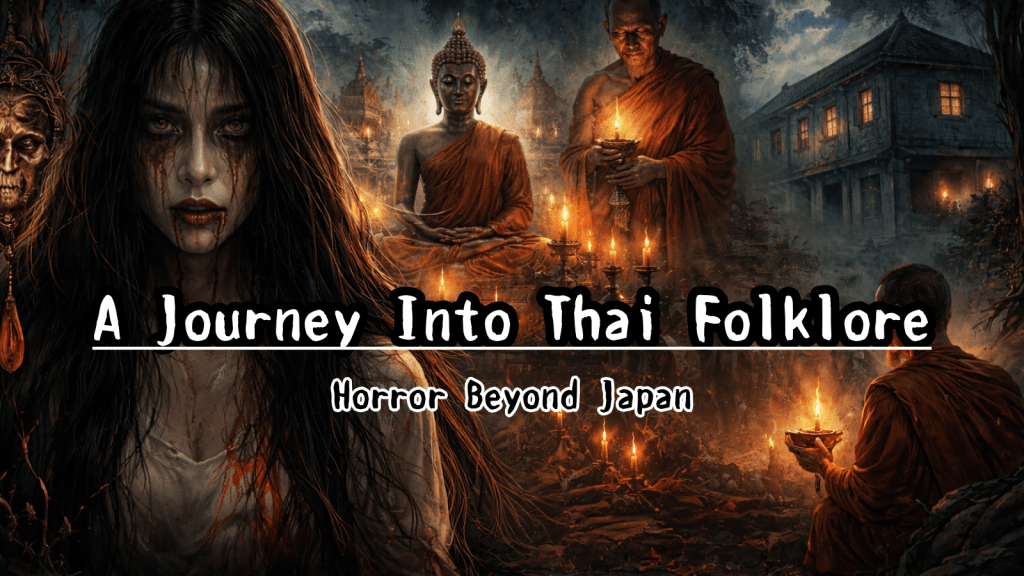
~ PART I ~
Karma, Impermanence, and the Shape of Suffering
Thai folk horror does not begin with ghosts, curses, or transgression. It begins with order; not the reassuring order of safety or justice, but a deeper and far less comforting structure in which nothing is wasted, nothing disappears, and nothing escapes consequence. In this worldview, suffering is neither an aberration nor an interruption. It is the visible motion of karma, unfolding according to its own logic, indifferent to human ideas of fairness, mercy, or timing. Thai horror emerges not from the sense that something has gone wrong with the universe, but from the growing realization that the universe is functioning exactly as it should.
This is why karma, as understood within Thai folk belief shaped by Theravāda Buddhism, cannot be reduced to a moral scoreboard or a system of divine punishment. Karma is not judgment; it is momentum. Every action, intention, attachment, and harm generates movement that must eventually resolve, though not necessarily in the lifetime or form one might expect. Resolution does not arrive on schedule, does not announce itself clearly, and does not guarantee comprehension. People suffer without understanding why not just because the system is cruel, but because it is vast, patient, and unconcerned with human clarity. Thai horror draws its power from this indifference, from the sense that pain does not need justification in order to persist.
At the center of this cosmology lies samsara, the endless cycle of birth, death, and rebirth. To an outside observer, reincarnation can appear hopeful, even merciful; a promise of renewal or a second chance. Thai folk horror strips this illusion away. Rebirth is not escape; it is continuation. To be reborn is to carry unresolved attachment, desire, fear, and guilt forward into another form. Liberation from this cycle is possible, but it is rare, distant, and demands a level of detachment few achieve. Most beings, human and otherwise, remain caught in repetition, moving forward without resolution. Within this framework, death is not an ending but a threshold, and a “bad death,” violent, sudden, humiliating, or emotionally unresolved, does not conclude suffering so much as condense it, anchoring it close to the living world.
Impermanence, a foundational Buddhist principle, further sharpens the horror. Everything decays. Everything changes. Everything passes. Thai folk horror emerges precisely from the refusal to accept this truth. Spirits linger not because they are evil, but because they are attached; to love that ended too abruptly, to anger that never found release, to shame that could not be voiced, to a life that ended incorrectly. Their suffering does not arise from death itself, but from the inability to stop wanting what is no longer available to them. In this sense, Thai ghosts are not monstrous intrusions but tragic extensions of human behavior. They remain because letting go proves harder than dying, and in remaining, they draw the living into the same unresolved emotional gravity.
Theravāda Buddhism does not deny the existence of such spirits; it contextualizes them. Spirits are beings still caught in samsara, no more eternal and no more free than humans. Their presence does not contradict Buddhist teaching but reinforces it, serving as evidence of what happens when attachment outlives the body. This is why monks appear so frequently in Thai horror narratives and why they are rarely triumphant figures. Chanting, prayer, and ritual offer grounding and stabilization, but they do not erase karma. They cannot undo what has already been set in motion. Enlightenment addresses the cause of suffering, not its accumulated effects, and Thai horror takes this distinction seriously. Buddhism explains why suffering persists; it does not always stop it.
Beneath this moral framework lies a persistent animist worldview that predates Buddhism and continues to shape everyday life. Spirits (phi) inhabit land, structures, and thresholds, and their presence is managed through appeasement rather than eradication. Spirit houses, offerings, and daily rituals do not contradict Buddhist belief so much as acknowledge a practical truth: while liberation may be the ultimate goal, most people are still trying to survive the present. Thai folk horror often arises when these layers fall out of balance, when ethical understanding fails to address immediate harm or when ritual appeasement is used to bypass moral responsibility. The universe does not react explosively to these failures. It simply waits.
This is why Thai horror feels so inevitable. These stories rarely rely on surprise or escalation, because the audience is not meant to wonder whether something terrible will happen, but when and how it will surface. Once something unresolved is introduced, an unacknowledged death, an unconfessed wrongdoing, an attachment that refuses to loosen, the trajectory narrows. The horror unfolds slowly, methodically, without malice or urgency. There is no chaos here, only motion continuing along a path already laid.
Thai folk horror is also notable for its lack of clear villains. Even cruelty and neglect are rarely framed as monstrous intent, but as ignorance, attachment, or carelessness compounded over time. This refusal to simplify guilt makes the horror heavier rather than lighter. There is no single enemy to confront and no decisive action that restores balance. Harm accumulates through ordinary failures to care, remember, or let go, and the universe responds without anger, without judgment, and without pause.
The fear that emerges from this system is quiet and suffocating. It is not the terror of invasion, but of inheritance; the realization that the suffering now unfolding was set in motion long ago, and that belief, prayer, or regret may soften its edges but cannot fully halt its progress. Thai folk horror does not ask whether the supernatural is real. It asks what happens when the weight of unresolved attachment becomes too heavy to carry any further.
It is from this cosmic order, governed by karma, shaped by impermanence, and haunted by continuation, that Thai ghosts, cursed bodies, and restless spaces emerge. The horror is not that the dead return, but that nothing ever truly leaves.
~ PART II ~
ANIMISM BENEATH BUDDHISM
If Buddhism provides the moral architecture of Thai folk horror, animism supplies its daily mechanics. Long before temples, sermons, and monastic codes structured spiritual life, the world was already inhabited by spirits attached to land, water, homes, trees, crossroads, and thresholds. When Buddhism arrived, these spirits did not vanish. They were not exorcised, overwritten, or rendered obsolete. Instead, they remained, folded into everyday life beneath the larger cosmic order, governing the immediate and the practical rather than the ultimate and the liberatory.
Thai folk belief does not imagine a world cleansed of spirits through enlightenment. It imagines a world in which most people are still living ordinary lives, far from liberation, and therefore still vulnerable to the unseen. Buddhism explains why suffering exists and how it may eventually end; animism explains how to avoid making things worse today. Horror emerges not from contradiction between these systems, but from the tension created when they are misaligned, neglected, or exploited.
The category of phi is deliberately broad. It does not describe a single type of being, but a spectrum of presences that resist neat classification. Some spirits are remnants of the dead. Others were never human at all. Some are tied to specific locations, others to families, objects, or repeated actions. What unites them is not moral alignment, but proximity. Spirits are close. They occupy the same spaces as the living, often invisibly, and their presence is managed through etiquette rather than confrontation.
This proximity makes Thai folk horror feel intimate in a way few traditions do. Spirits are not summoned from elsewhere; they are already present. They are acknowledged through daily rituals so mundane they barely register as religious acts: placing offerings, avoiding certain behaviors, speaking carefully, maintaining shrines. These actions are not expressions of fear so much as habits of coexistence. One does not defeat spirits. One lives alongside them and hopes not to offend.
The most visible manifestation of this coexistence is the san phra phum, the spirit house. These small shrines, found outside homes, businesses, schools, and hospitals, are not decorative symbols of belief but functional accommodations. They acknowledge that the land was occupied before human construction and that displacement without recognition invites disturbance. The spirit house does not banish spirits from human space; it negotiates boundaries. It offers spirits a place so that they do not insist on occupying others.
Thai folk horror often begins when this negotiation fails. A spirit house is neglected. Offerings cease. A building is erected without proper acknowledgment. The problem is not disbelief, but indifference. Spirits respond not with immediate violence, but with gradual disruption: misfortune, illness, emotional instability, accidents that feel coincidental until they no longer do. Horror unfolds as escalation rather than eruption, mirroring the slow accumulation of neglect that caused it.
Crucially, animist practice in Thai belief is not framed as superstition opposed to Buddhism, but as pragmatic necessity. Enlightenment may free one from samsara, but few people are enlightened. Until that point, one must still eat, sleep, work, love, and mourn in a world that contains unseen occupants. Appeasement is not a rejection of Buddhist ethics; it is an acknowledgment of human limitation. Thai folk horror exploits this gap relentlessly. Characters do not suffer because they lack faith, but because faith alone cannot manage proximity.
This layered belief system produces a distinctive form of horror logic. When something goes wrong, there is rarely a single explanation. A haunting may be karmic in origin but animistic in expression. A spirit may linger because of attachment, but act through place rather than person. Rituals meant to calm spirits may fail because the underlying moral harm remains unaddressed. Each system functions correctly within its own scope, and horror emerges precisely because no single framework is sufficient on its own.
Thai horror films repeatedly return to this failure of singular solutions. Monks chant, offerings are made, apologies are spoken… but the disturbance persists. The audience is not meant to conclude that these practices are ineffective, but that the damage exceeds their capacity. Animism manages coexistence; it cannot resolve accumulated injustice. Buddhism explains suffering; it does not rewind time. When harm becomes systemic, neither layer can fully contain it.
The persistence of animism beneath Buddhism also explains why Thai horror remains so focused on place. Homes, schools, hospitals, roads, and dormitories are not neutral settings. They are containers layered atop older presences, saturated with memory and repeated use. Spirits attach not only to trauma, but to routine, to the daily reinforcement of hierarchy, neglect, and silence. A location becomes haunted not because something terrible happened once, but because something harmful continues without acknowledgment.
In this sense, Thai folk horror treats haunting as an ecological phenomenon rather than an individual curse. Spirits accumulate where attention falters and responsibility disperses. The living do not notice until the environment itself begins to resist them. Doors stick. Sleep becomes impossible. Accidents cluster. Emotional states decay. The horror is not that a spirit appears, but that the world becomes subtly uninhabitable.
Animism, in Thai folk belief, does not promise protection. It promises awareness. It teaches that nothing occupies space without consequence, that no action is truly private, and that neglect is a form of violence. Thai folk horror weaponizes this lesson by placing characters in environments where awareness arrives too late, long after patterns of disregard have hardened into inevitability. By the time a spirit demands attention, the damage has already been done.
It is from this unresolved coexistence, between Buddhism’s moral horizon and animism’s immediate demands, that Thai folk horror draws its distinctive power. Spirits do not erupt from disbelief. They surface from neglect, from the quiet assumption that old rules no longer apply. The universe does not correct this assumption dramatically. It allows it to persist until the cost becomes unavoidable. And it is from here (this dense, shared space between the living and the unseen) that Thai folk horror begins to give its spirits names, bodies, and hungers.
~ PART III ~
GHOSTS, FAILED DEATHS, AND THE TERROR OF STAYING BEHIND
In Thai folk belief, death itself is not the primary source of fear. What terrifies is interruption; death that arrives too quickly, too violently, too chaotically, or under conditions of profound emotional distress. A life that ends incorrectly does not conclude; it stalls. The individual does not pass smoothly into rebirth or dissolution but remains suspended close to the living world, weighed down by attachment and unresolved momentum. Thai folk horror is structured around this idea with remarkable consistency: that suffering which cannot complete its course does not dissipate, but condenses, becoming dense enough to reshape space, behavior, and memory.
This cosmology reframes ghosts not as supernatural anomalies but as predictable outcomes. In a universe governed by karma and continuation, the spirit that lingers is not a violation of order but evidence that the order is still unfolding. Something has been set in motion that cannot yet come to rest. Horror emerges not from the presence of the dead, but from the recognition that their presence makes sense.
The circumstances of death carry enormous significance within Thai belief. Sudden accidents, violent crime, suicide, executions, and deaths marked by extreme fear, rage, or shame are understood to disrupt the ordinary transition out of the human realm. The dying person has no opportunity to loosen attachment or orient themselves toward release. Emotion freezes at the moment of impact, and the spirit remains anchored to that instant, repeating it endlessly without awareness that time has moved on. Thai ghost stories return again and again to this notion of repetition: spirits that appear at the same hour each night, that reenact the same final actions, that wander familiar routes without deviation. These hauntings are not staged performances for the living; they are habits formed under duress.
This repetition gives Thai horror its distinctive rhythm. Rather than escalating toward spectacle, it circles. The same sounds recur. The same images resurface. The same spaces grow heavier with each return. The terror lies not in surprise, but in accumulation; in watching suffering replay itself with mechanical persistence, indifferent to attempts at interruption.
Roadside shrines scattered across Thailand provide a visible acknowledgment of this belief system. These small structures, erected where fatal accidents occurred, are not merely commemorative. They function as containment efforts, attempts to stabilize the spiritual fallout of sudden death and provide the deceased with recognition sufficient to prevent dangerous attachment. Thai horror narratives often begin precisely where such efforts prove inadequate, when remembrance becomes ritualized without becoming restorative, or when neglect allows the emotional residue of violent death to intensify rather than soften. The shrine remains, but the suffering it marks continues to exert pressure on the living world.
Among the most feared spirits within this framework are those associated with violent or abrupt endings, commonly referred to as phi tai hong. These entities are considered especially dangerous not because they are malevolent, but because their deaths were too shocking to integrate. Their spirits remain disoriented, trapped in a moment of rupture that never resolved into understanding. In horror narratives, phi tai hong do not behave strategically. They overwhelm. Their presence destabilizes entire environments rather than targeting individuals alone. Lights flicker, sounds distort, emotions spike without cause. The violence of the original death ripples outward, infecting space itself.
What makes phi tai hong so unsettling is the absence of moral clarity. These spirits are not seeking revenge in a coherent sense. They do not negotiate or respond predictably to appeasement. They are not agents so much as forces, trauma given persistence. The living who encounter them are not punished for wrongdoing, but caught in the wake of suffering that never had a chance to dissipate. Thai folk horror insists, again and again, that proximity to unresolved violence carries risk regardless of intention.
Not all Thai spirits announce themselves with such intensity. Some are terrifying precisely because of their intimacy. Phi am, often associated with sleep paralysis and nocturnal oppression, operate at the threshold between consciousness and vulnerability. These spirits do not appear across rooms or down hallways; they hover inches away. They manifest through pressure on the chest, through the sensation of being watched or restrained, through breath felt but not seen. The terror of phi am lies in their closeness and their silence. There is no spectacle, no warning; only the sudden realization that one is not alone in the most defenseless state the body can occupy.
Thai folk horror treats these encounters not as psychological anomalies, but as moments when boundaries thin. Night, exhaustion, illness, and emotional stress all create conditions under which proximity becomes dangerous. Bedrooms, dormitories, hospital wards, and temporary living spaces recur as sites of encounter because they are places where control is relinquished. The body rests. The mind drifts. The world loosens its grip. Phi am exploit this looseness, reminding the living that vulnerability itself is a form of exposure.
If phi am represent proximity without form, then phi krasue represent form without containment. Often depicted as a floating female head with trailing organs, krasue is among the most visually disturbing figures in Thai folklore, but her horror is not merely aesthetic. Krasue embodies hunger (physical, emotional, and social) that cannot be controlled or concealed. She feeds on blood, filth, and decay, drawn toward childbirth, illness, and waste. Her body refuses closure. Her interior is permanently exposed.
Krasue narratives are deeply gendered and deeply revealing. They reflect anxieties surrounding female desire, bodily autonomy, and social transgression. The krasue is often associated with women who failed to conform, who practiced forbidden magic, or who were marked by shame. Her punishment is not death, but exposure: her insides made visible, her need rendered grotesque, her hunger transformed into monstrosity. Thai folk horror does not present krasue simply as a creature to be feared, but as a mirror held up to a society that polices female bodies through disgust and surveillance. The terror lies not in appetite itself, but in the cultural insistence that certain bodies must not want too much, take too much, or need too visibly.
Where krasue externalizes hunger, phi pop internalizes it. Phi pop are possession spirits associated with insatiable appetite, illness, and social disruption. Victims consume excessively, behave erratically, and gradually become ostracized as their condition worsens. These narratives often blur the boundary between spiritual affliction and social scapegoating. Accusations of phi pop possession cluster around the poor, the elderly, the socially isolated, and those who already exist at the margins of community life. Thai folk horror exposes how fear of spiritual contamination overlaps with fear of dependency and difference. The possessed individual becomes expendable, easier to fear than to care for.
Across these varied manifestations, Thai ghosts function less as antagonists than as emotional infrastructure. They are built from grief, shame, rage, fear, and longing that never found resolution, and they occupy places where such emotions accumulate without acknowledgment. Schools haunted by suicides, dormitories saturated with loneliness, hospitals layered with unspoken death; these spaces recur because they are environments of constant emotional output and minimal release. Ghosts do not appear because someone believes in them. They appear because something keeps happening without being addressed.
This understanding reframes haunting as an ecological phenomenon rather than an individual curse. Spirits gather where attention falters and responsibility disperses. The living do not notice until the environment itself becomes difficult to inhabit. Sleep deteriorates. Accidents cluster. Emotional states decay. The world resists habitation not through overt hostility, but through attrition. Thai folk horror excels at portraying this slow collapse, in which the supernatural does not attack so much as erode.
Exorcism and appeasement rarely provide final resolution in these narratives, and this refusal of closure is not pessimism but cosmological consistency. Attachment dissolves slowly. Karma unwinds over lifetimes. A chant may calm a spirit, but it cannot erase history. When a ghost recedes, it does so not because the problem has been solved, but because it has been temporarily stabilized. The underlying conditions remain. This is why Thai folk horror so often ends quietly. The haunting subsides. Life continues. The audience is left not with triumph, but with endurance. The damage has not been undone; it has simply become livable again.
Ultimately, Thai folk horror is less concerned with death than with remaining; with being caught in continuation without progress toward release. Ghosts are not warnings from beyond, but demonstrations of what happens when transition fails. They show the living a future shaped by unresolved attachment, emotional neglect, and silence. The terror is not that the dead return, but that they never truly leave and that the living are already learning how to share space with them.
~ PART IV ~
Purity, Pollution, and Flesh That Betrays You
In Thai folk horror, the body is never treated as a neutral container or an incidental detail. It is a threshold (porous, reactive, and morally legible) through which spiritual imbalance is made visible. Where many Western horror traditions imagine the body as something invaded by an external force, Thai folk horror begins from a far more unsettling premise: the body was never sealed to begin with. It breathes, bleeds, hungers, reproduces, decays, and fails, and these ordinary biological processes are precisely what make it vulnerable to karmic residue. Spiritual consequence does not hover abstractly over the world; it moves through flesh, following the same pathways as exhaustion, illness, and desire.
This understanding emerges from the convergence of Buddhist impermanence and older animist ideas of permeability. Bodies are unstable by nature, incapable of remaining fixed or pure. They age, weaken, and leak, and this instability renders them ideal sites for unresolved attachment to surface. Thai folk horror does not require elaborate possession narratives to justify bodily corruption, because the body’s ordinary functions already provide sufficient access points. The horror lies not in violation, but in continuity: in the realization that spiritual consequence obeys the same logic as biological process, moving gradually and without spectacle.
Within this framework, purity and pollution are not moral absolutes but conditions of exposure. Certain bodily states (illness, fatigue, pregnancy, menstruation, sexual activity, grief) are understood to thin spiritual defenses, not because they are sinful, but because they heighten vulnerability. Thai folk horror exploits this vulnerability relentlessly. Characters in stories are not punished for impurity; they are endangered because they are human. The body does not protect the self from karmic accumulation. It broadcasts it. Fear arises not from the sudden arrival of danger, but from the dawning awareness that danger has always been present, working quietly through sensation and need.
Nowhere is this logic more visible than in the treatment of female bodies, which occupy a uniquely fraught position in Thai folk horror. This focus is not incidental, nor merely exploitative. It reflects deep cultural anxieties surrounding reproduction, desire, caregiving, and containment. Women are associated with life-giving processes that are simultaneously revered and feared (childbirth, menstruation, nurturing, sexual availability) and Thai horror repeatedly transforms these associations into sites of dread. Female bodies become spaces where spiritual consequence is expected to surface, not because women are more culpable, but because they are more visibly entangled with thresholds of life and death.
The figure of the phi krasue crystallizes this anxiety with brutal clarity. Krasue’s horror is not solely her grotesque appearance, but the way her body refuses containment. Her organs trail openly behind her. Her hunger cannot be hidden or regulated. She consumes what polite society insists should remain unseen (blood, filth, decay) and in doing so violates the demand that female bodies remain modest, controlled, and self-effacing. Her punishment is not annihilation but exposure. She is forced into permanent visibility, her interiority rendered monstrous. Thai folk horror uses krasue not simply to shock, but to critique a social order that marks women as dangerous the moment their needs become impossible to suppress.
Pregnancy and childbirth intensify this logic further, occupying a uniquely dangerous position in Thai folk belief. These moments concentrate liminality: life enters as another life risks departure, blood flows, pain peaks, and control diminishes. Thai folk horror treats these events not sentimentally, but cautiously. Spirits are drawn to childbirth because it compresses vulnerability, attachment, and transition into a single space. Death during childbirth is considered especially tragic not only because of loss, but because it represents transition interrupted twice, both for the mother and the child. In horror narratives, maternity becomes a site of haunting rather than safety, not as condemnation of motherhood, but as acknowledgment of its exposure. To create life is to open oneself to forces that do not care about intention.
Illness functions similarly as a bodily expression of unresolved karma. In Thai folk horror, sickness is rarely random. It is not always framed as punishment, but it is almost always meaningful. The body becomes the medium through which emotional neglect, moral imbalance, or relational harm manifests. Possession narratives often blend seamlessly into illness narratives: a character grows weak, loses appetite, behaves erratically, or experiences pain that cannot be medically explained. Treatment stabilizes symptoms but fails to address cause, because the cause does not originate solely in biology. Hospitals and clinics thus become deeply unsettling spaces, layered with accumulated death and suffering that receives care but rarely release.
Possession, when it appears, rarely announces itself through dramatic violence. Instead, it manifests as appetite without regulation. People eat excessively, crave forbidden substances, or consume without satisfaction. Their bodies act independently of intention, exposing the fragility of self-control. In a culture shaped by Buddhist ideals of moderation and discipline, this loss of appetite control is profoundly frightening. Hunger represents attachment in its rawest form. When hunger governs the body, the self is revealed as permeable, unstable, and easily overtaken.
Phi pop narratives exemplify this fear while exposing its social dimension. The possessed individual becomes disruptive, burdensome, and eventually disposable. Accusations cluster around the poor, the elderly, and the socially isolated, blurring the line between spiritual affliction and scapegoating. Thai folk horror uses these stories to reveal how quickly care is withdrawn from bodies that no longer behave acceptably. Possession becomes not only a supernatural threat, but a metaphor for abandonment, where those who cannot regulate themselves are cast out rather than supported.
Throughout these narratives, secrecy plays a crucial role. Bodily states are hidden. Illness is concealed. Pregnancy is denied. Desire is suppressed. Pain is endured silently. Thai folk horror insists that such containment does not prevent harm; it cultivates it. When bodily truth is repressed, spiritual pressure has nowhere to dissipate. Attachment thickens. Shame accumulates. The body becomes a sealed vessel holding unresolved force until rupture becomes inevitable. Horror emerges not from excess, but from the effort to appear controlled, pure, and unaffected.
Ultimately, Thai folk horror insists that the body cannot lie forever. Flesh remembers what the mind represses. Blood, hunger, pain, and decay become languages through which unresolved karma speaks. This is why the genre is so often quiet and intimate. The most terrifying moments are not attacks or chases, but realizations: hunger appearing where it should not, bleeding without injury, exhaustion that feels imposed rather than earned. The horror does not arrive from outside. It surfaces from within.
In this cosmology, the body functions as a moral archive. It records attachment, neglect, violence, and desire long after conscious memory has moved on. Ghosts may linger nearby, but it is the body that registers their presence first—through compulsion, fear, illness, and fatigue. Thai folk horror offers no fantasy of bodily purity or spiritual insulation. To inhabit a body is to inherit everything it has carried and everything it has failed to release. The terror is not that the body can be possessed, but that it was never empty to begin with.
~ PART V ~
MAGIC, CURSES, AND MONASTIC TRANSGRESSION
In Thai folk horror, the most dangerous acts are not committed in ignorance, desperation, or fear. They are committed with understanding. Magic is frightening not because it is chaotic or irrational, but because it works. Rituals succeed. Charms protect. Spells bind. Power responds to discipline and intention. The horror emerges when that power is used to intervene in the moral flow of the universe rather than endure it. This is the central tension that defines Thai folk magic: it exists within a Buddhist worldview that teaches acceptance, detachment, and patience, yet it offers tools for acceleration, redirection, and control. Thai folk horror does not deny the reality of magic. Instead, it asks what happens when humans decide that karmic process is too slow, too impersonal, or too cruel and choose to interfere. The universe does not stop them.
Magic, often grouped under the term saiyasat, encompasses protective charms, curses, love spells, spirit-binding rituals, and bodily inscriptions. These practices are not universally condemned within folk belief. Many are pragmatic responses to fear, inequality, and vulnerability. Protection against violence, illness, or spiritual harm is not framed as immoral in itself. What Thai folk horror interrogates is orientation. Magic is not dangerous because it exists, but because it tempts its practitioner to refuse endurance. To cast a spell is to reject waiting. To curse is to displace suffering. To bind another’s will is to deny impermanence. Each act is a declaration that the slow unfolding of karma is unacceptable. Crucially, horror does not arise when these acts fail. It arises when they succeed.
Within Buddhist-inflected Thai belief, spiritual merit (bun) is accumulated through ethical conduct, generosity, discipline, and restraint. Merit is not meant to secure outcomes; it is meant to loosen attachment. Magic does not generate merit; it redirects it. Protective charms, blessings, and ritual inscriptions draw upon accumulated spiritual force and focus it toward specific ends.
Thai folk horror treats this redirection as profoundly unstable. Merit, once instrumentalized, ceases to function as moral grounding and becomes a volatile resource. Protection breeds dependency. Success intensifies fear of loss. Power encourages further intervention. The practitioner does not become free; they become invested. This is one of the genre’s most devastating insights: the universe does not punish the misuse of merit by withdrawing it. It allows it to operate, just not cleanly. The spell holds, but it warps. The benefit persists, but it corrodes its bearer.
The practice of sak yant, ritual tattoos inscribed with sacred symbols and mantras, stands at the intersection of magic, discipline, and bodily vulnerability. These markings are believed to confer protection, authority, charisma, or invulnerability, but only under strict behavioral conditions. The tattoo does not act independently; it reflects the bearer’s conduct.
Thai folk horror is deeply interested in the fragility of these conditions. Sak yant do not fail because the symbols are false, but because humans are inconsistent. Vows are broken. Humility gives way to ego. Discipline erodes under stress. When this happens, the tattoo’s power does not simply disappear. It inverts. Protection becomes exposure. Authority becomes instability.
The body, once again, becomes a moral archive. The ink remains visible even as alignment decays. The bearer walks through the world marked as sacred while internally misaligned, carrying power they can no longer safely contain. Thai horror finds this contradiction profoundly unsettling: the idea that spiritual authority can persist long after ethical grounding has collapsed.
Love magic occupies a uniquely disturbing position in Thai folk horror because it weaponizes the very force Buddhism identifies as the root of suffering: attachment. These spells do not create affection; they manufacture fixation. Desire is imposed rather than invited, binding the target into emotional dependency that mimics intimacy while hollowing it out.
Narratives involving love magic almost never resolve into fulfillment. Instead, they spiral into obsession, illness, paranoia, and social collapse. The practitioner becomes as trapped as the victim, bound by the same distorted attachment they sought to control. Thai folk horror frames this outcome not as irony, but as inevitability. Attachment, once forcibly intensified, cannot mature or release. It stagnates. What makes love magic especially horrifying is its familiarity. The desire to be loved, chosen, or remembered is not monstrous. Thai horror exposes how easily that desire becomes violent when it refuses impermanence.
Curses represent the most explicit attempt to redirect karmic consequence outward. Rather than endure suffering, the practitioner assigns it. Thai folk horror treats this act not as rebellion against cosmic order, but as a misunderstanding of it. Suffering cannot be exported without residue.
When a curse succeeds, the victim weakens but the practitioner does not heal. Instead, they become entangled in the very harm they sought to escape. Fear replaces relief. Guilt accumulates. Spirits gather. The act of displacement creates a circuit through which suffering circulates rather than resolves. The horror lies not in retaliation, but in contagion. Harm spreads outward, touching family, community, and space. The curse may land, but it never lands alone. Among the most unsettling figures in Thai folk horror is the monk who intervenes improperly. Monks represent discipline, restraint, and the possibility of liberation. When they violate vows, exploit authority, or use magic for personal ends, the resulting horror is not merely moral; it is existential.
These narratives do not frame monastic failure as simple hypocrisy. They frame it as structural collapse. If even those devoted to detachment succumb to control, what hope remains for anyone else? The monk who misuses power does not become a villain; he becomes a destabilizing force, wielding spiritual authority without alignment. Thai folk horror treats such figures with quiet dread. Their presence suggests that knowledge does not guarantee wisdom, and that proximity to sacred power magnifies harm when discipline fails. Authority, once bent toward desire, does not merely collapse; it accelerates decay.
Across Thai folk horror, a consistent pattern emerges: magic does not create suffering, but it accelerates it. It collapses time, forcing karmic processes meant to unfold slowly into immediacy. What might have softened over lifetimes hardens into trauma. What could have been endured becomes unbearable. This acceleration overwhelms bodies, relationships, and environments. The human scale cannot contain it. The horror is not explosive, but cumulative; systems strain, spaces rot, and spirits thicken in response. Magic does not break karma. It rushes it.
At its core, Thai folk horror is profoundly skeptical of control. The desire to command outcomes, secure certainty, or bypass suffering is treated not as evil, but as tragic misunderstanding. The universe is not hostile, but it is indifferent to human urgency. Magic promises relief from uncertainty. Horror demonstrates the cost of believing that promise. Those who intervene do not escape suffering; they bind themselves more tightly to it, becoming nodes through which unresolved force circulates. The universe does not retaliate. It accommodates and in accommodating, ensures collapse.
By the end of these narratives, the original motivation behind magical intervention becomes irrelevant. What remains is residue: strained bodies, fractured relationships, corrupted authority, and spaces saturated with unresolved consequence. Magic leaves traces. And when those traces accumulate beyond the capacity of individuals to contain them, the consequences cease to be personal. They become spatial.
~ PART VI ~
PLACES OF BAD KARMA
In Thai folk horror, places do not become haunted because something terrible happened once. They become haunted because something terrible kept happening, and no mechanism existed to release the accumulated weight of that harm. When suffering repeats without acknowledgment, when responsibility is dispersed across institutions rather than held by individuals, karmic residue ceases to move through bodies alone and begins to pool in space. This is the point at which Thai folk horror expands beyond ghosts as personal tragedies and reveals itself as a critique of modern systems. Haunting becomes architectural. Fear becomes infrastructural. The question is no longer who died, but where the damage settled.
Karma, in Thai belief, is motion. It flows, resolves, reincorporates. But motion requires channels. When suffering is repeatedly generated in the same locations (through neglect, coercion, hierarchy, or silence) and no meaningful acknowledgment occurs, that motion slows. It thickens. Eventually, it stagnates. Thai folk horror imagines haunted places as environments where karmic flow has been obstructed. The harm did not end cleanly, and it was never properly integrated into memory or ritual. The space itself becomes saturated, carrying emotional and spiritual weight long after the individuals involved are gone. This is why Thai haunted spaces feel oppressive rather than dramatic. They do not announce themselves with spectacle. They press inward. They make habitation difficult.
Few settings recur as frequently in Thai horror as schools and dormitories. This is not accidental. Schools are institutions built on hierarchy, obedience, and prolonged emotional pressure. They are spaces where shame is normalized, individuality is suppressed, and suffering is often minimized as character-building. Thai folk horror treats schools as engines of unprocessed karma. Students endure loneliness, bullying, humiliation, and fear in silence. Authority figures often remain distant or complicit. When tragedy occurs (suicide, violence, psychological collapse) the response is frequently administrative rather than emotional. The institution continues. The pain remains. Haunted school narratives reflect this imbalance. Ghosts do not appear because a single injustice occurred, but because suffering was routine. The space becomes dense with unacknowledged emotion, and the dead linger not out of malice, but because the system that shaped them never stopped operating.
Hospitals occupy a uniquely unsettling position in Thai folk horror. They are spaces designed to manage bodily failure, pain, and death, yet they rarely provide ritual or emotional resolution. Death is processed efficiently, clinically, and often anonymously. In Thai belief, this creates dangerous conditions. The dying may not receive sufficient acknowledgment. Families may be absent. Bodies move quickly. Grief is compressed to accommodate institutional pace. Thai horror imagines hospitals as spaces where spirits accumulate quietly, attached not to single tragedies but to repetition itself. Corridors echo with unresolved endings. Rooms carry the residue of countless departures. The haunting is not malevolent; it is cumulative. The terror lies in scale. One death is manageable. Thousands without closure are not.
Roads are among the most haunted spaces in Thai folk belief. Traffic accidents claim lives suddenly, violently, and often anonymously. There is no preparation, no farewell, no ritual framing. The dead remain attached to the site of impact because the transition was too abrupt to complete. Roadside shrines serve as attempts to stabilize this fallout, but Thai folk horror frequently depicts what happens when remembrance fades or proves insufficient. The road continues to take lives. Accidents cluster. Time folds in on itself. Unlike haunted houses, haunted roads cannot be avoided. They must be used. This inevitability gives Thai road horror its particular dread: the knowledge that modern infrastructure forces constant proximity to unresolved death.
Modern Thai horror increasingly centers on apartment buildings, condominiums, and dense urban housing. These spaces compress lives, emotions, and histories into vertical structures designed for efficiency rather than memory. Thai folk horror treats these buildings as containers for unresolved karma. Residents arrive carrying grief, guilt, exhaustion, and ambition. Neighbors remain strangers. Deaths occur unnoticed. When something goes wrong, no one knows who is responsible. Haunting in these spaces manifests as atmosphere rather than apparition. Sleep deteriorates. Sounds carry strangely. Emotional states sour. The building itself feels resistant to habitation, as though rejecting its occupants without explanation. The horror here is systemic. No single resident caused the haunting. Everyone contributes to it by passing through without acknowledgment.
Abandoned spaces are not frightening in Thai folk horror because they are empty, but because they represent interrupted intention. Projects began with promise (schools, factories, housing developments) but failed due to financial collapse, corruption, or neglect. These spaces are heavy with unrealized futures. The spirits that linger are not only the dead, but the ambitions that were never fulfilled. Thai folk horror frames abandonment as a form of violence, leaving karmic momentum suspended without resolution. To enter such a place is to step into arrested motion. Time does not move forward. It coils.
Traditional appeasement rituals struggle in these environments because the harm is not singular. There is no single spirit to appease, no single wrong to correct. The imbalance is structural. Thai folk horror repeatedly shows rituals failing not because they are incorrect, but because they are insufficient. The scale of suffering exceeds what individual acknowledgment can contain. The system that generated the harm remains intact. This is why so many Thai horror narratives end without full resolution. The haunting subsides temporarily. The space becomes tolerable again. But the conditions that produced it continue.
What makes Thai place-based horror especially resonant is its refusal to romanticize the past. The problem is not tradition versus progress; it is unprocessed continuity. Modern institutions generate suffering more efficiently than ever before, while offering fewer avenues for ritual release. Thai folk horror treats this mismatch as catastrophic. The land does not rebel. It absorbs. Over time, absorption becomes saturation. Thai folk horror ultimately suggests that places remember what people refuse to carry.
When emotional, moral, and karmic responsibility is deferred, it does not vanish; it settles. Haunted places are not cursed. They are burdened. They do not seek attention. They exert pressure. And when pressure exceeds capacity, the space itself begins to respond. By the time Thai folk horror reaches this stage, the haunting is no longer about spirits alone. It is about systems that produce suffering without accountability and spaces that are forced to hold the remainder. The fear is not that a ghost might appear. The fear is that the world you inhabit is already carrying more than it can contain.
~ PART VII ~
MODERN THAI HORROR CINEMA AS MORAL MEMORY
Modern Thai horror cinema does not function as escapism. It functions as remembrance. Rather than inventing new mythologies, Thai horror films return obsessively to old wounds (unresolved deaths, unacknowledged harm, institutional silence, emotional neglect) and insist on keeping them visible. These films do not ask whether the supernatural exists. They assume it does, because suffering that has not been processed must take form somewhere. Cinema becomes one of the few spaces where that form can be safely observed. This is why Thai horror often feels quieter, slower, and heavier than its international counterparts. The goal is not to shock the audience into fear, but to trap them inside recognition. You are not watching something alien. You are watching something you already understand but would rather not name.
Thai horror films do not adapt folklore in the sense of translating ancient beliefs into modern metaphors. They continue it. The rules remain intact. Karma still moves slowly. Attachment still binds. Spirits still linger when transitions fail. What changes is the setting: classrooms replace temples, apartments replace villages, hospitals replace family homes. This continuity explains why Thai horror resists explanation-heavy narratives. Characters do not need to be convinced that ghosts are real. They need to understand why this one is here. The tension does not arise from disbelief, but from inevitability. Once the conditions are established, the outcome feels unavoidable. The horror lies in watching characters realize that they are not encountering an anomaly, but a consequence.
Grief occupies a central role in modern Thai horror, not as an emotional subplot but as the primary mechanism through which haunting occurs. These films are populated by characters who carry loss quietly: dead siblings, lost parents, broken relationships, erased futures. Grief is rarely resolved through confrontation or confession. It is endured, normalized, and often ignored. Thai horror treats this endurance as dangerous. When grief is suppressed rather than acknowledged, it thickens. It becomes ambient. It settles into places and routines. Ghosts in Thai cinema often appear less as aggressors than as embodiments of grief that has nowhere else to go. They return not to punish, but to remain, forcing the living to share space with unresolved loss. This framing transforms haunting into a moral demand: remember, or be remembered by force.
Unlike many horror traditions, Thai cinema rarely presents clear villains. Even acts of cruelty or negligence are framed as part of broader systems: familial obligation, economic pressure, institutional hierarchy. Harm occurs not because someone is evil, but because no one intervenes. This produces a uniquely Thai form of guilt: collective, diffuse, and unassignable. Hauntings emerge not to accuse a single perpetrator, but to expose networks of silence. Schools haunt because bullying was normalized. Apartments haunt because isolation was accepted. Hospitals haunt because efficiency replaced ritual. The ghost does not point at one person. It occupies the entire space. Thai horror cinema understands guilt not as an emotion to be resolved, but as a condition to be endured.
Monks and religious ritual appear frequently in Thai horror films, but rarely as triumphant saviors. Chanting stabilizes. Blessings calm. Sacred words establish boundaries. What they do not do is erase history. This portrayal often confuses Western audiences accustomed to religious authority as a counterforce to the supernatural. Thai horror offers something far more unsettling: faith without absolution. Buddhism explains why suffering exists and how liberation might eventually be achieved, but it does not undo harm already done. Ritual in these films functions as containment, not cure. The haunting subsides. Life becomes livable again. But nothing is truly restored. The past remains present, simply quieter.
One of the most defining characteristics of modern Thai horror cinema is its refusal to provide clean endings. Ghosts may recede, but they rarely depart entirely. The final images are often calm rather than triumphant: a return to routine, a softened silence, a space that can once again be inhabited. This is not narrative pessimism. It is cosmological honesty. Thai folk belief does not promise resolution within a single lifetime. Karma unwinds slowly. Attachment dissolves gradually. To suggest total closure would be a lie. Thai horror cinema honors this truth by ending not with victory, but with endurance. The haunting stops screaming. It does not disappear.
International viewers often describe Thai horror as sad rather than frightening, oppressive rather than exciting. This reaction is not accidental. Thai horror is built on the assumption that fear and sorrow are inseparable. To be frightened is to recognize loss. To encounter a ghost is to confront what was never properly mourned. These films ask the audience to sit with discomfort rather than flee from it. There is no release valve in the form of humor, spectacle, or heroism. The reward is understanding, not relief. Thai horror does not entertain suffering. It witnesses it.
Ultimately, modern Thai horror cinema functions as a moral archive; a record of what society has failed to process elsewhere. It preserves memories that institutions cannot accommodate and emotions that daily life suppresses. Ghosts return not because the past is powerful, but because the present refuses to carry it. By staging these hauntings onscreen, Thai horror does something quietly radical: it insists that unresolved harm must be seen, even if it cannot yet be healed.
Thai folk horror does not imagine a future free of ghosts. It imagines a world learning, slowly and painfully, to live alongside them. Cinema becomes a space where this coexistence can be acknowledged rather than denied. The final terror is not supernatural. It is the realization that forgetting was never an option.
 J-Horror Blog
Leave a comment