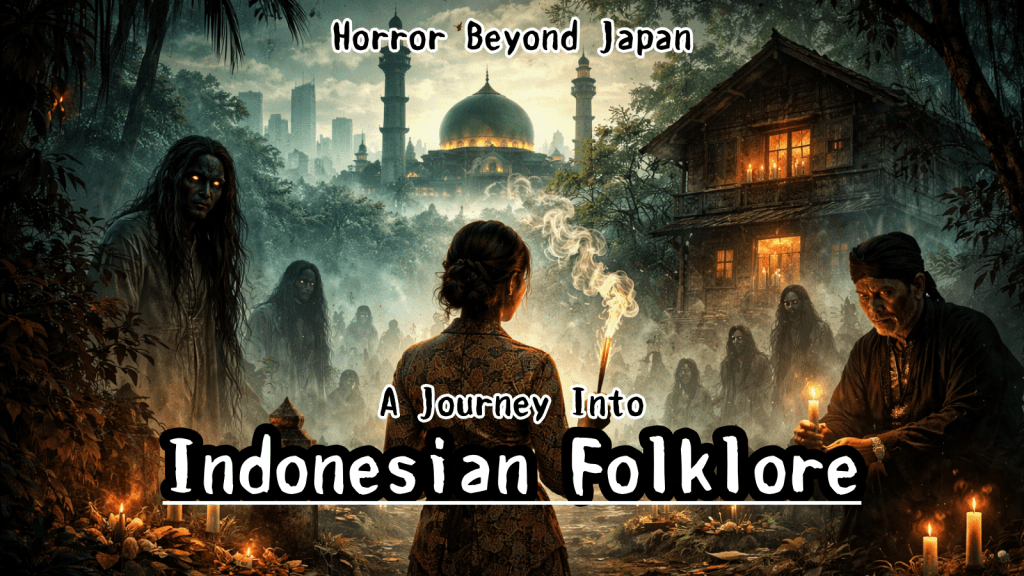
~ PART I ~
THE INDONESIAN SPIRITUAL UNIVERSE
To understand Indonesian horror, one must first abandon a deeply Western assumption: that the supernatural represents a break in reality. In Indonesian cosmology, spirits are not intrusions, they are not aberrations and they are not even necessarily hostile. They are simply there, occupying the same world as humans, separated not by distance but by attention, etiquette, and balance.
Indonesia’s horror tradition emerges from a worldview in which the universe is crowded, layered with presences both seen and unseen, all bound by reciprocal obligation. The fear does not come from the unknown, but from what is known too well; from the awareness that one has violated an unseen agreement, spoken when silence was required, or taken something that was never freely given. This is a horror of contamination, not confrontation. Of imbalance, not invasion.
At the heart of Indonesian spiritual thought is a porous reality. The boundaries between the human world, the spirit world, the ancestral realm, and the natural environment are not fixed walls but membranes, constantly shifting depending on time, place, and behavior. Certain locations (forests, rivers, mountains, crossroads, abandoned buildings) are understood as liminal zones, places where the separation between realms thins. These are not metaphorical thresholds; they are practical ones. To step into such a space is to enter into a relationship, whether one intends to or not.
In this worldview, the land itself is not inert. Mountains are not geological features but entities with memory and temperament. Rivers are not merely watercourses but pathways for spirits and ancestral forces. Old trees, especially banyan trees, are treated with a mixture of reverence and fear, as they are believed to house presences far older than the villages built around them. Horror, then, is not about being hunted by something alien. It is about realizing, often too late, that one has failed to behave correctly in a world that is always watching.
A crucial idea underpinning Indonesian folk belief is that of isi; roughly translated as “content,” “essence,” or “that which fills.” Everything possesses isi, which is similar to the East Asian concept of “chi” or “ki”. Objects, places, words, even silence carry an internal weight that can be cultivated, corrupted, or depleted. A house abandoned after a violent death is not empty; it is full. A forest untouched by humans is not neutral; it is dense with presence. A person who fasts, meditates, or suffers intentionally accumulates isi, becoming spiritually “heavier,” more potent, and more dangerous; both to themselves and to others.
This belief reframes the body itself as a vessel rather than a boundary. The human form can contain blessings, curses, spirits, and power simultaneously. Many of Indonesia’s most unsettling practices and legends, particularly those involving bodily modification or ritual implantation, derive their horror from this principle. The body is not sacred because it is inviolate; it is sacred because it is occupied.
Indonesian cosmology also rejects the idea of time as a simple, forward-moving line. Instead, time is layered, recursive, and situational. Certain hours, particularly dusk, midnight, and the moments before dawn, are considered spiritually unstable. Certain days, anniversaries, and ritual calendars reactivate past events, allowing old tragedies to bleed into the present. This conception of time explains why spirits often repeat behaviors, reenact deaths, or remain bound to specific locations. They are not “stuck” in the past; rather, the past is still present, coexisting with the now. In horror narratives, this manifests as inevitability. Once a boundary has been crossed, the outcome feels preordained; not because fate is cruel, but because the system is consistent. Rules broken demand consequences, and consequences are rarely dramatic. They are slow, personal, and suffocating.
Indonesia’s spiritual landscape did not evolve through erasure, but through accumulation. Indigenous animist beliefs form the bedrock upon which Hindu-Buddhist cosmology was layered, followed by Islamic theology infused with mysticism, and, in certain regions, Christian folk practice. These systems did not cancel one another out. They coexist; sometimes harmoniously, sometimes uneasily. As a result, Indonesian horror often emerges from contradiction. A spirit may obey animist logic while violating Islamic moral expectations. A ritual may succeed spiritually but fail ethically. A person may be protected by prayer yet undone by a neglected offering.
This stacking of belief systems creates a world where no single framework fully explains reality. Safety lies not in faith alone, but in correct behavior, careful negotiation, and communal knowledge passed down through whispers rather than scripture. Importantly, this also means that disbelief offers no protection. Skepticism does not negate consequence. Ignorance does not absolve responsibility. Horror comes not from refusing to believe, but from believing too late… or believing incorrectly.
Perhaps the most striking difference between Indonesian folk horror and its Western counterparts is that fear is rarely framed as an individual experience. Horror happens to communities, to families, to neighborhoods. When one person transgresses, many suffer. When one secret is kept, its cost spreads outward. Spirits retaliate not just against offenders but against those nearby. Curses leak. Ritual failures create ripples. The dead do not haunt because they are lonely, but because something remains unresolved within the social fabric. This collective dimension transforms horror into a moral ecosystem. The question is not “What did you see?” but “What did you do?” and more damningly, “What did you fail to do?”
Indonesian folk horror is quiet, patient, and deeply ethical. It is not concerned with spectacle or sudden violence. Its power lies in anticipation, in the knowledge that something is wrong long before it reveals itself. This is a horror of improper conduct, broken obligations, desecrated space & unpaid spiritual debts. The terror does not come from monsters bursting through walls, but from realizing that the wall was never a barrier to begin with.
In this universe, survival depends not on strength or intelligence, but on humility; on knowing when to lower one’s gaze, when to remain silent, and when to acknowledge that some things were never meant to be controlled. And it is from this worldview, dense with presence, layered with time, and governed by unseen contracts, that the most infamous practices, rituals, and spirits of Indonesian folklore emerge.
~ PART II ~
ILMU, KEBATINAN, AND THE CULTIVATION OF POWER
If Indonesian folk horror is governed by unseen contracts, then ilmu is the language in which those contracts are written. Unlike Western occult traditions that frame magic as knowledge to be acquired or symbols to be mastered, Indonesian esoteric practice treats power as something that must be endured. Ilmu is not learned in the abstract. It is accumulated through restraint, deprivation, and suffering; through the deliberate reshaping of the self into a vessel capable of holding something dangerous. To seek power is to accept transformation. To accept transformation is to accept risk.
Ilmu refers broadly to esoteric knowledge, spiritual power, and supernatural capability. It is not inherently evil. In fact, it is morally neutral; its danger lies not in its existence, but in its density. Ilmu adds weight to the soul. The more one carries, the less margin for error remains. A person with ilmu is said to be “berisi” (full). This fullness radiates outward. Animals react. Children grow uneasy. Sensitive individuals feel discomfort without understanding why. Power announces itself not through spectacle, but through subtle disruption. Importantly, ilmu is not passive. It requires maintenance. Ritual neglect, arrogance, or moral misalignment can cause power to curdle, turning protection into vulnerability. In horror narratives, this is often where the descent begins: not with ambition, but with complacency.
Where ilmu describes power, kebatinan describes the path toward it. Kebatinan is an inward-focused spiritual discipline concerned with cultivating the batin: the inner self, soul, or essence. It emphasizes self-control, introspection, and alignment rather than external spellwork. To practice kebatinan is to refine one’s internal state until it becomes receptive to forces beyond the ordinary.
This is not a comforting spirituality. Kebatinan assumes that the self is insufficient as it stands. Improvement comes through reduction: fewer desires, fewer attachments, fewer indulgences. Practitioners seek stillness not for peace, but for clarity, and clarity often reveals things better left unseen. In folk horror, kebatinan is frequently portrayed as a slow erosion of normalcy. Practitioners withdraw from social life. Speech becomes sparse. Sleep grows erratic. The line between devotion and obsession blurs, until the practitioner no longer knows whether they are cultivating power or being hollowed out to make room for something else.
Power in Indonesian folk belief is rarely gifted. It is paid for, and the accepted currency is suffering. Common methods of accumulation include prolonged fasting, isolation in spiritually charged locations, sleep deprivation, sexual abstinence, and ritual silence. Graveyards are favored not for shock value, but for their density of unresolved presence. Forests, caves, and mountains serve as both sanctuaries and tests, places where the practitioner must prove they can endure proximity to nonhuman forces without flinching.
The logic is brutally consistent: if the body can withstand deprivation, it can withstand possession. If the mind can endure fear, it can endure revelation. This framework produces a distinctive horror dynamic. Power-seekers are not reckless thrill-seekers; they are disciplined, patient, and often deeply sincere. Their tragedy lies in underestimating the after; the long-term consequences of becoming spiritually heavier than those around them. Words matter in Indonesian esoteric practice, not as symbols, but as actions. Spoken mantras are not metaphors; they are performative acts that shape spiritual reality. Breath control, repetition, and precise pronunciation are essential. A misspoken word does not merely fail; it misfires.
Silence, too, is a form of speech. Certain practices require extended periods of wordlessness, during which the practitioner becomes hyper-aware of internal and external movement. Horror emerges here not through what is seen, but through what is noticed: a sound that doesn’t belong, a presence felt but never acknowledged, a thought that is not one’s own. Breaking silence prematurely is considered dangerous; not because it angers spirits, but because it reveals weakness. In horror narratives, this moment often marks the beginning of spiritual leakage, when internal containment fails and unseen forces begin to press outward.
One of the most unsettling aspects of ilmu is its effect on the social fabric. Power isolates. A person who carries too much becomes difficult to be around. Conversations falter. Relationships strain. Communities sense imbalance even when they cannot name it. This is where Indonesian folk horror diverges sharply from heroic occult traditions. Power does not elevate the individual above the community; it estranges them from it. Protection becomes suspicion. Respect becomes fear. The practitioner becomes a problem to be managed rather than a figure to be admired. Many horror stories hinge on this tension. The community knows something is wrong, but confronting the practitioner risks spiritual retaliation. Silence becomes complicity. The situation festers until resolution arrives not through justice, but through catastrophe.
Perhaps the most important rule governing ilmu and kebatinan is this: nothing ends cleanly. Power cannot simply be put down. Practices abandoned halfway leave residue. Rituals improperly concluded remain open. The self, once altered, does not revert to its previous state. Even repentance does not guarantee release, it merely changes the nature of what is owed.
This is why Indonesian horror feels so fatalistic. The moment a character chooses to seek power, the story’s trajectory narrows. Not because they are doomed, but because the universe they inhabit is consistent. Contracts are enforced. Weight must be carried. Debts must be paid. In this world, the most terrifying realization is not that one has summoned something dangerous; but that one has become capable of holding it. And it is from this cultivated capacity, this deliberate internal reshaping, that the most infamous practices of Indonesian folklore emerge. Practices that place power not merely within the body, but beneath the skin.
~ PART III ~
SUSUK: Gold Beneath the Skin and the Horror of Embodied Power
There are many ways to carry power in Indonesian folklore, but none are as intimate, or as unsettling, as susuk. Unlike rituals that act upon the world, susuk acts upon the body itself. It does not surround, protect, or summon. It embeds. It turns flesh into a container, beauty into a contract, and desire into a debt that must eventually be paid. If ilmu teaches that power has weight, susuk answers a more dangerous question: where that weight is allowed to rest. Susuk is not metaphorical. It is not symbolic. It is believed to be real, physical, and measurable; sometimes even visible under X-ray. And this insistence on materiality is precisely what makes it horrifying.
At its most basic level, susuk refers to small, magically charged objects implanted beneath the skin. These objects are most commonly needles or slivers made of gold, silver, or even diamond, though regional variations exist. The material matters. Gold is favored not only for its value, but for its perceived spiritual purity and incorruptibility. Susuk is not decoration. It is not jewelry. It is not cosmetic surgery. It is closer to a permanent spiritual modification, performed through ritual rather than medicine. The insertion is carried out by a practitioner, often a dukun (traditional healer), who has cultivated sufficient ilmu to prepare, charge, and place the object correctly. Once implanted, the susuk becomes part of the body’s internal landscape. It does not merely sit beneath the skin; it integrates, reshaping the bearer’s spiritual presence.
The allure of susuk lies in what it offers: things that society values intensely but distributes unevenly. Commonly sought benefits include beauty that does not fade; charisma and magnetism; authority and respect; sexual desirability and professional success. In some cases, physical protection or invulnerability. These are not abstract rewards. They manifest socially. Doors open. Attention lingers. Voices soften. People respond without understanding why. The bearer becomes compelling, sometimes disturbingly so. Crucially, susuk does not override free will, it bends perception. Others choose the bearer, but those choices feel strangely preordained. This ambiguity is central to the horror. The power does not force. It persuades.
Susuk transforms the human body into a ritual site. Flesh becomes threshold. Skin becomes seal. The self is no longer a closed system, but a shrine; maintained, restricted, and vulnerable to desecration. The location of implantation varies depending on the desired effect: face and jaw for beauty and allure; chest or back for authority; arms or legs for strength and presence; more intimate placements for sexual power. These placements are never arbitrary. Each corresponds to flows of breath, voice, and gaze. The body is mapped spiritually, and the susuk is placed where it can most effectively influence how the bearer is perceived. Once implanted, the body is no longer neutral. It carries obligation.
Susuk is never unconditional. Acceptance of its power requires adherence to strict taboos and behavioral codes, which may include dietary restrictions, sexual limitations, prohibitions against arrogance or cruelty, requirements for ritual maintenance and silence regarding the presence of the susuk. Breaking these rules does not deactivate the susuk; it corrupts it.
This is where the horror deepens. Susuk does not punish immediately. It waits. The benefits persist long enough for the bearer to believe they are safe—long enough to grow dependent. When consequences arrive, they are intimate and irreversible: illness, social collapse, spiritual infestation, or sudden, inexplicable rejection by those who once adored them. The power does not leave. It turns.
One of the most persistent anxieties surrounding susuk is aging. Susuk is believed to resist decay. It preserves allure beyond its natural span. But time cannot be cheated indefinitely. When the body inevitably weakens, the susuk’s refusal to release creates tension; between what the bearer is and what they appear to be. Folklore is rich with stories of individuals who retain beauty into old age, only for the cost to surface internally: chronic pain, spiritual infestation, or a hollowing of identity. The face remains luminous while the self beneath it rots. This dynamic transforms beauty into body horror. The longer one benefits, the worse the reckoning becomes.
Perhaps the most terrifying belief surrounding susuk concerns death. It is widely held that dying with susuk still embedded prevents the spirit from moving on cleanly. The metal anchors the soul to the body, trapping it in a liminal state; neither fully dead nor properly present. Such spirits are restless, distorted, and dangerous. For this reason, removal before death is considered essential. But removal is not simple.
Improper extraction can kill the bearer, release hostile spiritual energy, transfer the burden to the remover or leave fragments behind. Stories abound of families discovering too late that a deceased relative carried susuk, only to experience hauntings, illness, or misfortune in the aftermath. In these tales, the horror is not the ghost itself, but the realization that love unknowingly inherited a debt.
While men are not excluded from susuk practices, women are disproportionately associated with it; particularly in narratives involving beauty and sexual power. This reflects broader social anxieties around female autonomy, desirability, and control. A woman who is too beautiful, too successful, or too irresistible becomes suspect. Her power must have a source, and that source must be illegitimate.
In this sense, susuk functions as a cultural horror story about women who exceed the boundaries placed upon them. The punishment is not for seeking beauty, but for owning its effects. The folklore asks a cruel question: if your desirability disrupts social order, must it be unnatural? This framing makes susuk an especially potent subject for feminist horror analysis. The body becomes both weapon and evidence.
Susuk terrifies not because it is monstrous, but because it is plausible within its worldview. It does not require belief in grotesque creatures or apocalyptic forces. It requires only the recognition that people will pay almost anything to be desired and that the body is often the first collateral. It collapses the distance between self-improvement and self-destruction. Between adornment and violation. Between agency and entrapment. In Indonesian folk horror, susuk represents the ultimate escalation of ritual logic: if power has weight, and the body can hold it, then eventually someone will decide that the safest place to store desire is under the skin. And once that choice is made, there is no clean way back.
~ PART IV ~
SANTET, PELET, AND THE WEAPONIZATION OF DESIRE
In Indonesian folk belief, desire is not a passive emotion. It is a force, capable of shaping reality when properly cultivated, or of destroying lives when misdirected. Santet and pelet exist at the point where longing, resentment, and obsession harden into intention, and intention becomes action. These practices are feared not because they are rare, but because they are understandable. Anyone can want. Anyone can envy. Anyone can feel wronged. Santet and pelet terrify precisely because they translate ordinary human emotions into supernatural consequence. This is not horror born of monsters. It is horror born of people who decide that wanting something badly enough entitles them to take it.
Santet is often translated as “black magic,” but this term flattens its cultural meaning. Santet is not merely harmful magic, it is malicious intent given structure. It is the deliberate use of ritual knowledge to inflict suffering on another person from a distance. Unlike curses in Western folklore, santet does not rely on dramatic incantations or visible spellcasting. Its terror lies in its subtlety. Victims do not collapse in flames. They grow ill. They weaken. Their lives unravel quietly while doctors find no cause and neighbors whisper explanations they dare not say aloud.
Santet operates through intermediaries: objects, substances, and symbols infused with intent. Nails, broken glass, grave dirt, hair, nails, clothing remnants; these are not ingredients so much as anchors, physical points through which harm can be directed. The more intimate the connection to the victim, the more effective the working is believed to be. The horror of santet is not simply pain, but uncertainty. Suffering becomes ambiguous. Is this illness natural? Is this misfortune coincidence? Or has someone, somewhere, decided you deserve to be undone?
What makes santet especially devastating is not only the act itself, but the accusation. To be suspected of using santet is to be marked as socially toxic. Communities fracture under suspicion. Old grudges resurface. Every misfortune becomes evidence. Unlike visible crimes, santet cannot be proven conclusively, which means it is never fully disproven either.
This ambiguity produces a uniquely cruel form of horror: paranoia without resolution. Victims do not know whom to fear. Accused practitioners cannot clear their names. Entire villages may spiral into mistrust, violence, or vigilantism. In folk horror narratives, santet often spreads beyond its original target. Families suffer. Innocents fall ill. The act of weaponized desire poisons the social environment itself, creating a feedback loop of fear and retaliation.
If santet is violence, pelet is coercion. Pelet is a form of love or attraction magic intended to make someone desire the practitioner; sometimes romantically, sometimes sexually, sometimes obsessively. Unlike susuk, which alters the self to become desirable, pelet alters another person’s emotional landscape. This distinction is crucial. Pelet does not enhance connection; it overrides consent.
Victims of pelet are described as behaving strangely: fixation, emotional instability, withdrawal from loved ones, uncharacteristic devotion. The horror is not sudden possession, but gradual erosion of autonomy. The affected individual believes their feelings are genuine, even as their life collapses around them. In narratives, pelet is rarely framed as romantic. It is invasive. It warps identity. Love becomes something done to you, rather than something chosen.
As with susuk, pelet is deeply gendered in folklore. Women are often portrayed as its practitioners, particularly when men behave irrationally or abandon social obligations. The implication is clear: female desire, when expressed too forcefully, must be unnatural. At the same time, men who use pelet are framed differently; not as seductive, but as desperate or pathetic, attempting to force affection they cannot earn. In both cases, pelet becomes a cultural expression of anxiety around unbalanced desire: when attraction threatens social order, it must be explained as manipulation. This framing reveals a darker truth beneath the folklore. Pelet horror exposes how societies struggle to articulate consent, agency, and emotional autonomy; especially when desire disrupts established hierarchies.
Neither santet nor pelet are safe for those who wield them. Folk belief holds that malicious intent stains the practitioner, attracting spiritual consequences. Power used selfishly becomes unstable. Rituals misfire. Spirits demand payment. What begins as control often ends as possession, illness, or madness. This is a recurring moral structure in Indonesian folk horror: power acquired through harm corrodes its wielder first. The universe does not punish immediately, but it remembers. When retaliation comes, it is often disproportionate and deeply personal. Practitioners lose what they sought to protect. Love becomes revulsion. Revenge breeds endless escalation. Desire consumes itself.
Santet and pelet are terrifying not because they are exotic, but because they articulate a universal fear: what if someone wants you badly enough to destroy you? These practices externalize that fear, giving it ritual form. They suggest that desire, unchecked by ethics or restraint, is inherently predatory. That longing is not neutral. That to want is already to exert pressure. In Indonesian folk horror, the most dangerous words are not curses, but promises. The most frightening acts are not violent outbursts, but sustained attention. To be the object of someone’s obsession is to be placed in spiritual danger.
Santet and pelet do not end cleanly. Like all Indonesian esoteric practices, they leave residue. The harm spreads. Spirits linger. Communities rot from within. And when power leaks outward, when rituals fail, when deaths go unresolved, when bodies become sites of unfinished business, the dead do not remain silent… they return.
~ PART V ~
SPIRITS, THE RESTLESS DEAD & THE CONSEQUENCES OF UNFINISHED RITUALS
In Indonesian folk belief, the dead do not rise because they are angry. They rise because something has gone wrong. Spirits emerge not as anomalies, but as symptoms; evidence that a contract was broken, a debt ignored, or a boundary violated. Ghosts are not interruptions of the living world; they are reminders that the living world has failed to complete its obligations. This is the final stage of Indonesian folk horror: when private transgressions become public hauntings, and when the cost of power spills beyond the body that first carried it.
Death, in Indonesian cosmology, is a transition, not a departure. The spirit is expected to move onward, toward ancestral realms, reincarnation, or dissolution, guided by ritual, remembrance, and proper conduct by the living. When those processes fail, the dead remain unfinished. Unfinished spirits are not necessarily malicious. Many are confused, anchored by attachment, or bound by unresolved spiritual weight. The horror lies not in their intent, but in their persistence. They linger because they must. Crucially, this unfinished state is often caused by the living: improper burial rites, hidden spiritual practices (susuk, santet) undiscovered at death, unpaid ritual obligations, sudden or violent death without closure, social shame that prevents proper mourning. In such cases, haunting is not revenge. It is inertia.
Indonesian folklore does not treat all spirits equally. Distinctions matter, not in taxonomy, but in cause. Some spirits are bound to places: forests disturbed by development, rivers polluted, houses built without permission or offerings. Others are bound to relationships: abandoned children, betrayed lovers, neglected ancestors. Still others are bound to objects: talismans, buried ritual materials, or bodies altered by illicit power. What unites them is incompletion. Something remains unbalanced, and the universe resists moving forward until it is addressed. This is why Indonesian hauntings feel cyclical rather than climactic. Spirits do not seek dramatic confrontation. They repeat. They appear at the same hour. They reenact the same gestures. They occupy space until the living either understand or are destroyed by ignorance.
Kuntilanak and the Horror of Interrupted Life
Among the most iconic figures of Indonesian folk horror is the kuntilanak, a female spirit associated with death in childbirth, abandonment, or violent betrayal. She is not frightening merely because of her appearance, but because of what she represents: a life denied completion.
The kuntilanak’s horror is deeply gendered. She embodies the terror of reproductive failure; not as personal tragedy, but as social catastrophe. Her presence accuses the community as much as any individual. Someone failed her. Someone ignored warning signs. Someone chose silence over responsibility. She is not summoned. She emerges. In stories, the kuntilanak often appears near trees, abandoned buildings, or liminal paths; spaces already thick with unresolved presence. Her laughter or cries are not taunts; they are echoes of an experience that never found resolution.
Tuyul and the Cost of Exploitation
Where kuntilanak represents personal injustice, tuyul spirits represent systemic exploitation. Tuyul are childlike spirits bound to practitioners, often used to steal wealth. Their horror lies not in violence, but in instrumentalization. They are treated as tools: fed, commanded, discarded. But folklore is clear: exploitation does not remain contained. Tuyul bring wealth at the cost of illness, infertility, social decay, or spiritual infestation. The household that profits becomes unstable. The boundaries between family and possession blur. The haunting that follows is not punishment, it is consequence. The spirit reflects the ethics of its use. When treated as expendable, it becomes uncontrollable.
When Spirits Are Made, Not Born
Not all spirits are dead humans. Some are constructed; formed through repeated ritual action, sustained intent, or accumulated emotional residue. These entities are among the most dangerous, because they lack clear narratives or endpoints. They are born from obsession, secrecy, and repetition. A curse renewed too often. A ritual performed mechanically without reverence. A desire pursued long after it should have been abandoned. Such spirits do not haunt in recognizable ways. They feel wrong. They cause spaces to become oppressive, relationships to sour, and time to distort. People avoid affected areas without knowing why. Animals refuse to enter. Illness spreads without pattern. These are hauntings without faces and therefore without easy solutions.
Indonesian folk horror places enormous responsibility on the community. Spirits do not dissipate through individual heroism. They require collective acknowledgment: rituals performed correctly, secrets brought into the open, debts named and addressed. This is why so many horror narratives end ambiguously. Resolution is possible, but only if the living are willing to confront uncomfortable truths about themselves and one another. More often, they are not. Silence allows hauntings to persist. Denial feeds them. Fear gives them room to grow. The ghost remains not because it cannot leave, but because no one has made space for its departure.
Indonesian spirits are terrifying because they are reasonable. They do not appear arbitrarily. They do not terrorize indiscriminately. They arrive when rules are broken and remain when responsibility is deferred. They expose the lie that power can be used privately without public consequence. In this worldview, haunting is not an aberration; it is accounting. Every ritual leaves residue. Every desire has reach. Every attempt to control the unseen reshapes the seen. When that reshaping becomes unsustainable, the dead step in; not as villains, but as witnesses.
But spirits do not exist in isolation. They inhabit places (forests, rivers, mountains, neighborhoods) and those places remember. The final escalation of Indonesian folk horror occurs when hauntings cease to be personal and become geographic. When entire landscapes absorb spiritual imbalance and begin to push back. And that is where we go next.
~ PART VI ~
HAUNTED LANDSCAPES, SACRED GROUND & THE GEOGRAPHY OF FEAR
In Indonesian folk belief, land is not a backdrop for human activity. It is an active participant; a witness, a recorder, and, when pushed too far, an enforcer. Forests do not merely conceal spirits. Mountains do not simply house them. Rivers do not just carry them. These places become haunted when spiritual imbalance accumulates beyond the capacity of individuals or communities to contain it.
This is the final escalation of Indonesian folk horror: when wrongdoing is no longer localized, when rituals fail repeatedly, when debts compound rather than resolve and the land itself absorbs the residue. At this stage, there is no single ghost to appease. No body to bury correctly. No confession that will restore balance. The environment itself has been altered.
One of the most persistent misunderstandings about Indonesian spiritual geography is the assumption that sacred places are inherently protective. In reality, sacredness denotes sensitivity, not safety. Sacred forests, mountains, and waterways are dangerous precisely because they are powerful. They demand etiquette, restraint, and humility. To enter such spaces casually, to exploit them, mock them, or attempt to dominate them, is to invite retaliation not from a single entity, but from the ecosystem of presence that inhabits them.
Many folk horror narratives begin with trespass: a forest cleared without offerings, a mountain path ignored or disrespected, a river polluted or dammed, a building constructed atop forgotten graves. The horror unfolds not because something awakens, but because something has been provoked. Indonesian forests occupy a unique place in folk horror. They are not merely wild; they are crowded. Spirits, ancestors, territorial beings, and residual energies coexist within them, layered and overlapping.
To become lost in a forest is not simply a navigational failure. It is often interpreted as a spiritual misalignment. The forest does not confuse the traveler, it rejects them. Paths loop. Time distorts. Familiar landmarks refuse recognition. In these stories, the forest is not hostile in a human sense. It is indifferent to human urgency. Those who panic, shout, or assert themselves only worsen their situation. Survival depends on composure, humility, and, crucially, knowing when to stop moving. The horror is existential. The land does not chase. It waits.
Mountains in Indonesian folklore are associated with power, hierarchy, and spiritual authority. They are places of pilgrimage, ascetic practice, and dangerous ambition. To climb a mountain is to approach something greater than oneself, and the mountain responds accordingly. Volcanic mountains, in particular, are treated as temperamental entities. Eruptions are not framed as random disasters, but as expressions of imbalance: responses to neglect, arrogance, or exploitation. Modern explanations may coexist with these beliefs, but they do not replace them.
In horror narratives, mountains punish subtle failures: disrespectful behavior, impure intent, broken vows. The land does not need to act dramatically. Weather shifts. Visibility drops. Injuries occur at inopportune moments. Help arrives too late. The mountain’s authority is absolute—and indifferent to intention.
Rivers occupy a liminal role between stability and change. They carry offerings, corpses, waste, and stories downstream, accumulating memory as they move. A polluted river is not merely dirty; it is offended. Many hauntings originate near waterways, where unresolved deaths and discarded ritual materials gather. Spirits attached to rivers are often restless, appearing and disappearing without pattern. They are difficult to appease because their domain is constantly in motion. In folk horror, rivers symbolize consequences that cannot be contained. What is thrown away does not vanish, it travels. It resurfaces elsewhere, implicating those who believed distance equaled absolution.
Modern Indonesian horror frequently focuses on structures built in defiance of spiritual geography: malls, hotels, apartments, factories, and highways constructed without consultation, offerings, or respect. These buildings are not haunted because they are new. They are haunted because they are misplaced.
The land beneath them remembers what was removed: graves, forests, ritual sites, villages. The spirits displaced do not always manifest clearly. Instead, the structure itself becomes hostile: accidents increase, tenants leave, businesses fail, illness spreads. The horror is architectural. Space becomes oppressive. Function collapses. Progress rots from within.
In earlier stages of folk horror, balance can sometimes be restored. Rituals performed correctly. Debts acknowledged. Silence broken. But haunted landscapes represent accumulated failure. Too many unresolved deaths. Too many broken contracts. Too much exploitation layered atop neglect. At this point, no single ritual can cleanse the land. The imbalance has become structural. In these narratives, the only resolution is abandonment. People leave. The area empties. Nature reclaims what it can. The land remains dangerous; not because it is evil, but because it has been irreversibly altered. This is horror without redemption.
Western horror often frames haunted places as puzzles to be solved or evils to be banished. Indonesian folk horror rejects this logic. Some damage cannot be undone. Some land remembers too much. This worldview transforms horror into a critique of extraction, colonialism, and unchecked development. The land is not passive resource; it is participant and judge. Those who treat it as disposable eventually become disposable themselves. The terror lies not in sudden catastrophe, but in inevitability. Once imbalance reaches a certain threshold, the outcome is no longer negotiable.
By the time Indonesian folk horror reaches the level of haunted landscapes, the story is no longer about individuals. It is about systems: of belief, exploitation, silence, and denial. The land does not scream. It does not chase. It simply refuses to cooperate. Paths close. Resources vanish. Lives unravel. And when people finally understand what has happened, they realize the most frightening truth of all: the land did not turn against them; it merely stopped pretending they belonged.
~ FAITH WITHOUT ERASURE ~
Islam, Pluralism, and the Persistence of the Unseen in Indonesian Folk Belief
One of the most striking features of Indonesian folk horror, particularly in modern cinema, is the constant presence of Islam. Mosques appear in the background. Calls to prayer echo through haunted spaces. Characters recite verses, wear amulets inscribed with Arabic script, and invoke Allah even as spirits close in. And yet, the existence of ghosts, curses, ritual magic, and animist presences is never treated as contradictory to faith. Islamic fundamentalists, however, may beg to differ. This coexistence often confuses outside viewers, especially those accustomed to horror traditions where religion functions as a singular counterforce to the supernatural. In Indonesian horror, Islam does not replace folklore; it exists alongside it, sometimes in tension, sometimes in cooperation, sometimes in uneasy silence. This is not syncretism as aesthetic. It is pluralism as lived reality.
In Indonesian folk belief, Islam is not presented as an abstract doctrine or distant theology. It is embedded in daily life; in speech, posture, routine, and moral vocabulary. Characters pray reflexively. They invoke Allah instinctively. Religious language is not dramatic; it is habitual. Crucially, this does not eliminate belief in spirits. Instead, spirits are recontextualized.
They are understood not as rivals to Allah, but as created beings, existing within a larger divine order. Some are dangerous. Some are neutral. Some are offended. Their existence does not threaten faith; it complicates human responsibility. In this framework, belief in the unseen (ghaib) is not fringe. It is doctrinally acknowledged. The horror does not arise from disbelief, but from misalignment; from failing to live correctly within a world that contains more than the human eye can perceive.
One of the most revealing aspects of Indonesian horror cinema is how prayer functions. Prayer is present. It is sincere. It is often powerful. But it is not absolute. Characters pray for protection, but prayer does not undo broken contracts, erased graves, or exploited land. It does not negate ritual negligence. It does not reverse harm already done. Instead, it offers endurance, clarity, and sometimes survival, but rarely restoration.
This portrayal avoids both cynicism and triumphalism. Faith is not mocked, nor is it portrayed as a magic bullet. It is treated as necessary but insufficient in the face of systemic wrongdoing. The horror lies precisely here: belief alone cannot repair damage that belief was never allowed to prevent.
In many Indonesian horror narratives, religious figures (imams, clerics, teachers) appear alongside or in contrast to dukun and ritual specialists. This juxtaposition is not framed as a battle between truth and superstition. It is framed as a division of jurisdiction. Religious authority addresses morality, ethics, and personal conduct. Folk ritual addresses land, spirits, residue, and imbalance. When problems arise that span both domains, neither authority is fully equipped to resolve them alone.
This produces a recurring horror dynamic: religious leaders provide guidance, prayer, and warning but lack the means to confront spiritually saturated environments created by industrial harm, colonial residue, or communal silence. The failure is not theological. It is structural.
Islamic belief in Indonesian horror is often materially expressed. Qur’anic verses are written, worn, buried, or affixed to walls. Amulets coexist with older talismans. Arabic script appears alongside indigenous symbols. To outside viewers, this may look contradictory. Within the cultural logic, it is pragmatic.
Faith is not only spoken; it is carried. This materialization of belief parallels earlier folk practices rather than erasing them. Protection is layered. Defense is cumulative. No single system is assumed to be sufficient on its own. Horror emerges when these layers conflict; when an object meant to protect is placed on land that refuses it, or when sacred words are spoken without acknowledgment of older obligations beneath them.
A critical distinction in Indonesian horror is that spirits are not framed as equal oppositional forces to God. They are subordinate, constrained, and limited but still dangerous. This framing preserves both religious orthodoxy and folk belief without collapsing either.
Spirits are frightening not because they challenge divine authority, but because they exploit human failure. They operate in the gaps left by neglect, arrogance, and exploitation. They do not overthrow order; they reveal where order was never upheld. This is why Islamic belief can remain ever-present without resolving the horror. The problem is not metaphysical rebellion; it is ethical breakdown.
Indonesian horror does not frame folk belief as sinful rebellion against Islam. Instead, it frames horror as the result of human wrongdoing within a moral universe. Desecration, exploitation, coercion, and denial are the true transgressions. Spirits are consequences, not temptations. Ritual magic is dangerous not because it exists, but because it is often used to bypass responsibility. This framing allows horror to function as moral critique rather than theological conflict. Faith remains intact. Society does not.
Islam’s omnipresence in Indonesian horror cinema reflects reality rather than agenda. Faith shapes how characters interpret events, respond to fear, and understand consequence. To remove it would be to falsify the setting. At the same time, its presence underscores a devastating truth: faith alone cannot shield people from systems built on harm. Prayer echoes through haunted buildings not as spectacle, but as testimony. Someone believed. Someone tried. And still, the world they inherited was already unstable.
The deepest horror in this pluralistic framework is not contradiction; it is coexistence without resolution. Islam persists. Folk belief persists. Spirits persist. Capitalism persists. None fully cancel the others. They overlap, grind, and erode one another unevenly. The result is not chaos, but pressure. Indonesian horror emerges from that pressure; from lives lived at the intersection of faith, memory, obligation, and loss. It is a horror that does not ask which belief system is correct. It asks which debts remain unpaid.
~ PART VIII ~
MODERN INDONESIAN HORROR CINEMA AS LIVING FOLKLORE
Modern Indonesian horror does not treat folklore as a relic. It treats it as infrastructure. Spirits still obey rules. Rituals still matter. Power still accumulates weight. What has changed is not the cosmology, but the environment in which it operates. High-rise apartments replace villages. Factories replace forests. Hospitals replace ancestral homes. And yet the old systems persist, pressing outward through concrete and glass as insistently as roots through stone. This is why Indonesian horror cinema feels so different from its global counterparts. It does not ask what happens if the supernatural is real. It assumes it is and instead asks what happens when modern life refuses to accommodate it.
One of the most striking features of Indonesian horror films is the absence of discovery-driven storytelling. Characters do not slowly uncover the existence of spirits. They already know. The tension lies elsewhere: Can the correct ritual still be performed? Does anyone remember the rules? Has the damage already passed the point of repair?
Exposition is minimal because it is unnecessary. The audience is not meant to be shocked by the presence of ghosts, but by the inevitability of consequence. Once imbalance is introduced, the trajectory narrows. The film’s suspense comes from watching characters fail; not because they are foolish, but because they are constrained by systems larger than themselves. This narrative structure mirrors folklore precisely. Horror does not erupt. It unfolds.
Modern Indonesian horror cinema treats ritual with startling seriousness. Scenes involving mantras, offerings, fasting, or invocation are not framed as exotic set-pieces. They are procedural, almost bureaucratic. Steps must be followed. Timing matters. Silence matters.
Failure is rarely explosive. A word mispronounced. An offering incomplete. A practitioner distracted. These small errors produce catastrophic fallout later, reinforcing the folk belief that precision is ethics. This approach denies the audience catharsis. Ritual does not guarantee safety. It merely reduces risk. And when it fails, the blame is not externalized. Someone did not do enough.
Apartments, malls, schools, and hospitals dominate modern Indonesian horror settings. These are not neutral spaces; they are compressed environments designed to suppress older spatial logic. Folklore insists that space requires acknowledgment. Modern architecture insists that space be optimized.
The resulting conflict produces a distinctive form of claustrophobic horror. Spirits have nowhere to go. The dead cannot disperse. Ritual energy ricochets within hallways and stairwells. Buildings become pressure chambers. Hauntings in these spaces feel invasive not because spirits enter private life, but because private life was built atop something unresolved. The modern world did not eliminate sacred geography. It paved over it.
The recurring presence of dukun figures in Indonesian horror cinema is often misunderstood as reliance on a trope. In reality, it reflects a cultural crisis: there are fewer people who know what to do. Dukun are not heroes. They are exhausted intermediaries, navigating belief systems that no longer receive communal support. Their failures are often structural, not personal. They are called too late. They are asked to fix problems created by institutions that refuse responsibility. In many films, the dukun’s warnings are ignored, dismissed, or overridden by authority figures: developers, administrators, bureaucrats. When catastrophe follows, it confirms the folk-horror thesis: knowledge without power cannot stop extraction.
Modern Indonesian horror cinema continues, and sharpens, the gendered anxieties present in folklore. Women’s bodies remain sites of spiritual consequence: pregnancy, beauty, labor, and domestic space are all portrayed as vulnerable to imbalance. However, contemporary films increasingly frame this not as moral failing, but as systemic exploitation. Women suffer not because they transgress, but because they are overburdened (emotionally, socially, spiritually) without support.
The horror does not punish women for desire. It punishes a society that demands sacrifice while denying agency. This shift is subtle but profound. It transforms folk motifs into social critique without abandoning the underlying cosmology. Modern Indonesian horror rarely names capitalism explicitly. It doesn’t need to. The antagonist is always present: a development project that ignores warnings, a workplace that suppresses history, an institution that prioritizes profit over ritual obligation.
The supernatural responds not to evil intent, but to structural negligence. No villain monologue is required. The system itself generates the haunting. This restraint is what makes these films feel so grounded. Horror emerges from recognizable pressures: deadlines, budgets, authority hierarchies. The supernatural simply exposes their cost.
Perhaps the most unsettling feature of modern Indonesian horror cinema is its refusal to resolve fully. The spirit may be appeased, but the building remains. The ritual may succeed, but the system continues. Survival does not equal restoration. These endings reflect folk logic faithfully. Balance can be momentarily stabilized but not fundamentally corrected; not without dismantling the conditions that caused the haunting in the first place. Horror ends not with triumph, but with endurance.
International audiences often describe Indonesian horror as “heavy,” “slow,” or “oppressive.” These are not flaws. They are features of a worldview that rejects escapism. This cinema resonates globally because it articulates a shared anxiety: the sense that modern life is built atop unresolved harm, and that no amount of convenience can erase that fact. Indonesian horror does not imagine a return to the past. It imagines the past refusing to leave.
By treating folklore as living structure rather than aesthetic inspiration, modern Indonesian horror cinema offers a model for ethical storytelling. It does not extract myths for spectacle. It honors their logic, even when that logic indicts the present. Which brings us to the final question that I must ask: What does it mean to engage with Indonesian folk horror responsibly; as a writer, a creator, an outsider? That is where this blog post must end… but not before a curated list of good Indonesian horror movies.
Living Folklore in the Modern Era
Indonesian horror cinema is not an adaptation of folklore; it is its continuation. Where many national horror traditions treat folk belief as a fading relic to be modernized or explained away, Indonesian films operate under a different assumption: the rules were never repealed. Spirits still obey contracts. Ritual still carries weight. Land still remembers. What has changed is the environment in which these forces now operate: urban apartments, factories, hospitals, plantations, and decaying infrastructure layered atop unresolved spiritual ground.
This is why Indonesian horror feels so dense, so morally heavy, and so resistant to clean resolution. These films do not ask whether belief is rational. They ask what happens when modern life refuses to accommodate belief at all. The following films represent the core canon of modern Indonesian horror: works that embody folk cosmology, pluralistic faith, gendered spiritual consequence, and the long shadow of colonial and capitalist extraction.
FOUNDATIONAL / MUST-SEE FILMS
Satan’s Slaves (2017, dir. Joko Anwar)
A defining work of contemporary Indonesian horror. Family, ritual failure, and generational spiritual debt collide inside a decaying home saturated with unacknowledged history. Prayer is present, sincere, and insufficient. The house itself becomes an accounting device, recording every unpaid obligation.
Satan’s Slaves 2: Communion (2022, dir. Joko Anwar)
Expands the logic of the first film outward; from family to community, from house to infrastructure. Haunted apartments, institutional neglect, and collective silence transform modern housing into a pressure chamber of unresolved harm. One of the clearest cinematic expressions of haunted modernity.
Impetigore (2019, dir. Joko Anwar)
Rural folk horror at its most unforgiving. Birth, land, lineage, and curse intertwine in a village that cannot escape its own history. The film’s cruelty is not gratuitous; it is systemic. This is folklore as inheritance rather than myth.
RITUAL, DUKUN, & ESOTERIC PRACTICE
The Queen of Black Magic (2019, dir. Kimo Stamboel)
Santet as institutional reckoning. Abuse, suppression, and collective denial erupt into ritualized retaliation. The horror here is not chaos, but precision—violence that knows exactly where to land.
May the Devil Take You (2018, dir. Timo Tjahjanto)
Occult inheritance horror stripped of sentimentality. Illicit ritual does not end with death; it metastasizes. Power is treated as contamination, passed down through neglect and secrecy.
May the Devil Take You Too (2020, dir. Timo Tjahjanto)
Escalates the first film’s ideas into architectural and institutional space, emphasizing how private transgression becomes public disaster.
HAUNTED SPACE & MODERN LIFE
Danur: I Can See Ghosts (2017)
A gentler but deeply revealing film. Childhood perception and the everyday presence of spirits are treated as normal… until they aren’t. Demonstrates how Indonesian horror often frames the supernatural as mundane rather than shocking.
The 3rd Eye (2017)
Classic “second sight” narrative grounded firmly in Indonesian spiritual logic. Seeing spirits is not empowerment; it is exposure.
The 3rd Eye 2 (2019)
Leans further into ritual procedure and communal responsibility, reinforcing that perception alone cannot resolve imbalance.
FEMALE-CENTERED & HISTORICAL HORROR
Suzzanna: Buried Alive (2018)
Revisits an iconic Indonesian horror figure through the lens of social cruelty, gendered violence, and spiritual injustice. Female rage here is not monstrous; it is historically legible.
Ivanna (2022)
Colonial trauma made literal. Haunting functions as historical memory, refusing to allow racialized and imperial violence to remain buried.
EXTREME & BLEAK ENTRIES
Macabre (2009)
More exploitation-leaning than folkloric, but thematically obsessed with hospitality, punishment, and moral inversion. A useful edge case.
Kafir (2018)
Faith, curses, and familial collapse intersect. Prayer exists but it does not overwrite what has already been unleashed.
HISTORICAL CONTEXT
Pengabdi Setan (1980)
The original Satan’s Slaves. Essential for understanding how modern Indonesian horror reclaims and reframes its own past rather than abandoning it.
WHY THESE FILMS MATTER
Taken together, these works demonstrate why Indonesian horror resonates so powerfully both locally and internationally. They reject spectacle in favor of structure. They treat faith with seriousness rather than cynicism. They understand horror not as invasion, but as consequence. Most importantly, they refuse closure. Survival does not equal restoration. Ritual does not erase history. The land does not forget simply because the living wish it would. These films do not offer comfort, but they offer clarity. They show us what happens when the unseen is acknowledged, but responsibility is deferred.
Thank you for reading.
 J-Horror Blog
Leave a comment