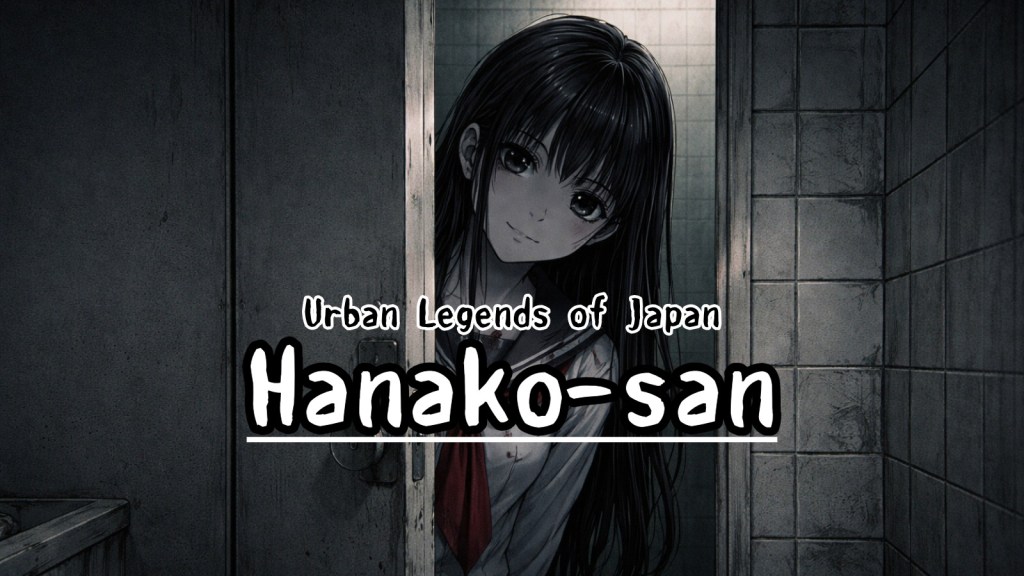
Introduction: The Girl in the Third Stall
There are few ghosts in the world as widely known, casually invoked, and quietly misunderstood as Hanako-san. In Japan, her name is whispered not in temples or abandoned tunnels, but in elementary schools. Not in the dark woods or on lonely highways, but in fluorescent-lit hallways that smell faintly of cleaning solution and chalk dust. She does not belong to the margins of society. She belongs to one of its most normalized institutions. Hanako-san is not the ghost of a forgotten place. She is the ghost of a place everyone has been to.
Ask almost any Japanese adult about Hanako-san and they will smile faintly, half-amused, half-unsettled, as if recalling a childhood rumor they never fully believed but never fully dismissed either. Ask a Japanese child and you may get a very different reaction: a nervous laugh, a refusal to answer, or a sudden insistence that they don’t want to talk about it. Because Hanako-san is not simply a story children hear. She is a story children perform. A ritualized haunting reenacted in school bathrooms across the country for decades. Knock three times on the door of the third stall on the third floor. Ask politely if Hanako-san is there. Wait for an answer.
If she answers, something bad happens.
Hanako-san is one of Japan’s most persistent modern urban legends, and also one of its most psychologically intimate. She is not a wandering spirit. She does not stalk victims across cities or emerge from cursed videotapes or crawl out of wells. She never leaves the place where she died. She waits in a bathroom stall. Specifically, a girl’s bathroom stall. Usually, the third one. Usually on the third floor. Usually in an elementary school. Her haunting is not cinematic. It is bureaucratic. It is procedural. It has rules. And like all the most disturbing rules in folklore, they are taught to children by other children.
What unsettles me most about Hanako-san is not the violence associated with her legend: the clawed hands, the red eyes, the voices from behind the door, the stories of children being dragged into the stall and never seen again. What unsettles me is how normalized her presence is within the social imagination. She is not treated as a cosmic horror or a sacred yūrei. She is treated as a dare. A rumor. A rite of passage. A joke that becomes less funny the longer you stand in front of the door waiting for something to answer back. Hanako-san is not framed as a monster; she is framed as a neighbor.
There is something deeply perverse about the fact that one of Japan’s most ubiquitous ghosts is a dead schoolgirl who lives in a bathroom. It feels too symbolic to be accidental. Bathrooms are already liminal spaces; private but not safe, intimate but institutional, places where children hide, cry, self-harm, get bullied, get cornered, or try to disappear for a few minutes from the social machinery of school life. A bathroom stall is where you go when you don’t want to be seen. It is where vulnerability becomes invisible. And Hanako-san lives there. Forever.
Like all durable urban legends, Hanako-san has no single canonical origin story. In some versions she was abused by her parents and fled into the school, where she was murdered. In others she was killed by a stranger hiding in the bathroom. In still others she died during an air raid in World War II and now haunts the place where she sought shelter. Sometimes she is a bullied child who committed suicide. Sometimes she is simply “a girl who died here.” The details shift from region to region, generation to generation, school to school but the constants never change:
She is always a child.
She is always female.
She is always trapped inside a school.
She is always waiting to be summoned.
This is why I do not think of Hanako-san as a ghost in the conventional sense. I think of her as spiritual residue; a psychic scar left behind by generations of childhood trauma, institutional cruelty, and unspoken grief. She is not haunting schools because she wants to. She is haunting schools because schools are already haunted. She is what happens when a place absorbs too much pain and never metabolizes it.
What makes Hanako-san so uniquely disturbing within the framework of Japanese horror is how cleanly she fits into the same metaphysical logic as Sadako, Kayako, Toshio, Kagutaba, Shirome, the Inunaki Tunnel, and Kisaragi Station. She is not driven by revenge. She is not motivated by hatred. She does not deliver moral punishment. She simply exists as a localized curse; a presence bound to a specific place, triggered by ritualized behavior, and incapable of resolution.
Like the Saeki house in Ju-on, the bathroom stall is a cursed coordinate in space. Anyone who steps too close to it under the right conditions becomes part of the haunting whether they deserve it or not. The curse is not ethical. It is mechanical. That is pure J-horror logic.
But Hanako-san predates most of cinematic J-horror. She is older than Ringu. Older than Ju-on. Older than Noroi. She is a piece of folklore that evolved organically inside the same cultural anxieties those films later formalized. She is proto–J-horror. A yūrei shaped not by temples and shrines, but by fluorescent lights, tiled floors, and the emotional architecture of compulsory education. She is the ghost of modernity’s childhood.
There is something especially cruel about the fact that Hanako-san only appears when children summon her. She does not intrude. She does not stalk. She does not force her way into anyone’s life. She waits. And when she is called, she answers. This inversion of agency is horrifying. The children are not victims of a predatory spirit. They are participants in a ritualized haunting they barely understand.
And this is why I find Hanako-san so much more disturbing than she first appears. Because beneath the surface of a schoolyard dare lies something unbearably sad. A dead girl whose existence has been reduced to a rumor, a ritual, and a joke. A child ghost whose only social role left in the world is to frighten other children for entertainment. She does not get justice. She does not get rest. She does not get remembered as a person. She gets remembered as a bathroom ghost.
Hanako-san is not a legend about fear; she is a legend about neglect. She is a legend about what happens when children die and no one builds a language to mourn them properly. She is a legend about what happens when institutions outlive the people they break. That is why I think Hanako-san deserves to be taken seriously. Not as a monster. Not as a joke. But as one of the most quietly tragic figures in modern Japanese folklore.
The Legend Itself: Rituals, Rules, and Regional Variants
The legend of Hanako-san does not exist as a single story. It exists as a ritual framework that mutates slightly from school to school, city to city, and generation to generation. This is one of the clearest indicators that Hanako-san is not a fixed folkloric character in the traditional sense, but a living piece of oral culture; a ghost who is continuously rewritten by the children who fear her, summon her, and dare one another to speak her name out loud. What remains eerily consistent across these variations is not her backstory, her appearance, or even her temperament, but the ritual mechanics by which she is invoked.
In almost every version, the ritual begins in a school bathroom. Not just any bathroom, but a girl’s bathroom. Not just any stall, but the third stall from the end. Not just any floor, but the third floor of the building. The numbers matter. The repetition matters. The symmetry matters. Children are instructed to knock three times on the stall door and ask, in a polite voice, “Hanako-san, are you there?” In some versions, she answers with a soft “Yes, I am.” In others, a small hand reaches out from under the door. In still others, the door creaks open by itself. What happens next depends entirely on which version of the story you grew up hearing and, more disturbingly, on whether the person performing the ritual is deemed “sincere” or merely curious.
This procedural rigidity is one of the most unsettling aspects of the legend. Hanako-san is not summoned by accident. She does not appear randomly. She is called into manifestation through a highly specific sequence of actions, words, and spatial coordinates. This places her in the same folkloric category as ritual spirits, summoning demons, and cursed thresholds; entities that only exist at the intersection of intention, repetition, and place. The bathroom stall is not just where she lives. It is the interface through which she can be accessed.
In some versions of the legend, if Hanako-san answers your knock and you open the door, she will drag you into the stall and kill you. In others, she will simply vanish, leaving behind blood stains, handprints, or the sound of giggling. In milder tellings, she plays pranks: pulling legs, slamming doors, stealing shoes, whispering names. In darker ones, she disembowels children, strangles them, or causes them to disappear entirely. Some regional variants say that if you refuse to open the door after she answers, she will follow you home. Others say she will curse you, ensuring illness, bad luck, or death within days. There is no moral consistency to her behavior. And that is precisely the point.
What makes Hanako-san uniquely disturbing among urban legends is not just that children perform her ritual, but that the ritual itself is taught to them by other children. There is no adult intermediary. No priest. No folklorist. No authority figure. The legend is transmitted peer-to-peer, whispered in hallways, traded during recess, performed after school, and reenacted during dares. This gives the ritual a strange psychological weight. Children are not merely hearing about a ghost. They are being initiated into a small, forbidden ceremony that temporarily suspends the rules of adult reality.
The bathroom becomes a stage. The stall becomes a shrine. The knock becomes a prayer. And the question “Hanako-san, are you there?” becomes an invocation. This is not metaphorical. Functionally, this is how summoning rituals work in every culture. What makes Hanako-san so uncanny is that this entire structure has been smuggled into the everyday life of schoolchildren and disguised as a playground dare.
There are dozens of documented regional variants of Hanako-san, and they are often wildly contradictory. In some versions she wears a red skirt. In others, a white blouse. In some she has a bob haircut. In others, long black hair covering her face. Sometimes she has a pale, human face. Sometimes her face is missing. Sometimes her eyes bleed. Sometimes she has reptilian skin, clawed hands, or a slit mouth. In a few rural variants, she is said to have three heads or a snake’s body hidden beneath her uniform.
Likewise, her origin story mutates constantly. In some tellings she was murdered by a serial killer who hid in the school bathroom. In others she was abused by her parents and fled into the school, where she died. In wartime variants she was killed during an air raid while sheltering in the bathroom. In bullying variants she committed suicide after relentless harassment. In still others she is simply described as “a girl who died here long ago.” What never changes is her age. She is always a child.
This instability of form and backstory strongly suggests that Hanako-san is not a remembered person, she is a folkloric role. A narrative slot into which different generations pour their own anxieties, traumas, and moral panics. She absorbs new cultural fears and re-expresses them through the same ritualized framework. In the 1950s and 60s she is an air-raid victim. In the 70s and 80s she is a bullied child. In the 90s she becomes more overtly violent. In the 2000s she becomes internet-memefied, YouTube-ified, and commodified into mascots and horror IP. Her core identity remains stable while her surface details mutate. That is the hallmark of a true urban legend.
Another deeply unsettling feature of the Hanako-san ritual is that it centers entirely on a door, a literal threshold. The act of knocking, waiting for a response, and deciding whether or not to open the stall door places the summoner into a liminal decision state. You are given a moment where nothing happens. You are suspended between worlds. You are still in the ordinary bathroom. You have not yet done anything wrong. And then something answers you back. The horror is not in what she does next. The horror is in the fact that something answers at all.
In many versions, Hanako-san only manifests if the person calling her is “serious.” This is an extraordinary detail that is often overlooked. It implies that she is not triggered by curiosity, boredom, or play. She is triggered by sincerity. The ritual punishes those who approach it lightly. In effect, Hanako-san is a curse that demands emotional authenticity. If you treat her like a joke, she retaliates. This creates a deeply perverse moral inversion. The ghost is not offended by cruelty or violence. She is offended by insincerity.
What all of these variants have in common is not their imagery or outcomes, but their structure. Hanako-san is a localized, ritual-bound, place-specific haunting. She cannot be summoned anywhere else. She cannot be invoked without the bathroom. She cannot be encountered without the stall. She cannot be accessed without performing the correct procedural steps.
This places her squarely within the same metaphysical category as the Saeki house in Ju-on, the cursed videotape in Ringu, the Shirome ritual, the Inunaki Tunnel legend, and Kisaragi Station. In all of these cases, horror does not emerge because someone is evil or sinful. It emerges because someone steps into a specific cursed coordinate in space and time. The curse does not care who you are; it only cares where you are and what you do there.
Seen through this lens, Hanako-san stops being a ghost story and becomes a spatial infection. A metaphysical trap embedded into the architecture of everyday life. A piece of folklore that weaponizes place, repetition, and childish curiosity. And perhaps most disturbingly of all: she does not hunt children; children go to her.
So, Who Was Hanako?
As mentioned earlier, one of the most unsettling things about Hanako-san is that she does not have a biography; she has a cloud of contradictory origin stories that refuse to stabilize into anything resembling a coherent human life. In some tellings she was murdered by a stranger hiding in the school bathroom. In others she was abused by her parents and fled into the school, where she was later found dead. In wartime variants she was killed during an air raid while sheltering in the bathroom. In bullying narratives she committed suicide after relentless harassment by her classmates. In still others she is described simply as “a girl who died here long ago,” with no explanation at all. These stories are not just inconsistent; they are mutually annihilating. They cannot all be true and that matters.
In traditional folklore, ghosts are anchored by biography. They are the spirits of specific people who suffered specific wrongs. Their hauntings are legible because their grievances are legible. Even in J-horror, Sadako has a mother, a childhood, a murder scene, and a psychic lineage. Kayako has a marriage, a pregnancy, a violent death, and a house. Toshio has a body, a cat, and a staircase.
Hanako-san has none of that: no canonical parents, no canonical killer, no canonical death, no canonical year, no canonical city, no canonical school. She does not remember who she was and neither does anyone else. This is the first and most important clue that Hanako-san is not a remembered person. She is a folkloric role.
She is a narrative slot into which different generations pour their own unresolved anxieties about childhood, abuse, war, bullying, institutional cruelty, and premature death. Every era rewrites her origin story to match the kind of violence it is most ashamed of at that moment in history. In the shadow of World War II, she becomes an air-raid victim. In the era of rising awareness of domestic abuse, she becomes a battered child. In the era of school bullying and youth suicide panics, she becomes a victim of harassment. In the era of serial killer anxiety, she becomes a murdered schoolgirl. Hanako-san does not have a past; she has a function.
What all of her backstory variants have in common is not how she died, but how she lived. She is always a child. She is always female. She is always isolated. She is always powerless. She is always failed by the adults who were supposed to protect her. And she always dies in a place that is supposed to be safe. This is not coincidence; it is symbolic compression. Hanako-san is not one dead girl. She is every dead girl nobody knew how to mourn.
In this sense, Hanako-san is not a ghost in the conventional folkloric sense at all. She is closer to what you might call a cultural revenant; a spirit formed not from one person’s grievance, but from accumulated, unresolved grief that has nowhere else to go. She exists because Japanese society, like all societies, has produced generations of children who died invisibly: from abuse, neglect, war, suicide, illness, and bullying, often inside institutions that were never held accountable for what happened within their walls. Hanako-san is the psychic remainder of that moral debt. She is what happens when a culture metabolizes tragedy by turning it into a rumor instead of a reckoning.
This also explains why Hanako-san never grows up. She is eternally the same age. She is eternally a schoolgirl. She is eternally trapped in the same building, the same stall, the same ritual. She never moves on because there is nothing in the legend that would allow her to. There is no exorcism ritual for Hanako-san.
There is no appeasement ceremony. There is no moral resolution. There is no apology. She does not remain because she is vengeful. She remains because no one has ever finished the story she started living.
There is something especially cruel about the fact that most versions of Hanako-san’s backstory revolve around abuse, bullying, or wartime death, and yet she is remembered primarily as a prank ghost. A dare, a joke, a playground ritual. The legend strips her of moral seriousness and converts her into a form of entertainment for other children. Her suffering becomes set dressing for thrill-seeking. This is not just narratively bleak; it is culturally damning.
What makes this even more unsettling is that Hanako-san’s violence, when it appears in darker variants, has no ethical target. She does not hunt abusers. She does not punish bullies. She does not seek out violent adults. She attacks the same demographic she belongs to— children. The powerless harming the powerless. The victim haunting the vulnerable. This is not revenge; it is trauma echo.
In this sense, Hanako-san is spiritually closer to Kayako and Toshio than to Sadako. Like the Saeki family, she does not distribute justice. She distributes contamination. Anyone who steps into her cursed coordinate becomes part of the haunting whether they deserve it or not. The curse is not ethical. It is mechanical. It propagates blindly. This places her squarely within J-horror metaphysics. She is not a moral agent. She is a malfunctioning grief engine.
Perhaps the most tragic thing about Hanako-san is that she does not even know who she is anymore. The multiplicity of her backstories implies that her identity has dissolved. She has been overwritten so many times by rumor that whatever person she once was, if she ever existed at all, is now irretrievable. She is not haunting a bathroom because she remembers her life; she is haunting a bathroom because she no longer has one.
This is why I think it is a mistake to ask, “Who was Hanako-san, really?” That question assumes there is an answer. There isn’t. And that absence is the point. Hanako-san is not a ghost with a story. She is a story that accidentally became a ghost and that, more than anything else, is what makes her unbearable to me. She is not waiting for justice. She is not waiting for closure. She is not waiting for release. She is waiting because no one ever taught the culture how to finish grieving her.
The School as a Haunted System
If Hanako-san were merely the ghost of a murdered girl, she would haunt a house, a street corner, a riverbank, or a grave. That is where personal ghosts go. But she does not. She haunts a school. More specifically, she haunts the interior architecture of a school: a bathroom stall, a tiled corridor, a floor that children walk every day without thinking about it. This detail is so normalized in the legend that it is rarely interrogated, yet it is the single most important metaphysical clue the story offers. Hanako-san is not bound to a person. She is bound to an institution.
Schools in Japan are not neutral spaces. They are not merely sites of education or benign socialization. They are disciplinary machines, conformity engines, and social sorting devices. They are the first place where children learn, in a sustained and embodied way, that their bodies, voices, time, and identities are not fully their own. From an early age, students are trained to suppress difference, obey hierarchy, endure humiliation quietly, and accept institutional authority as morally legitimate even when it is emotionally brutal. This is not an abstract critique. It is an architectural one. The school building itself becomes a technology of psychological conditioning, shaping not only behavior but interior emotional life.
Hanako-san emerges precisely from that architecture. She does not haunt playgrounds, classrooms, gyms, rooftops, or teacher’s offices. She haunts the bathroom. In other words, she occupies the only place in a school where a child is ever truly alone. School bathrooms are among the most emotionally loaded spaces in childhood. They are where children go to cry without being seen, hide during panic attacks, self-harm, vomit from anxiety, or try to disappear for a few minutes from the social machinery of school life. They are also where children are cornered by bullies, sexually harassed or assaulted, mocked for their bodies, and humiliated in private. Bathrooms are private spaces embedded inside a public institution. They are liminal zones inside a disciplinary system. They are the only place where vulnerability becomes temporarily invisible and that is where Hanako-san lives. This is not symbolic coincidence; it is psychological inevitability.
The stall itself matters just as much as the bathroom. A stall is a box you step into and close a door behind you. It is a coffin-shaped space scaled to a child’s body. It is a temporary hiding place, a confessional booth without absolution, a room-within-a-room designed for shameful functions. Hanako-san is not just in the bathroom; she is inside a locked compartment inside a locked institution. The physical structure of her haunting mirrors the emotional structure of childhood repression: pain nested inside secrecy, secrecy nested inside routine, routine nested inside authority.
What makes this even more disturbing is that she does not appear randomly. She appears only when someone performs a ritualized act of transgression. They knock on the door. They speak her name. They violate the boundary between ordinary space and haunted space. They ask permission to be acknowledged. This is exactly how institutional trauma behaves. It remains invisible as long as no one presses on the wrong boundary. But the moment someone does, the moment someone names it, touches it, or tests it, something answers back. Hanako-san is not an intruder into the school system. She is its byproduct. She is not haunting the school because something went wrong once. She is haunting it because something is always wrong.
The Japanese school system has long been associated with intense bullying (ijime), rigid conformity pressures, extreme academic stress, teacher abuse scandals, sexual harassment, corporal punishment, and student suicide. For decades, institutions systematically minimized or concealed these problems in order to preserve reputational harmony. Students were told to endure. Parents were told not to cause trouble. Administrators were incentivized to bury incidents quietly. This created precisely the kind of moral environment in which a legend like Hanako-san becomes inevitable. She is not the ghost of one murdered child. She is the psychic condensation of thousands of silenced ones.
This also explains why Hanako-san never leaves the school. She is not a restless spirit seeking justice. She is a trapped presence embedded in a system that never acknowledged what it did. She cannot move on because the institution that produced her never changed. Her haunting is not about unfinished business; it is about ongoing business.
The ritual structure of her legend reinforces this interpretation. Children summon her. She does not choose them. She does not stalk them. She waits passively until someone violates a taboo. This mirrors the way trauma behaves inside institutions. It does not leap out randomly. It remains dormant until someone steps into the wrong place at the wrong time. And when she harms children, it is not because she is evil. It is because she is replaying what the institution did to her. This is not revenge; it is recursion.
There is something unbearably bleak about the fact that Hanako-san’s only remaining social role is to frighten other children inside the same system that killed her. The school did not save her. The adults did not protect her. And now her afterlife consists of being used as a tool of terror for other vulnerable children. She has become part of the institution. She has been absorbed into it. She is now one of its disciplinary myths.
In this sense, Hanako-san is not a monster. She is an artifact. She is a cursed data file embedded in the operating system of compulsory education. She is what happens when trauma is archived instead of healed. And that is why she feels so much more disturbing than a wandering yūrei. Because she is not haunting a ruin. She is haunting a functioning building; a place where children still go every day, a place that pretends nothing is wrong.
Hanako-san is not asking to be remembered. She is not asking to be avenged. She is not even asking to be released. She is simply there, waiting behind a door that children are taught never to open. Which makes her, in the most quietly horrifying way possible, one of the most honest ghost stories Japan has ever produced.
Hanako-san and the Metaphysics of Ritual Horror
Seen through the lens of J-horror metaphysics, Hanako-san does not belong to the category of vengeful spirits, wandering yūrei, or moral revenants. She belongs to the same ontological family as the Saeki house in Ju-on, the cursed videotape in Ringu, the Shirome ritual, Inunaki Tunnel, and Kisaragi Station. These are not ghosts in the traditional folkloric sense. They are localized curse systems — haunted coordinates embedded into ordinary reality, activated not by sin or malice, but by proximity, repetition, and procedural transgression. They do not hunt. They do not judge. They wait.
Hanako-san fits this pattern with chilling precision. She is bound to a specific spatial node: a bathroom stall on the third floor of a school. She is activated through a repeatable ritual: three knocks, a polite invocation, a moment of waiting. She manifests only when someone steps into the correct configuration of place, time, and intention. This is not ghost behavior. This is curse logic. The haunting is not an expression of her will; it is the mechanical execution of a metaphysical program that has been running uninterrupted for decades.
Like Kayako and Toshio, Hanako-san does not distribute justice. She distributes contamination. Anyone who enters her cursed coordinate under the correct conditions becomes part of the haunting whether they deserve it or not. The curse is not ethical. It is infrastructural. It behaves more like radiation than like revenge. And this is why she feels so spiritually modern. She is not a moral agent. She is a malfunctioning grief engine, endlessly replaying the same traumatic script inside the same institutional architecture.
What makes Hanako-san uniquely unbearable within this metaphysical framework is that her curse is not triggered by cruelty, arrogance, or violence. It is triggered by curiosity, sincerity, and childish bravado. In many versions of the legend, she only appears if the person summoning her is “serious.” If you treat her like a joke, nothing happens. This creates a grotesque inversion of moral logic. The ritual does not punish wrongdoing. It punishes emotional authenticity. It punishes vulnerability. It punishes children for believing, even momentarily, that the world might answer them back. This places Hanako-san in direct alignment with the deepest, bleakest current in J-horror: the idea that the universe is not merely indifferent to suffering, but structurally hostile to meaning itself.
But what truly elevates Hanako-san from an eerie folkloric curiosity into something metaphysically catastrophic is the fact that she exists entirely inside children’s folklore. Unlike Sadako, whose curse is discovered by adults, or Kayako, whose house becomes a site of adult investigation and intervention, Hanako-san is transmitted peer-to-peer among children. There is no adult intermediary. No priest. No folklorist. No authority figure. The ritual is taught in whispers. It is performed after school. It is reenacted during dares. It is passed from older students to younger ones like a secret handshake with death folded into it.
This gives the legend a strange and deeply perverse psychological weight. Children are not merely hearing about a ghost. They are being initiated into a small, forbidden ceremony that temporarily suspends the rules of adult reality. The bathroom becomes a shrine. The stall becomes an altar. The knock becomes a prayer. The question “Hanako-san, are you there?” becomes an invocation. Functionally, this is not metaphorical. This is exactly how summoning rituals work in every culture. What makes Hanako-san monstrous is that this entire structure has been smuggled into the everyday life of schoolchildren and disguised as a playground dare.
This is why I think it is a mistake to interpret Hanako-san as a children’s ghost story. She is a children’s ritual. And that distinction matters. A story can be ignored. A ritual cannot. A story ends when the listener stops believing in it. A ritual persists as long as someone keeps performing it. And for decades now, children across Japan have continued to knock on that door. They have continued to speak her name. They have continued to test whether the rules still work. They have continued to keep her alive.
This is also why Hanako-san feels so much more tragic than cinematic J-horror spirits. Sadako has a lineage. Kayako has a biography. Toshio has a cat, a staircase, a family, a moment of death. Hanako-san has none of these. She has no canonical parents, no canonical murder, no canonical year, no canonical school. She is not anchored to a single trauma. She is anchored to a category of trauma. She is the ghost of childhood itself.
And this is where the legend becomes culturally damning. Hanako-san exists because Japanese society has repeatedly failed to metabolize childhood suffering in any meaningful way. Bullying, abuse, war trauma, sexual violence, institutional neglect, and student suicide have all been treated, historically, as problems to be minimized, concealed, or reframed as individual weakness. The system survives by pretending nothing is wrong. The children survive by pretending nothing hurts. Hanako-san is what happens when that repression curdles into folklore.
Perhaps the cruelest thing about her is that she does not even get to be remembered as a person. Whatever child she once was, if she ever existed at all, has been overwritten by rumor. She is no longer a girl. She is a stall. She is a knock. She is a rule. She is a dare. She is a joke that becomes less funny the longer you stand there waiting for something to answer. She has been converted into infrastructure. In the end, I do not think Hanako-san is a monster. I think she is an institutional wound that learned how to speak.
She does not stalk children. Children go to her. They summon her. They recreate her death ritualistically. They keep her bound to the place that killed her. And that, to me, is the most quietly horrifying thing about this legend. Not that a ghost lives in a bathroom stall. But that an entire culture taught its children how to summon her.
~END~
 J-Horror Blog
Leave a comment