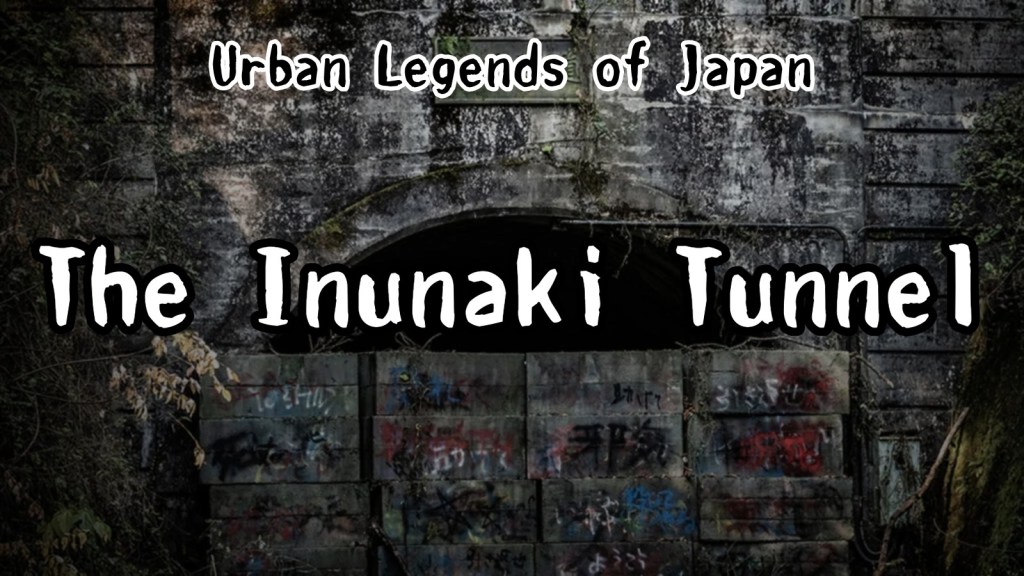
Introduction – the Shape of a Modern Ghost Story
There are some ghost stories that feel ancient, as though they have always existed.
And then there are others that feel new; not in the sense that they were recently invented, but in the sense that they could only have come into being in the modern world, in the wake of highways, depopulated towns, sealed tunnels, and communities that simply… disappeared.
The legend of the Inunaki Tunnel, often times Howling Tunnel, belongs to the second kind.
It is one of Japan’s most persistent modern urban legends: a story that refuses to settle into a single definitive version, that mutates slightly with each retelling, and that continues to resurface in online forums, late-night radio programs, amateur exploration videos, and whispered conversations among people who live near the mountains where it is said to exist.
Depending on who tells it, the tunnel leads to an erased village.
Or it passes through the remains of one.
Or it marks the boundary between the living world and somewhere else entirely.
People report hearing voices at night…
Crying…
Howling…
Footsteps where no one should be walking…
Some say those who enter too far into the tunnel are never seen again.
Others say they come back changed.
Others still say time behaves strangely there; that minutes stretch into hours, or that people emerge long after they were supposed to and yet, despite all of this, the Inunaki Tunnel does not feel like a story that was created to frighten children or go viral online. It feels like a story that grew.
Place-Based Curses and the Weight of Geography
I’ve always been drawn to place-based curses.
Not cursed objects.
Not cursed videotapes.
Not haunted dolls.
But locations.
Houses that won’t let go of what happened inside them.
Forests that remember what was buried beneath their roots.
Tunnels that seem to hold onto voices long after their owners are gone.
There is something uniquely unsettling about the idea that a place itself can become a vessel for grief, violence, neglect, or abandonment; that it can continue radiating harm long after the original event has faded from public memory.
In J-horror especially, this idea appears again and again:
The Saeki house in Ju-On.
The well and cabin in Ringu.
The cursed village in Noroi.
The sealed tunnel in Howling Village.
These are not just backdrops; they are protagonists in their own right. They are sites where something went wrong and was never properly acknowledged, mourned, purified, or resolved. The Inunaki Tunnel belongs to this same spiritual lineage.
Urban Legends as Spiritual Residue
It’s easy to dismiss stories like this as fake.
As internet creepypasta.
As attention-seeking folklore.
As teenagers trespassing into abandoned places and frightening themselves.
But I don’t think urban legends like the Inunaki Tunnel persist because people are gullible. I think they persist because they are trying to say something.
Urban legends are not factual records; they are emotional records.
They form in the wake of forced relocations, submerged villages, unmarked graves, abandoned infrastructure, erased communities, social neglect, unspoken historical trauma and more. They are what happens when a place carries a wound that was never properly named. In that sense, urban legends are a kind of spiritual residue; a cultural afterimage left behind by events that were too small, too rural, too shameful, or too inconvenient to be recorded in official history. They are how grief leaks back into the world.
What makes the Inunaki Tunnel legend especially haunting is how plausible it feels within Japan’s real historical landscape. Japan is full of places that are legally gone, physically inaccessible, administratively erased and culturally half-remembered. Entire villages were displaced by dam projects. Rural towns collapsed during post-war urban migration. Mountain communities were abandoned as infrastructure modernized. Tunnels were sealed for safety, rerouted, or left to decay.
These places still exist physically. They just no longer exist socially. And when people stumble upon them, or rumors about them, something uncanny happens. The gap between what should be there and what is there becomes unbearable. That is where ghost stories are born.
The Inunaki Tunnel does not feel like a traditional kaidan. There are no neat moral lessons. No clean narrative arcs. No righteous spirits seeking justice. Instead, it feels like a modern kaidan: fragmented, unstable, unresolved. It doesn’t tell you what happened. It only tells you that something did. And that it never stopped echoing.
What draws me to this legend isn’t fear in the jump-scare sense. It’s the melancholy. The sense of abandonment. The idea that entire lives and communities can vanish so completely that they leave only rumors behind. The suggestion that curiosity itself can become a form of trespass. The Inunaki Tunnel doesn’t threaten you. It waits. And that is much more unsettling.
What This Essay Will Explore
In what follows, I want to do four things:
- Lay out the major versions of the Inunaki Tunnel legend
- Trace the real historical conditions that likely gave birth to it
- Examine why this story feels so deeply J-horror in spirit
- Reflect on what it says about memory, abandonment, and haunted places
This is not an attempt to prove whether the legend is “real;” it’s an attempt to understand why it refuses to die.
The Legend Itself: Versions and Motifs
One of the most unsettling things about the Inunaki Tunnel legend is that there is no single, authoritative version of it. Ask ten people and you will hear ten slightly different stories; different prefectures, different tunnel names, different explanations for what happened to the village beyond it. Some say the tunnel leads directly into an erased 19th century settlement (Inunaki Village). Others insist it only passes near one, or that the village itself no longer exists in physical space at all. In certain tellings, the location can be named precisely; in others, it is said to have been deliberately removed from official maps. And yet, despite these inconsistencies, the emotional shape of the story never really changes. The same images recur. The same warnings repeat. The same quiet dread hangs over every telling. It feels less like a story with a stable plot and more like a wound that keeps reopening in slightly different places.
In its most commonly repeated form, the legend describes a tunnel located in or near a mountainous, rural region of Japan; a place that already feels socially thin, far from major roads, and unmoored from everyday life. The tunnel is said to either lead to, pass by, or once have connected to a village that no longer exists. The village is not listed on modern maps, and older residents in nearby towns avoid discussing it or claim to know nothing at all. People who stumble upon the tunnel describe an immediate sense of wrongness: the air feels heavy, sound behaves oddly, and voices echo where no one should be speaking. At night, passersby report hearing crying, whispering, chanting, coughing, or a low, animal-like howling sound drifting out from within. Some claim that if you walk too far into the tunnel, it subtly changes; growing longer, distorting your sense of distance, or making the exit behind you feel impossibly far away. Eventually, you are no longer walking through a tunnel so much as being drawn into something else entirely.
Nearly every version of the legend involves an old village that has been erased from both geography and public memory. What happened to it varies depending on who is telling the story. In some accounts, the villagers were massacred. In others, they starved during a famine, succumbed to disease, or became involved in a cult that ended in ritual suicide. A few versions suggest forced relocation for a dam or industrial project, while others offer no explanation at all. The village is simply gone, and that absence becomes the horror. Those who claim to have reached it describe collapsed houses, rusted tools, abandoned shrines, children’s shoes, and household objects left exactly where they were dropped, as if everyone stepped outside for a moment and never came back. In some tellings, the village appears intact but deserted; in others, it is partially submerged, buried, or reclaimed by forest. Almost always, however, witnesses insist that the place does not feel empty. It feels watched. Occupied. As though something is still living there, just out of sight. Some versions include a (seemingly) friendly old man, a resident of an otherwise abandoned village, who eventually turns murderous. Often, there is said to be a sign preceding the village which says something to the effect of the constitution of Japan is not in effect past this point.
Sound is one of the most psychologically potent motifs in the legend and the detail from which it takes its name. People report hearing voices deep within the tunnel, sometimes calling their name, sometimes whispering indistinctly, sometimes crying in a way that feels human but wrong. In some versions, the howling grows louder the farther one walks into the tunnel, not closer, as if something is receding from the listener while drawing them forward at the same time. Others claim the sounds come from just behind them, even when no one is there. This transforms the tunnel from a mere physical structure into a kind of auditory trap; a place that lures people forward not through visual spectacle, but through the promise of human presence and recognition.
Many retellings of the story incorporate modern disappearance cases. Teenagers who went exploring and never came back. Urban explorers who uploaded one last shaky video before contact was lost. Friends who heard screaming over a phone call that suddenly cut out. In some variants, the missing are later found dead near the tunnel; in others, they are never found at all. A particularly grim motif appears in several versions: people who vanish are later seen standing at the tunnel entrance at night, silent and motionless, staring outward. If approached, they disappear. These sightings suggest that the tunnel does not merely kill people, it absorbs them, incorporating them into the place itself.
Another recurring element is distorted time. People claim they entered the tunnel for only a few minutes and emerged hours later, or that they went inside during daylight and came out after dark. Phones and watches stop working. Recorded footage skips or jumps forward. This detail gives the legend a liminal, almost cosmic edge, implying that the tunnel is not merely haunted but unstable; a rupture in ordinary reality where the usual rules no longer apply. In this sense, the Inunaki Tunnel begins to resemble a threshold rather than a location, a place where the boundary between the living world and something else has thinned to the point of collapse.
Almost every version of the legend ends with the same warning: do not enter the tunnel, do not go looking for the village, do not respond if you hear someone calling your name, and do not stay if you feel watched. This warning is never framed as superstition. It is framed as etiquette. As if the tunnel is not evil in any conventional sense but deeply offended by curiosity… as though it is a wound that does not want to be reopened. The story does not threaten you. It simply tells you that certain places are not meant to be entered again.
What ultimately separates the Inunaki Tunnel legend from internet creepypasta is not how frightening it is, but how unstable it remains. The story refuses to settle into a single shape. Details slide. Locations change. Explanations contradict one another. That instability is not a flaw; it is the point. Because this is not a legend about a monster. It is a legend about a place that remembers something no one else wants to. In that sense, the Inunaki Tunnel does not behave like a fictional narrative at all. It behaves like a ghost. It attaches itself to abandoned infrastructure, depopulated regions, sealed tunnels, and erased villages. It mutates as it moves from mouth to mouth. It feeds on silence, not spectacle. And it persists not because people believe it is true, but because people feel that it might be.
The Real History Beneath the Legend
There is a real place in Japan that has come to function as a gravitational center for many of these stories. It is located near the Inunaki mountain pass in Fukuoka Prefecture. Long before it became a meme, a creepypasta subject, or the inspiration for later horror films, Inunaki Tunnel/Village were already infamous. The tunnel and its surrounding roads were partially abandoned after new routes were constructed, leaving the old passage isolated, unmaintained, and increasingly absorbed back into forest. It became one of those places that still physically exists, but no longer socially does; exactly the kind of liminal space where urban legends naturally take root.
In 1988, Inunaki Tunnel became associated with a real and deeply brutal murder case, when a young man was abducted, tortured, and burned alive by a group of assailants in the area. The crime had nothing to do with ghosts, curses, or the supernatural but in a cultural sense, it didn’t need to. The site was permanently stained by human cruelty, and from that moment forward, it ceased to be just another abandoned tunnel. It became a place people avoided. A place people whispered about. A place that no longer felt neutral.
Over time, the legends began to accumulate. Stories of voices in the tunnel. Of figures seen at night. Of people disappearing or returning changed. Of a “forbidden village” beyond the pass where Japan’s laws supposedly no longer apply. These tales were not historically accurate, but they were emotionally precise. They were how a site of real violence, abandonment, and isolation was metabolized into folklore.
It is not difficult to see how Inunaki Tunnel, with its real death, real abandonment, and real bureaucratic neglect, could have become the spiritual template for the legend. Even if the stories are not literally about the path to Inunaki Village, they are clearly about places like it. Places that modern infrastructure moved past. Places that tragedy marked and then left behind. Places that no longer belong fully to the living world but were never properly laid to rest.
In that sense, the Inunaki Tunnel does not need to exist as a single, secret location hidden in the mountains. It already exists. It exists in every sealed tunnel that leads nowhere. In every depopulated village that still has a name no one remembers. In every place where something terrible happened and was quietly absorbed into the landscape without ceremony or closure.
The legend is not pointing toward one cursed tunnel. It is pointing toward a pattern. And that pattern is the real haunting. For any who are interested, there are numerous videos online from travel vloggers & influencers walking through the hard-to-access tunnel; you can even see the Spongebob graffiti.
Other Observations
What makes the Inunaki Tunnel legend so unsettling is not that it sounds supernatural. It’s that it sounds historically plausible. Once you step away from the ghost-story framing and look at Japan’s modern rural history, the emotional logic of the legend begins to feel less like fantasy and more like cultural afterimage. The Inunaki Tunnel does not feel like a story that came from nowhere. It feels like a story that rose up from a place where something quietly ended.
Beginning in the postwar period and accelerating rapidly from the 1950s through the 1980s, Japan underwent one of the most extreme rural depopulations in the industrialized world. Young people left mountain villages for factory jobs and urban work. Agricultural communities collapsed. Local schools closed. Clinics shut down. Shrines fell into disrepair. Entire settlements emptied out in a single generation. Today, Japan has thousands of genkai shūraku (marginal villages) where the remaining population is so elderly that the community is no longer socially or economically viable. Many of these villages become functionally dead long before they are officially declared abandoned. They still exist on maps, but no one lives there anymore. And many others never even made it that far. They were erased.
One of the darkest and least-discussed chapters of modern Japanese infrastructure history is the mass displacement caused by dam construction. From the 1950s through the 1970s, dozens of rural communities were forcibly relocated to make way for hydroelectric dams, flood-control projects, and water reservoirs. Entire villages were evacuated, demolished, submerged, or moved into anonymous housing blocks. Families who had lived on the same land for generations were uprooted, often with inadequate compensation and little political power to resist. In some cases, shrines, cemeteries, and ancestral homes were simply abandoned or flooded. There are still reservoirs in Japan where, during droughts, the rooftops of old houses and torii gates emerge from the water like bones. These places are not haunted in any literal sense, but they are saturated with unresolved grief. And they are precisely the kind of places that breed legends.
The Inunaki Tunnel almost always centers on an old tunnel, and that detail is not arbitrary. Japan is full of obsolete tunnels. Mountain roads were rerouted. Rail lines were abandoned. Highways were rebuilt. Old tunnels were sealed off for safety reasons, left to decay, or quietly forgotten. Some of them genuinely lead nowhere now. Others lead into regions that are no longer inhabited. Many sit at the edge of forests or mountains, just off modern roads, half-hidden behind brush and rusted fencing. They look exactly like the entrances described in the legend. And they feel exactly as wrong as the legend says they do.
What urban legends like the Inunaki Tunnel are really haunted by is not massacre or cult suicide. They are haunted by bureaucratic disappearance. There are countless small communities in Japan whose decline and death were never meaningfully documented. No tragedy. No dramatic event. Just slow depopulation, economic collapse, infrastructure withdrawal, and administrative neglect. People moved away. The last residents died. The government stopped maintaining the roads. And eventually, the place ceased to exist in any social sense. When locals say, “There used to be a village there,” and no one else remembers it, that absence becomes uncanny. Not because something supernatural happened, but because something human did.
Urban legends do not form randomly. They form around emotional pressure points. The Inunaki Tunnel legend is exactly the kind of story that grows around places where people were uprooted, communities were erased, grief went unmourned, and memory became socially inconvenient. It is a story that gives shape to something that cannot otherwise be expressed. The idea that voices can still be heard there, that people disappear into the tunnel, that time behaves strangely, that the village is still “there” somehow; these are not horror tropes. They are metaphors. They are ways of saying: This place is not finished with us yet.
When viewed through this lens, the tunnel itself becomes more than a creepy setting. It becomes a symbolic threshold between modern Japan and the Japan that was abandoned, between living communities and erased ones, between recorded history and forgotten history. It is the architectural embodiment of transition, loss, and social amnesia; a place you are not supposed to go back to, a place that resists being looked at too closely.
The Inunaki Tunnel legend persists not because people are gullible, but because it is emotionally correct. It expresses something that is historically true in a spiritual register: that entire communities were erased, that grief was buried under concrete, that progress required sacrifice, and that nobody really wants to talk about it. So the ghosts talk instead.
When you place the legend against this real historical backdrop, something subtle but devastating happens. The story stops feeling like a scary rumor. It starts feeling like a wound that never healed properly, a place where history ended without ceremony, where memory was cut off mid-sentence.
This is also why the legend feels so profoundly J-horror in spirit. It shares the same DNA as the cursed village in Noroi, the abandoned house in Ju-On, the erased well in Ringu, and the sealed tunnel in Howling Village. All of these stories are ultimately about the same thing: what happens when trauma is not integrated into history, when grief is not witnessed, when places are abandoned without ritual, closure, or acknowledgment. The Inunaki Tunnel is not a monster story. It is a historical ghost story. The most disturbing thing about the Inunaki Tunnel is not that people say it is haunted. It’s that nothing about it actually needs to be supernatural. Everything about it already is.
Final Thoughts
I don’t think the Inunaki Tunnel legend is “true” in any literal sense. I don’t think there is one secret tunnel hidden in the mountains that swallows people whole, or a single erased village frozen in time beyond a sealed road, or voices physically echoing through concrete at night. But I also don’t think the story is a lie. And that distinction matters more to me than whether the legend can be verified. What unsettles me about the Inunaki Tunnel is not the supernatural framing; it’s the emotional precision. The story feels like it knows something about loss, abandonment, and historical amnesia that modern life doesn’t want to admit. It understands that places can outlive the people who gave them meaning, and that when those people vanish without closure, something lingers; not as a ghost, but as an unresolved presence in the cultural subconscious. In that sense, the tunnel doesn’t need to be haunted. It already is.
I am drawn, again and again, to horror stories that are rooted in places rather than monsters; stories where the setting itself becomes the curse, not because something supernatural moved in, but because something human ended badly and was never acknowledged properly. The Inunaki Tunnel sits perfectly in that lineage. It feels like a scar in the landscape, not a spectacle, not a jump scare, not a morality play, but a quiet reminder that progress often leaves wreckage behind it. This is the same reason I am so deeply attached to J-horror. Because J-horror does not usually ask, What is the monster? It asks, What happened here?
What I find most devastating about the legend is not that people disappear into the tunnel. It’s that nobody tries to save the place. There is no priest who purifies it, no official investigation that reclaims it, no ritual of closure that lays it to rest. The solution is simply: don’t go there. Avoid it. Seal it off. Let it rot quietly in the mountains. That response feels painfully honest. It mirrors the way modern societies deal with uncomfortable history; not by integrating it, but by building around it and pretending it isn’t there.
I also can’t ignore how deeply this legend resonates with the emotional logic of early-2000s J-horror; the era that shaped my entire relationship with the genre. Ringu, Ju-On, Noroi, Kairo — all of them are, in their own way, about wounds that were never allowed to close, about people who were erased, abandoned, or silenced, about places that remember what everyone else has agreed to forget. The Inunaki Tunnel feels like it belongs in that canon even though it was never filmed in that era. It feels like a story that was always waiting for someone to notice it.
I think this is why I don’t experience legends like this as entertainment in the usual sense. They don’t thrill me. They grieve me. They leave me with a soft, heavy sadness rather than adrenaline, a sense of standing too close to something private, something unfinished. They feel less like horror movies and more like overheard confessions from the land itself.
There is a particular kind of loneliness embedded in the Inunaki Tunnel legend that I find unbearable in the best possible way: the loneliness of a place that no longer belongs to anyone, the loneliness of a community that vanished without witnesses, the loneliness of grief that had nowhere to go, so it stayed where it was born. That loneliness is what howls.
If the Inunaki Tunnel has a moral, and I’m not sure it does, it isn’t “don’t be curious” or “don’t trespass” or “don’t believe in urban legends.” It’s something much quieter and much crueler: some wounds cannot be safely reopened, some places are haunted not by spirits but by history, and some stories exist not to be solved, but to be sat with.
I don’t want this legend to be debunked. I don’t want it to be turned into a listicle or another YouTube mystery video or a found-footage gimmick. I want it to remain what it already is: a soft, unresolved ghost story about abandonment. In the end, I don’t believe the Inunaki Tunnel is calling people into it. I think it’s asking to be remembered. And that, somehow, feels even worse.
~ END ~
 J-Horror Blog
Leave a comment