Introduction
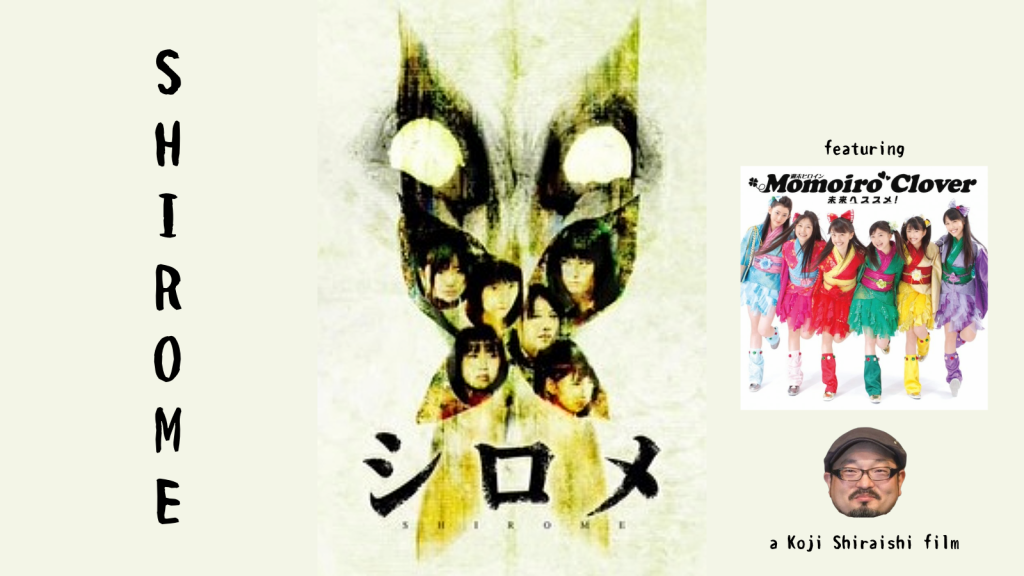
At first glance, Koji Shiraishi’s Shirome (2010) looks like a joke. It opens not with dread or blood or ghostly imagery, but with rehearsal footage of a real-life J-pop idol group (Momoiro Clover Z) practicing choreography, laughing with one another, and nervously talking about their dreams of one day performing on Kōhaku Uta Gassen, Japan’s most prestigious year-end music program. The film is framed as a behind-the-scenes cable TV special. The girls are playing themselves. The tone is light, awkward, sweet, and almost aggressively wholesome. And for a long time, it stays that way. Which is exactly what makes Shirome so dangerous.
To understand why Shirome works at all, you need to understand idol culture. Japanese idol groups are not built around mystique or rebellion. They are built around accessibility. Youth. Sincerity. Emotional transparency. Fans are not meant to admire idols from a distance; they are meant to feel as though they are watching someone grow up in real time. Momoiro Clover Z, at the time of filming, were not yet a major act. They were still climbing. Still doing street performances. Still hoping for a breakthrough moment. They were, in other words, exactly the kind of group whose dreams still felt fragile and real. That matters. Because Shirome is not about punishing arrogance or decadence. It is about punishing hope.
Shirome was directed by Koji Shiraishi, best known for Noroi: The Curse (2005), Occult (2009), and later Cult (2013). Across these films, Shiraishi developed a very specific horror language: pseudo-documentary realism, improvised performances, occult bureaucracy, and the slow intrusion of cosmic or spiritual malice into banal, procedural reality. But Shirome is his strangest experiment. Here, he disguises a curse narrative as: an idol promotion vehicle; a lighthearted mockumentary; a reality-TV haunted-location special.
For most of its runtime, the film feels closer to a prank show or variety program than a horror movie. There are staged scares. Campy occult theatrics. Awkward jokes. Nervous laughter. Even moments that play like parody. It is very easy, early on, to think: Oh. This is just a cute gimmick. That misreading is the film’s most important weapon.
The genius of Shirome is not that it hides its artifice; it foregrounds it. We are constantly reminded that this is a TV production. There are cameras everywhere. Directors interrupt scenes. Crew members step into frame. The girls speak directly to handheld camcorders. Occult “experts” are introduced with theatrical flair. Promotional placards are held up for the camera. Everything about the film screams: This is content. Which makes the slow emergence of genuine terror all the more destabilizing. Because somewhere along the way, the performance layer stops protecting anyone. And the ritual layer starts working anyway.
Shirome is often treated as a curiosity; a weird footnote in Koji Shiraishi’s filmography, or a novelty project tied to a pop group. That is a mistake. What Shirome actually is, in retrospect, is one of the cruelest and most conceptually daring entries in modern J-horror. It is a film about: ambition as spiritual exposure; sincerity as vulnerability; idol culture as ritual sacrifice; media production as occult machinery. And it does all of this without ever raising its voice. It smiles. It jokes. It dances. It documents. And then it closes the trap.
What follows is a scene-by-scene account of the recovered footage, followed by an analysis of the film’s symbolism, themes, and quietly devastating ending.
~ WARNING: MAJOR SPOILERS AHEAD ~
Plot Synopsis
The 2010 mockumentary Shirome (white eyes) opens with a block of text, presented as a traditional urban legend, translated from Japanese:
It is said that “Shirome,” a spirit that grants wishes, resides in an abandoned building. Inside, there is a butterfly painted on the wall. If you stand in front of it, call out “Shirome” three times and make a wish sincerely, Shirome will grant it. However… if you enter the building for fun, or do not make your wish with genuine intent, Shirome will appear with huge, white, glaring eyes… and drag you straight to hell.
With this ominous warning, the film immediately frames itself as both folklore and cautionary tale, grounding the coming events in the language of rumor and ritual. We then cut to a montage of stage performances by the real-life J-pop idol group Momoiro Clover Z (often shortened to Momoclo), who play themselves throughout the film. In many respects, Shirome functions as a promotional vehicle for the group but it is also unmistakably a Koji Shiraishi project, blending documentary aesthetics, occult paranoia, and flashes of deliberate camp. The color-coded members introduced are: Reni Takagi (purple), Momoka Ariyasu (green), Ayaka Sasaki (pink), Shiori Tamai (yellow), Akari Hayami (blue), and Kanako Momota (red).
A narrator (Masataka Ishizaki) explains that the group was formed in 2008, beginning with street performances before slowly gaining popularity and solidifying their lineup in 2009. We are told of their ambitions to one day perform on Kōhaku Uta Gassen, Japan’s prestigious year-end music program. Then the tone subtly shifts. The narrator informs us that this “program” was originally filmed as footage for a cable television show but was shelved after controversy surrounding its contents.
“Our flowering heroines might have been cursed. All answers are in the footage.”
With that declaration, the framing device locks into place. What we are about to see is not a finished television program but recovered material; raw, unedited, and possibly dangerous. The found-footage narrative begins in earnest.
May 2, 2010
The next segment is timestamped: May 2, 2010, inside what the subtitles call the “Lesson Studio,” a practice room where the high-school-aged members of Momoiro Clover Z are rehearsing their newest single. The song is introduced as a recent hit, and the girls are in the middle of singing and dancing, full of nervous energy and adolescent enthusiasm. This footage is clearly part of the group’s lead-up documentary for their long-term goal of appearing on Kōhaku Uta Gassen.
Director Koji Shiraishi enters the room, on camera, in his role as director of the cable program filming them. He congratulates the group on the success of their latest single and explains that the network would like to produce a special program centered entirely on Momoiro Clover. The girls react with immediate excitement. He then asks them, “Would you sell your soul for Kōhaku?” After some thought, they each agree. Shiraishi then produces a hand-held promotional placard for them to pose with as they are filmed. Printed across it is the program’s working title:
“Survival Entertainment — Momoclo’s Haunted Spot Hunt.”
The mood shifts from celebration to curiosity. Shiraishi explains that for this special, they will be visiting an abandoned building connected to an urban legend; the legend of Shirome. The girls grow visibly wary, though their unease is wrapped in laughter and bravado. Some of them have heard of the story before; others have not. Shiraishi recounts the legend for them and asks how they feel about it. Their reactions are candid and charming (nervous jokes, half-belief, half-dismissal) the kind of natural, unguarded moment that reinforces the film’s documentary illusion.
Then, without warning, the lights cut out. From somewhere in the darkness, Buddhist chanting begins to echo through the room. The girls scream and clump together in panic. Moments later, a well-dressed man enters, pushing a small cart laden with strange objects and ritual implements. With theatrical composure, he introduces himself: Yoshida Kyōjin — relator of ghost tales.
He will serve as the project’s “occult expert.” It is an entrance staged with deliberate flair, equal parts parody and portent, and the first unmistakable sign that this cheerful idol documentary is already slipping into something far stranger. Yoshida begins by retelling the legend of Shirome, then launches into a related story meant to illustrate its consequences.
He speaks of two junior high school girls, best friends named Aki and Midori, who had sworn to remain together forever. When Aki’s family decided to move to Hokkaido, the girls were devastated. Shortly before the move, Aki went to explore an abandoned building, the same one linked to the Shirome legend, and vanished. Not long after, Midori disappeared as well. Their parents searched desperately. Eventually, they investigated the abandoned building themselves. Inside, they discovered the two girls hanging side by side, having taken their lives with a jump rope.
As Yoshida recounts the details, the girls listen in mounting horror. He continues: the bodies showed signs of violent scratching and bruising. He then produces an old newspaper clipping reporting the “suicide.” Over the past four years, Yoshida claims, six people have died in that same building. The story ends and, without warning, Yoshida collapses. He retches violently onto the floor, convulsing as the girls scream and scatter in panic. The sudden, grotesque break from theatrical storytelling into bodily collapse is profoundly unsettling, blurring the line between staged performance and genuine crisis. Filming is halted. A forty-minute break is called.
After the interruption, the girls regroup with Shiraishi in a meeting room, seated around a long table. He apologizes for Yoshida’s “accident” and assures them that filming will proceed as planned. Tomorrow, he explains, they will travel to the abandoned building itself. The shoot should take approximately two hours. Their objectives are simple: locate the painted Shirome butterfly, perform their song, and each make a wish. Akari Hayami makes the claim that she’s spiritually sensitive, but the mood gradually lightens. Shiraishi asks them, one by one, to speak candidly to a camera about how they felt today and what they think about tomorrow’s shoot. After setting up the equipment, he and the crew leave the room.
On-screen text appears: Something strange happened while their comments were being recorded.
The lights begin to flicker. In the mirror behind them, an unexplained anomaly appears; subtle, fleeting, but enough to send the girls into genuine fear. They scream. Filming stops. Shiraishi and the crew rush back in, promising that for tomorrow’s shoot they will bring psychics and protective talismans to ensure everyone’s safety. After a period of calm, filming resumes.
The final segment of the day shows the girls in their pajamas, settling down to sleep in the practice hall. Stationary cameras are positioned around the room, and a handheld camcorder is passed between them to record casual vlog-style footage. Kanako Momota begins filming, laughing nervously as she tries to keep the mood light. She first interviews Momoka Ariyasu, who says she plans to sleep and forget everything; the best possible solution, she jokes. Next is Ayaka Sasaki, who admits she’s exhausted and intends to go to bed early, prompting cheers of agreement from the others.
When Akari Hayami is interviewed, her tone shifts. She quietly says she feels as if someone is watching them from above. The others dismiss the idea, laughing it off. Akari grows visibly uncomfortable, as though she’s embarrassed for voicing the fear, or hurt that no one takes her seriously. Reni Takagi is next. She pretends to be asleep as a prank, then laughs and admits she’s confused but in good spirits, and plans to sleep early as well. Shiori Tamai says she’s frightened and jokingly asks Kanako to come sleep beside her. The girls laugh, and Shiori takes the camcorder. Now interviewing Kanako, she asks how she feels. Kanako replies that with Shiori nearby, she feels safe.
“I’ll protect you,” Shiori promises, and the group laughs together. Once again, Akari repeats that she feels they’re being watched. This time, no one wants to hear it. After a collective “good night,” the lights go out.
The film cuts to night-vision images from the stationary cameras. The girls lie sleeping, motionless in the green glow. Akari’s camera feed begins to glitch. An orb of light drifts into the frame, gliding toward Kanako. As it touches her, Kanako suddenly sits upright. The orb withdraws, and she lies back down, apparently unaware. Akari tosses and turns as further distortions ripple through the footage.
Morning
The next scene takes place aboard their school bus as they travel toward their destination. One by one, the girls introduce themselves to the camera, each delivering a short personal jingle. They explain their mission: to find Shirome, perform their song, and wish to appear on Kōhaku Uta Gassen. They discuss the previous night. Akari mentions hearing faint pitter-patter sounds above her. We are shown the audio clip. The girls try to keep their spirits up, even when Akari admits she dreamed of countless white eyes covering the studio ceiling. The film returns to the sleeping footage. Akari lifts her arm. Her hand hangs limply over the edge of her bedding. From the ceiling, a thin, worm-like tendril slowly descends, swaying in the air. It hovers inches above her head. Then, just as silently, it retracts.
As the bus nears its destination, Shiraishi gathers the girls for a brief meeting. He explains that they will be blindfolded for the final stretch of the journey, so they won’t know the exact location of the site until they arrive. The blindfolds go on. When the bus finally stops, everyone disembarks. At Shiraishi’s instruction, the girls remove their blindfolds. Before them stands an abandoned school.
The reaction is immediate and visceral. Several of the girls gasp. A few appear close to tears. The building is large, silent, and unmistakably wrong. On camera, they collect themselves and speak bravely about the experience; how frightening it is, but how important this opportunity is, and how appearing on Kōhaku would make it worth enduring.
They are then introduced to two spiritual practitioners brought in for protection. The first is Ms. Yuko Sou, an older woman dressed in somber, dark clothing. She says that even from outside she can feel a presence at the far end of the building. The second is Kenjiro Kamishima, a bald, middle-aged man wearing a flamboyant blue-and-white satin outfit adorned with ornate traditional patterns; the kind of costume associated with esoteric Buddhist ritual, theatrical but not entirely unserious. Kenjiro identifies himself as an exorcist. He gestures toward a half-dead pine tree near the entrance, explaining that its vitality has been drained by some unearthly curse, and warns the girls to remain vigilant.
Before entering, the group moves to the rear of the school to perform a purification ritual. Kenjiro shakes a ritual rod strung with metal rings, chanting and tracing deliberate gestures through the air. The scene is staged, but not entirely dismissible; his movements carry the practiced confidence of someone who has performed such rites many times before. Shiraishi then explains who will enter the building: Momoiro Clover, Yuko Sou, Kenjiro, and the essential crew members. At the very end of his speech, he adds one more name. A special guest. The familiar Buddhist chanting begins again. From around the corner emerges Yoshida Kyōjin, pushing his small cart, accompanied by an assistant dressed in matching thematic attire. The girls recoil.
Both Sou and Kenjiro immediately object. Sou says Yoshida carries a strange, disturbing energy. Kenjiro warns that Yoshida is particularly susceptible to possession, and that he has not undergone proper purification. Ratings or no, he insists, Yoshida’s presence is a serious mistake. They are visibly angry with Shiraishi for not disclosing this beforehand. It becomes apparent that Yoshida is the on-camera host or presenter for this episode of the program, though this is never fully clarified in the subtitles, and that his presence is, in some way, unavoidable.
Ignoring the objections, Yoshida rings a ‘bell’ (Tibetan singing bowl) and begins his presentation. He retells the Shirome legend. He recounts the story of Aki and Midori. Then he adds something new. Earlier that very day, he says, he interviewed Midori’s cousin… and he has video footage to show them. A portable DVD player is brought out.
On the screen, a young man sits alone in his kitchen, subdued and tense. He explains that he and Midori were close, that their families were intertwined, and that shortly before her death they had attended a wedding together. She seemed cheerful. Happy. Not suicidal in any way. He clears his throat repeatedly. Yoshida, off-camera, explains that he asked a friend of the family to speak about what had recently happened. The young man continues.
On the anniversary of Midori’s death, he visited her grave. Three of her classmates were there as well. They insisted that neither Aki nor Midori had ever shown signs of suicidal intent. They told him about the abandoned school. The exact room. The corridor. That night, he went there alone. He entered through a broken first-floor window and climbed toward the second floor. The hallway was long and oppressive. As he walked, the floorboards made a strange snapping sound. He felt as if someone were watching him from above. Then he heard pitter-patter footsteps beside him.
Terrified, he pressed on, believing perhaps that Midori was trying to call to him. He reached the final classroom. He slid the door open. A pause. Yoshida prompts him gently: “Was the butterfly mark there?” The man nods. Yes. It was there. At that moment, he begins to cough. The coughing worsens. Audio distortion ripples through the recording. He says he entered the room… and then something tugs violently at his chair. He freezes, confused. Then the chair is abruptly yanked out from under him. He tumbles to the floor in shock. Neither he nor Yoshida can explain what happened. The interview ends. The Momoiro Clover girls stare at the screen in silence. Their earlier bravado has evaporated. Whatever this program was meant to be, it is no longer entertainment.
Shiraishi asks Yoshida to explain what just happened. Yoshida, pale and shaken, claims that a poltergeist intervened; that some unseen force flipped the chair, throwing Imani toward him. More importantly, he adds, they now know something crucial: They know the location of the butterfly mark. As he speaks, faint orbs of light briefly drift through the frame. Yoshida winces. He clutches his head. His breathing becomes labored. He suddenly drops to one knee. Kenjiro steps forward at once, declaring that Yoshida is beginning to be possessed. Yuko Sou approaches as well, sensing something wrong. The crew gathers, uncertain. Then, without warning, Yoshida explodes into rage. He lunges toward the girls. Screaming, the girls scatter and huddle together as Kenjiro and several crew members restrain him. He thrashes violently, eyes rolling back, convulsing as Kenjiro begins an emergency exorcism. Yoshida shrieks. Finally, he collapses, exhausted and free.
Yuko Sou and Kenjiro Kamishima are furious. They insist this never should have happened, that introducing Yoshida without informing them was reckless and dangerous. They want to leave immediately. Shiraishi begs them to stay. The shoot cannot continue without them. After a tense standoff, Kenjiro relents but only if a second purification ritual is performed. This time, he replaces his ritual rod with a tanto, holding the blade aloft as he chants. He explains that the goddess Kannon now resides within the protective talismans the girls are holding, and that Sanskrit scripture has been inscribed inside them. The girls are in tears. They do not believe they are safe. Kenjiro and Yuko do their best to comfort them. The sun is setting. There is no more time to delay.
Night
At last, they enter the abandoned school. They move cautiously down a first-floor hallway, the camera shaking with every step. The director’s team at the front stops and asks both Yuko and Kenjiro to come forward and assess the space. Kenjiro pauses, sensing the air. What they feel, he says, is only spiritual friction; negligible. They should continue. Shiraishi instructs both exorcists to act as living sensors, to alert him to any change. They proceed. Doors rattle in the distance. Strange noises echo down the corridor. Yuko reassures them that it is only a poltergeist; nothing to fear. The girls, however, are barely holding themselves together. At one point, a worm-like chain of small orbs drifts across the camera lens.
They reach the final first-floor door before the stairwell. Yuko stops. There is a presence here. Shiraishi asks who will open it. They nominate Kanako. Trembling, she steps forward and slowly slides the door open. Inside, a single ceiling light swings gently back and forth. The tension breaks, briefly, with nervous cheers. They enter the classroom.
They document the room carefully. Then someone notices something like fine sand drifting through the air; a pale, shifting shadow moving across the wall and up toward the ceiling. Kenjiro points to the top corner. Whatever its true form is, he says, it is up there. In the last room. On the second floor. Without further debate, they resolve to go there at once.
They exit the classroom and continue to the far end of the first-floor hallway, where the stairwell leading to the second floor should be. It has been barricaded. Not with anything ordinary, but with a grotesque, primal construction of junk, broken furniture, rusted metal, and sharp, jagged objects; a barrier that looks less like vandalism and more like an intentional ward. On the footage, a thin, worm-like string of orbs drifts upward along the stairs. No one on camera reacts. It becomes clear that the orbs are invisible to the naked eye, perceptible only in playback.
Kenjiro approaches the barricade and immediately senses something wrong. Embedded throughout the heap are evil charms and occult objects; items placed deliberately to attract, bind, or amplify malignant energy. Yuko confirms his reading. It is far too dangerous to pass. They descend and search for another stairwell.
As they cross the lower floor, Kenjiro leads, occasionally chanting loudly when he feels the atmosphere shift. His voice grows more urgent as they approach the second staircase. Kenjiro and Yuko ascend first. The camera remains at the bottom. Suddenly, from above, desperate screaming erupts. When the camera reaches the landing, Kenjiro is crouched beside Yuko, who sits slumped against the wall, trembling. She says she cannot endure it, the energy is overwhelming. She must leave. And so must everyone else.
Shiraishi refuses. The program must be completed. The girls protest weakly, clearly terrified, but Shiraishi’s insistence weighs heavily on them. Yuko warns him bluntly: this is not just dangerous… it could be fatal. Shiraishi brushes aside the warning. They will only go a little farther. If it feels unsafe, they will leave. “Many have died here,” Yuko replies. In the end, Yuko and Kenjiro refuse to proceed further. They will remain at the bottom of the stairs and attempt to protect them from a distance. The girls beg them to come along. “We can’t,” they say. Shiraishi leads the crew and Momoiro Clover onward. Before they go, Kenjiro produces a small handbell handle attached to a singing bowl. As long as they can hear the ‘bell’, he tells them, they will be protected. To steady themselves, the girls sing a brief cheer. They advance, clinging to the faint sound of the bell behind them.
At last, they reach the final door. Like the barricaded stairwell, it is adorned with dead flowers and occult objects. The bell has fallen silent. They hesitate. Then, together, they slide the door open. Inside is the butterfly. The two white spots on its wings are not paint at all; they are faces from an old class photograph, sprayed into place. Beneath the symbol stands a makeshift altar, smeared with an unknown white slime and littered with personal belongings: glasses, photographs, small keepsakes. Among them, a letter. They read it aloud. It is from the mother of a seven-year-old boy suffering from a malignant tumor, begging Shirome to save her child.
One by one, the girls stand before the butterfly and make their silent wishes. Afterward, someone says, half-joking, half-serious: “Let’s dance, to show our sincerity.” They prepare to record a live performance of their hit song. They begin. Midway through, the radio providing the instrumental track fails. They hesitate. Then, without stopping, they continue vocally. Dancing. Singing. Praying. In the room where so many have died.
As the girls finish their vocal performance of their song, the footage begins to glitch intermittently. They regroup before the butterfly and perform the Shirome ritual chant. Together, they speak their wish aloud: To appear on Kōhaku Uta Gassen. A disturbance ripples through the room. The girls tense. Some panic. The atmosphere grows heavy, charged. Then, as things momentarily settle, the camera captures something their naked eyes cannot see. Floating in the air is a cuttlefish-like entity; translucent, softly undulating, vaguely organic. It is the same sandy shadow seen earlier, now revealed in full. The girls, unaware of its presence, resolve aloud to fulfill their dream no matter what. The footage cuts.
June 26, 2010 — The Concert
A new timestamp appears: June 26, 2010. We are now at the venue for Momoiro Clover’s second anniversary concert. The narrator tells us this is the final footage and that something shocking occurs. For their success, he suggests, the girls may have been cursed. Onstage, Momoiro Clover performs to a packed crowd. The audience cheers. The dream appears to be coming true. As the footage continues, subtle glitches distort the image. In the front row, several audience members begin reacting strangely; flinching, recoiling, jerking as though touched by something unseen. The girls continue performing, oblivious.
After the show, we follow them backstage. They are euphoric. Exhausted. Fulfilled. Koji Shiraishi greets them and congratulates them warmly. Then he asks the same question he posed during the initial filming: “Would you sell your soul for Kōhaku?” One by one, the girls nod. Yes. They would. The footage glitches violently. Kanako freezes in place. Something unseen slams Shiraishi to the floor. He scrambles backward, pointing in terror toward the girls, now huddled together. “What?!” one of them screams. Akari Hayami collapses to the ground, sobbing, backing herself into a corner. The jellyfish-like creature descends onto her. The footage cuts to black.
A group photograph of Momoiro Clover fills the screen. The narrator speaks: Momoiro Clover’s success showed no signs of slowing down. The title appears.
Credits — The Final Twist
During the end credits, we are shown behind-the-scenes footage of the girls leaving the school corridor after filming the Shirome sequence. They look drained. Quiet. Shiraishi suddenly stops them and holds up a sign. The subtitles translate it as: “You’ve been punk’d!” The girls burst into laughter and tears, overwhelmed with relief. It is revealed that at least some of their terror, some of their reactions, were real, unscripted responses to scares they weren’t expecting.
My Analysis
A.) Symbolism
1. The Butterfly
The butterfly painted on the wall is the film’s central occult symbol, and it works on several levels at once. In Japanese and broader East Asian symbolism, butterflies are often associated with the soul, transformation and the boundary between life and death Here, that symbolism is corrupted. The butterfly does not represent rebirth or freedom; it represents transactional spirituality. It is a sigil that converts sincere human longing into something consumable by an inhuman force. The most disturbing detail is that the butterfly’s “eyes” are not painted at all. They are faces cut from an old class photograph and spray-painted into place. This quietly implies that every wish granted costs a human presence; a life, a soul, or at least a fragment of one. The butterfly is not a benevolent spirit. It is a mouth.
2. White Eyes and Watching from Above
White, staring eyes recur throughout the film: Akari’s dream of eyes covering the ceiling; the sense of being watched from above; the jellyfish-like entity hovering overhead. This creates a visual language of vertical predation. The danger in Shirome does not come from dark corners or hidden doorways; it comes from above. From ceilings. From upper floors. From unseen air. This reframes horror as something cosmic and impersonal. The entity is not stalking individuals. It is harvesting proximity.
3. The Cuttlefish Entity
The revelation of the cuttlefish-like being is one of the film’s most quietly devastating moments. It has no face. No voice. No malice. It simply floats. It behaves less like a demon and more like a spiritual parasite; something that feeds on sincerity, desperation, and ambition. Its transparency is key. It exists in the same space as the girls, yet only cameras can see it. This suggests that the curse does not operate on the level of human perception, only on systems of recording, memory, and ritual documentation. In other words: it is real only once you try to make it real.
4. Orbs, Glitches, and Technical Artifacts
Throughout the film, supernatural events appear first as: camera glitches; orbs; audio distortions; video tearing. This is not just a found-footage trope. It functions symbolically. The curse expresses itself through media distortion because the entire ritual is being mediated. The girls are not encountering Shirome privately or spiritually; they are encountering it as content. The supernatural breaks through the only membrane it can: the recording itself.
B.) Themes
1. Transactional Spirituality
At its core, Shirome is about the horror of turning faith into a bargain. Every wish in the film comes with a cost: a child’s life; a woman’s sanity; a group’s future; a soul’s autonomy. The letter from the mother begging Shirome to cure her son is the emotional fulcrum of the story. It frames the entire ritual not as evil curiosity, but as human desperation. The horror is not that people make wishes. The horror is that something is listening.
2. Sincerity as Vulnerability
Unlike many curse narratives, Shirome punishes sincerity, not mockery. The ritual only works if the wish is genuine. This creates a deeply nihilistic inversion of religious morality: the purer your intent, the more edible you become. This reframes innocence as danger. It also explains why Akari (the most sensitive, fearful, and intuitively aware of the group) becomes the focal point of the entity’s attention. She is the most sincere.
3. Ambition as a Spiritual Exposure
The girls’ dream of performing on Kōhaku Uta Gassen is portrayed gently and sympathetically. They are not greedy. They are earnest teenagers chasing something beautiful. That’s what makes the ending cruel. Their success is real. Their curse is also real. The film suggests that extreme ambition, even innocent ambition, creates spiritual permeability. Wanting something badly enough opens a door. And something is always waiting on the other side.
4. Exploitation as Structural Horror
Everyone with power in the film makes the same decision: keep filming. Shiraishi (as a character) consistently overrides safety concerns, spiritual warnings, and emotional distress for the sake of content completion. The horror is not just supernatural. It is institutional. The girls are not sacrificed to a demon. They are sacrificed to production.
C.) Meta-Horror
Shirome is not just a horror movie. It is a horror movie about making a horror movie about making a TV show. That nesting is deliberate. The film weaponizes: documentary framing; idol promotion; reality-tv staging; found-footage authenticity. The viewer is constantly forced to ask: Is this real? Is this staged? Does it matter? The ending credits, revealing that some scares were unscripted, are not a release valve. They are the final act of cruelty. Because now the audience realizes: Some of the terror was real. Some of the consent was compromised. Some of the ritual happened regardless.
D.) Idol Culture
This is where Shirome becomes genuinely unique. Idol culture in Japan is built on: youth, innocence, accessibility, and endless optimism. Shirome turns all of that into occult currency. The girls are not chosen because they are sinful. They are chosen because they are: pure; earnest; desperate to succeed; willing to endure anything for their dream. The question Shiraishi asks at the beginning and the end, Would you sell your soul for Kōhaku,” is not metaphorical; it is literal. And they say yes.
My Verdict
Shirome is one of the cruelest horror films I’ve ever seen; not because it is violent, but because it is gentle. It does not punish arrogance. It punishes hope. It does not target mockers. It targets dreamers. And in doing so, it quietly suggests something unbearable: That some successes are not achievements; they are survivals. What makes Shirome so unsettling is how little it resembles a conventional horror movie for most of its runtime. For long stretches, it plays like a benign idol documentary: awkward jokes, rehearsal footage, nervous laughter, teenage sincerity, backstage chatter. The girls are not written as horror archetypes; they are written as people. Earnest, sweet, slightly awkward, and visibly nervous about disappointing adults who hold power over their futures.
That realism is not incidental. It is the mechanism of the horror. By the time the supernatural elements fully assert themselves, the viewer has already internalized the film’s central emotional truth: that these girls are too young, too sincere, and too hopeful to understand what is actually being asked of them. And they say yes anyway.
What elevates Shirome far beyond a novelty found-footage experiment is how precisely it understands the psychology of ambition. The girls are not greedy. They are not corrupt. They are not reckless thrill-seekers. They are simply desperate to succeed. Their dream of performing on Kōhaku Uta Gassen is treated with absolute sincerity by the film. It is not mocked. It is not deconstructed. It is framed as something beautiful, something life-defining, something worth sacrificing for. That is what makes the ending so devastating. Because Shirome does not argue that their dream is foolish. It argues that their dream is dangerous.
Koji Shiraishi’s genius here is not in inventing a new kind of ghost or curse, but in inventing a new kind of horror bargain. Shirome is not a demon who punishes arrogance. It is not a spirit who targets mockery. It is not even malicious in any human sense. It is a spiritual machine that converts sincerity into payment. The more genuine the wish, the higher the price. This is one of the bleakest metaphysical ideas in modern horror. It reframes hope itself as a vulnerability.
The final act (the concert, the glitches, the audience reacting to unseen forces, Akari’s collapse backstage) is not shocking in a traditional horror sense. It is confirmatory. It confirms what the film has been whispering since the opening legend: that wishes work, that curses are real and that bargains are binding. And that success does not mean salvation. When the narrator calmly observes that Momoiro Clover’s success shows no signs of slowing down, it lands like a tombstone inscription. They got what they wanted. And they paid for it.
What truly hollowed me out, though, is the ending credits twist: the “You’ve been punk’d!” sign, the relieved laughter, the implication that some of the terror was staged. Because it doesn’t release the tension. It deepens it. It forces the viewer into an ethical vertigo: Which scares were real? Which reactions were unscripted? Which lines were crossed without consent? And does any of that actually matter if the ritual still worked? In that moment, Shirome implicates the audience directly. We didn’t just watch a curse story. We participated in a media ritual built on fear, exploitation, ambition, and sincerity. The camera didn’t protect anyone. It only proved that it happened.
I consider Shirome one of Koji Shiraishi’s most conceptually devastating films; quieter and less operatic than Noroi, less overtly transgressive than Occult, but arguably more emotionally ruthless than either. It is a horror film about: idol culture; media exploitation; spiritual commodification; adolescent vulnerability; the unbearable cost of wanting something too badly. It doesn’t scare you in the moment. It stays with you afterward. Like a thought you can’t get rid of. Like a deal you didn’t realize you’d made. That said, it has a comedic side, too.
Final Verdict
Shirome is not just a fun horror movie, it is a soft-spoken curse story about ambition, sincerity, and the violence of success. It is one of the most quietly upsetting entries in modern J-horror, and one of Koji Shiraishi’s most ethically and spiritually disturbing works. If Ringu is about technological contagion and Ju-On is about inherited trauma, then Shirome is about something far crueler: the price of dreams that actually come true.
~ END ~
 J-Horror Blog
Leave a comment