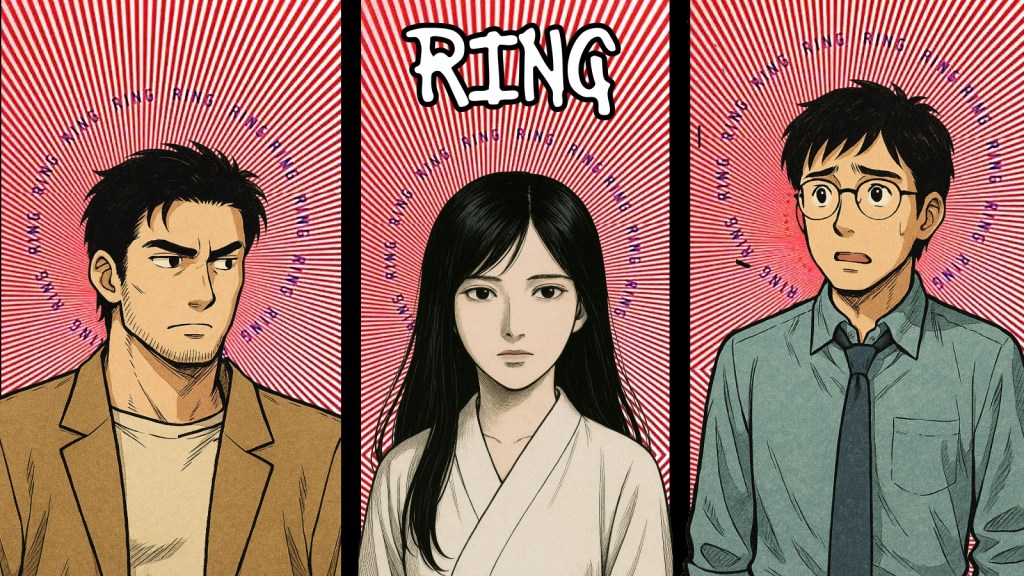
A Look at Koji Suzuki’s 1989 Novel Ring and Its Divergence from the Films
Today, I want to discuss Koji Suzuki’s 1989 novel Ring, the chilling source material for the iconic media franchise that spawned several films, television series, and even a remake in Hollywood. While the various adaptations have veered into supernatural horror, the original novel takes a markedly different approach, blending mystery-thriller elements with psychological tension. For those unfamiliar with the plot, the novel is a compelling, albeit unsettling, narrative that diverges from the spectral horror seen in the films. Suzuki, who is somewhat of a cross between Stephen King and Dr. Lipschitz (yes, the Rugrats psychologist), initially made his name in Japan as an author of child-rearing books before venturing into fiction. This gives his writing a peculiar blend of deep psychological insight with an occasional tendency toward over-explanation in the details of human behavior.
( Caution: Spoilers Ahead! )
The Introduction: Sensuous Death and the Male Gaze
The story begins with Tomoko Oishi, a Yokohama high school girl, sitting in her room, studying for an upcoming test. The room is stiflingly hot and humid, a classic setting for the oppressive atmosphere that soon sets in. Tomoko occasionally slaps her thigh; an action that feels almost self-conscious, as if it carries a deeper, unspoken significance (or because of the fly in her room). She laments that her parents have gone to Tokyo for a baseball game, leaving her behind. The almost casual sadness in her thoughts paints a picture of a typical teenager, until her death looms on the horizon.
In the subsequent moments, Tomoko leaves her bedroom to use the bathroom and get a drink. Here, the tone shifts: strange things begin to happen, and her peaceful evening transforms into a horrifying night. As the events unfold, culminating in her mysterious death, I couldn’t help but notice a certain sensuousness in the language used in the introductory sequence. It’s almost as though the male gaze of the author, Suzuki, shines through as Tomoko’s movements and the moments before her death are described with a peculiar emphasis on her physicality. This sets the stage for a pattern in the novel where female bodies are often objectified, and death is depicted as both inevitable and tragically beautiful.
The Cabbie, the Biker, and the Startling Clue
The plot takes an unexpected turn when we shift to the perspective of a jaded Tokyo cabbie, who is nearing the end of his shift. He finds himself stuck in traffic, hoping for one last passenger before the light turns green. In a twist of fate, a man on a motorcycle pulls up next to him, blocking his access to potential fares. At first, all seems normal, but suddenly, the motorcyclist falls onto the cab, spasming uncontrollably, struggling to remove his helmet.
The cabbie, more concerned about his car’s dents and scratches than the well-being of the motorcyclist, steps out to assess the damage. He makes no effort to assist the man but does make a half-hearted attempt to call an ambulance. By the time he returns, the motorcyclist is dead; yet the cabbie’s concern remains with the car. It’s an unsettling moment, highlighting the detachment of everyday life and setting up a bizarre tone of apathy in the face of tragedy.
This is where the story begins to make its first connection to Tomoko’s death. As it turns out, the motorcyclist was a high school boy, and his death occurred at roughly the same time as Tomoko’s. The eerie similarity in the deaths leads us into the central mystery of the novel.
Introducing Kazuyuki Asakawa: The Reluctant Investigator
The story then pivots to Kazuyuki Asakawa, a 30-year-old newspaper reporter, who becomes the main protagonist. We’re introduced to Asakawa in the midst of a routine taxi ride, where he happens to cross paths with the same cabbie who witnessed the biker’s strange death. Through casual conversation, Asakawa learns about the unusual nature of the motorcyclist’s death, which only deepens his intrigue. It’s here that we discover the crucial connection: Tomoko was Asakawa’s niece, the daughter of his wife’s sister. The eerie pattern of deaths starts to take shape, drawing Asakawa into a mystery that will change his life forever.
Asakawa’s Family: More Props than People
At this point, we’re introduced to Shizuka, Asakawa’s wife, and their infant daughter, Yoko. However, it’s clear that they function more as props for Asakawa to show off, rather than fully realized characters in their own right. Despite a few fleeting moments where Asakawa expresses concern for his family, he is misogynistic and treats Shizuka poorly. The novel hints at his emotional distance and lack of genuine connection with those closest to him, a stark contrast to the traditional portrayals of family in other forms of fiction. This creates an emotional disconnect, which makes his later investigation feel more self-centered than an attempt to solve a mystery for the sake of others.
Tomoko’s Room: A Place of Secrets
After Tomoko’s funeral, Asakawa travels with Shizuka and her family to her sister’s house in Yokohama. There, Asakawa takes it upon himself to snoop through Tomoko’s room, searching for any clue that might explain her strange death. It’s here that Asakawa uncovers a membership card for a mountain resort, belonging to a person named Iwai. This discovery sends him down a rabbit hole, leading him to uncover more victims, names, and connections tied to the strange deaths.
The VHS Tape: A Clue in the Curse
The next major turning point comes when Asakawa visits the South Hakone Pacific Land mountain resort, where the teens (including Tomoko) stayed shortly before their deaths. After an uneventful night at the resort, Asakawa comes across an old VHS tape that seems to be connected to the deaths. The tape itself reveals that watching it is linked to dying within seven days, unless the viewer performs a specific ritual. However, the crucial part of the tape that explains this ritual has been taped over, leaving Asakawa frustrated and at a loss for how to stop the impending doom.
Ryuji Takayama: The Oddball Philosopher
Asakawa’s journey then leads him to Ryuji Takayama, a genius & old high school friend, now an adjunct philosophy professor at a prestigious university. Ryuji is presented as a mysterious, odd figure with a strange, almost supernatural aura. While in the films, Ryuji is depicted as a psychic, in the novel, he is not. Rather, he’s an intellectual with an oddball personality; somewhat of a self-proclaimed outsider (with a little bit of edgelord mixed in). Asakawa recalls a memory of his junior high days where Ryuji (then mainly an acquaintance, at best) asks Asakawa to call his home and ask for him, in order to gauge the mother’s reaction, which was normal. Ryuji then went on to tell Asakawa a story about how, just that morning, he had raped a college girl alone in her apartment. It was after this strange school conversation that Asakawa began to idolize Ryuji and became his good friend. Not a good look, my dude.
One of the more humorous aspects of the book is Asakawa’s odd fixation on Ryuji’s short stature and muscular physique, which comes across as unintentionally (and gratuitously) homoerotic. This seemingly out-of-nowhere obsession adds a bizarre and slightly absurd undercurrent to their interactions, almost as though the author didn’t realize how over the top it comes across. It’s one of those moments where you can’t help but chuckle at the awkwardness, especially considering how seriously it’s treated in the narrative.
It’s like a perfect little Freudian slip hidden in Suzuki’s prose, which just makes it all the more charming and funny. The way Asakawa’s fixation on Ryuji’s body is portrayed gives it a strange, almost subliminal subtext that makes the interactions between them feel more awkwardly loaded than they probably should be. That unintentional humor is what makes it stand out, and it’s part of what adds some unexpected charm to the novel. Ryuji gained his muscles from being a shot put champion when in school.
Onwards to Izu-Oshima Island
Asakawa ropes in Ryuji, who, being Ryuji, insists on watching the cursed tape himself. After some additional digging (and Ryuji mapping out the video events like he’s trying to solve a crossword puzzle), they discover a name of interest: Sadako Yamamura. This leads them to pack their bags and head south for Izu-Oshima Island, departing from the port city of Atami.
Asakawa’s feelings about Ryuji are, let’s say, complicated. On one hand, he admires him almost to the point of idolatry. On the other, he frequently despairs at Ryuji’s cavalier attitude, sometimes furious at his refusal to take things seriously. (It’s very much the energy of a sitcom duo where one friend is deadly earnest and the other just shrugs and says “eh, whatever.”)
When they arrive, they check in with the island affiliate of Asakawa’s news company: Hayashi, a semi-retired gentleman who runs his “office” out of his own home with his wife. Hayashi’s main job is basically to serve as a plot Uber: he drives the pair around, introduces them to locals, and helps them get where the narrative needs them to be. After a night’s stay, he takes them to Sashikiji, on the southern tip of the island, stopping at Yamamura Manor where he’s made their reservations.
During the drive, the men press Hayashi for info on Sadako, but he admits he never knew her personally. So, he sets them up with a family contact instead: Takashi Yamamura, Sadako’s cousin. Later, Asakawa phones a journalist friend back in Tokyo, Yoshino, asking him to dig into Sadako’s background. Yoshino reluctantly agrees. This sets up a dual investigation, with Asakawa and Ryuji pursuing leads on the island while Yoshino does the legwork in the city.
At some point, Asakawa discovers that both Shizuka & Yoko had inadvertently seen the cursed tape. Asakawa becomes furious and more desperate, sending his family to stay with Shizu’s parents until he returns.
Yoshino’s Investigation
The narrative shifts to Yoshino’s POV. He tracks down the “Theater Troupe Soaring”, which could be an anime title, where Sadako once performed twenty-some years prior. There, Yoshino meets the troupe’s leader, Arima, who describes Sadako as a woman of remarkable beauty with a strange, almost off-putting demeanor. Members whisper about her uncanny aura; one even recalls seeing her psychically power an unplugged television, which, if true, is maybe the most metal party trick imaginable.
Arima suggests Yoshino track down other former troupe interns, providing a list of names for him to follow up on. Yoshino dutifully heads off to gather more testimonies, expanding the picture of Sadako as both enchanting and unnerving.
Old Gen Speaks
Meanwhile, back on Izu-Oshima, Asakawa and Ryuji regroup at Hayashi’s home. To add local flavor, Hayashi rings up Genji (“Old Gen”), a retired fisherman and childhood friend of Shizuko Yamamura (Sadako’s mother). Genji arrives ready to reminisce, especially since he harbored a lifelong crush on Shizuko.
His tale is one of the novel’s eerier episodes: he recalls rowing her out to sea one pitch-black night, after she claimed a statue of En no Ozunu (a legendary IRL mystic) had been dumped into the ocean by American soldiers earlier in the day. Shizuko insisted she could feel its presence. Once anchored, she stripped down, dove into the dark water, tied a rope around the statue, and had Genji haul it up. From that moment on, Shizuko seemed… changed. Withdrawn. Strange. And she began making eerily accurate predictions.
By 1947, Shizuko left her hometown for Tokyo, where she became involved with Dr. Heihachiro Ikuma, a researcher of psychic phenomena. Their affair resulted in the birth of Sadako, but to avoid scandal, Shizuko returned home briefly before eventually reuniting with Ikuma years later. Genji’s wistful crush ended in tragedy, as Shizuko’s life spiraled into isolation and stigma.
Yoshino’s Fax
Back in the present, a three-page fax arrives from Yoshino, filling in more gaps. Shizuko once performed her powers at a live demonstration arranged by Ikuma. The skeptics in attendance erupted in accusations of fraud, someone died and the ridicule drove Shizuko to despair. Not long after, she committed suicide by leaping into Mt. Mihara, a volcano she and her daughter had eerily predicted would erupt back on the island.
Ikuma’s reputation collapsed; he divorced his wife and retreated into the life of a mountain ascetic in hopes of gaining supernatural powers, himself, but only contracted tuberculosis. Along with the fax came a photo of Sadako, universally agreed to be hauntingly beautiful. The group speculates that Sadako likely died long ago, but a new lead emerges: the tuberculosis sanatorium once tied to her story had been sold and converted into the South Hakone Pacific Land resort. Yes, the very place Asakawa saw the tape.
Yoshino also uncovers another name: Dr. Jotaro Nagao, who once worked at that sanatorium as a young physician and now has a private practice in the port city of Atami (which is close to Izu-Oshima island).
Finding Jotaro
After a typhoon passes overnight, Asakawa and Ryuji return to Atami to seek out Dr. Nagao. They confront him at his office, where he initially assumes they’re police. Once reassured, he recounts a story that explains the horrific center of Sadako’s curse.
As a young doctor, Nagao encountered Sadako when she visited her ailing father at the sanatorium. Overcome by a violent compulsion, he lured her aside and raped her. During the assault, he noticed something that shocked him further: Sadako was intersex, with hidden male anatomy (having testicles, but otherwise female; no eggplant emoji. The book refers to her condition as Testicular Feminization Syndrome and the characters discuss her as if she were wholly male). Panicking and further unhinged, he strangled her, tossed her into a nearby well, and hurled rocks in after her to cover his crime. Finally, he covered the well and she was never discovered. Nagao claims his mind felt as if it were taken over, and we’re meant to believe that Sadako controlled him psychically, but I don’t buy it.
Asakawa and Ryuji, paragons of journalistic and academic integrity/ethics, decide not to turn him in because, hey, “it happened so long ago” (only two decades, no big deal). They thank him for his candor and walk away pleased with the information.
Finding Sadako
The pair conclude that Sadako’s body must still be at the bottom of the well beneath Cabin B4 at South Hakone Pacific Land. They break into the understructure of the cabin, find the covered well, and spend hours hauling up buckets of muddy water until they (read: Asakawa) uncover her skeletal remains.
Instead of alerting the authorities, they bag up the bones themselves, stash them in their rented cabin, and… go to sleep. (Because nothing screams healthy coping like sharing a bed with your best bro with a plastic bag of human remains nearby.) At one point, Asakawa even presses his ear against Ryuji’s chest to check if he’s still alive, in one of the book’s more unintentionally intimate moments. Asakawa figures that Ryuji had washed the bones in the bathroom sink and, rather than returning to his own rented room, just fell into Asakawa’s bed. At one point, Asakawa muses to himself that Ryuji would be “cuter” if his eyes were larger/more open and less angular. I don’t know how else to interpret that line other than he’s somewhat closeted.
The Final Acts
The next morning, the resort manager gives them a wake-up call. Both men are exhausted and Ryuji tells him that he (Asakawa) had blacked out in the well and that Ryuji had to climb down and carry him out. They part ways and say they’ll contact each other in a few days. Asakawa returns Sadako’s remains to her family on Izu-Oshima, convinced this may have lifted the curse. Ryuji heads back to Tokyo to polish the manuscript he’s about to submit. But he doesn’t escape. While working late, he catches his reflection in a mirror and sees his own face looking faintly decomposed, a grotesque hint of death that jolts him with terror. Panicked, he grabs the phone and frantically calls his girlfriend and student, Mai Takano, managing only a scream before the curse claims him.
Asakawa, horrified at the news, rushes to meet Mai. She describes Ryuji’s strange duality: childish innocence with her, polished professionalism with colleagues, and roguish “bad boy” behavior with Asakawa; which makes his old high-school confession of rape sound more like a desperate act of posturing than truth, though it remains disturbing either way. Mai also tells Asakawa that despite what people may think, he and Mai didn’t have a sexual relationship (this is shown to be false in the next book, Spiral/Rasen).
Terrified for his wife and daughter, Asakawa realizes he may have survived because he copied the tape and passed it on. The novel ends with him frantically driving to meet his family in a rental car, VCR in tow, desperate to protect them by perpetuating the curse.
TL;DR:
Koji Suzuki’s Ring (1989) is more mystery-thriller than ghost story. Journalist Kazuyuki Asakawa investigates a string of sudden deaths, discovers a cursed VHS tape, and teams up with his eccentric friend Ryuji to trace its origin to psychic prodigy Sadako Yamamura. Their search spans Tokyo taxis, a storm-swept Izu-Oshima, eerie theater memories, and finally a hidden well beneath a mountain resort. Sadako’s tragic backstory (intersex identity, psychic gifts, and murder at the hands of the rapey Dr. Nagao) fuels the curse. The men exhume her remains, but the tape’s infection isn’t so easily stopped: Ryuji dies, and Asakawa realizes survival means copying and sharing the tape, ensuring the cycle continues.
Oh, and along the way there’s a surprising (and hilariously unintentional) vein of homoerotic subtext in Asakawa’s constant admiration for Ryuji’s physique; proof that sometimes the scariest thing in a horror novel is the author’s Freudian slip. I jest; there’s nothing wrong with people liking who they like. Oh, and we also find out that Ryuji was, himself, a rapist in junior high. Upon hearing his confession all those years ago, Asakawa became Ryuji’s number one fanboy.
Book Versus Movie
How does the novel differ from the various film adaptations (I will compare mainly to the 1998 movie with Hiroyuki Sanada)?
Protagonist & Family
- Novel:
- Kazuyuki Asakawa is a male newspaper reporter, married to Shizuka with a baby daughter, Yoko.
- His wife and child are largely background characters, appearing mainly to raise the stakes.
- Film:
- Protagonist becomes Reiko Asakawa, a female TV journalist and single mother to a young son, Yoichi.
- The shift creates a more intimate mother–child dynamic and gives the story a maternal emotional core.
Tone & Genre
- Novel:
- Primarily a mystery–thriller with science-fiction elements.
- The curse is treated as a virus-like psychic infection (nensha thoughtography).
- No ghosts, no crawling out of TVs.
- Film:
- Full-on supernatural horror with an unmistakable ghost story vibe.
- Sadako becomes a vengeful yūrei (spirit) capable of emerging from screens.
The Cursed Tape
- Novel:
- VHS tape delivers a spoken message explaining that viewers will die in seven days unless they perform a ‘charm’ (ritual)—details lost because someone taped over the end.
- Infection manifests as a virus causing a throat tumor and fatal heart attack (Technically discovered at the beginning of the sequel).
- Film:
- Tape is a near-wordless montage of surreal images; no direct instructions.
- Victims die of pure fright (heart failure) after seeing Sadako’s ghostly apparition.
Sadako’s Nature & Backstory
- Novel:
- Sadako is intersex and a natural nensha psychic.
- Murdered by Dr. Nagao after he discovers her intersex body and assaults her.
- Dies slowly of starvation in the well, her psychic “virus” propagating the curse by way of supernatural bitterness and hate.
- Possible hint of a sea-spirit ancestry through her mother Shizuko’s mystical encounter.
- Film:
- Sadako is presented as a female spirit, no intersex element.
- Killed by her biological father Heihachiro Ikuma (not Nagao) during a psychic demonstration gone wrong.
- Survives for 25 years in the well only through supernatural means.
Ryuji Character
- Novel:
- Ryuji is Asakawa’s old high school friend, a genius and eccentric philosophy professor with a dark sense of humor.
- No psychic powers.
- Their relationship is laced with unintentional homoerotic undertones and playful tension.
- Film:
- Ryuji is Reiko’s aloof ex-husband, giving the story a co-parenting angle.
- Portrayed as mildly psychic, sensing supernatural presences.
Ending & Survival Mechanism
- Novel:
- Asakawa survives because he copies the tape and shows it to someone else, spreading the “virus.”
- The curse is a contagion: a memetic infection that requires duplication.
- Final scare is Ryuji seeing an image of his decomposing face in the mirror, prompting heart failure.
- Film:
- Reiko survives by copying and sharing the tape as well, but the emphasis is on the ghost’s vengeance, not a viral mechanism.
- Final scare is Sadako crawling out of the television.
Supporting Characters & Plot Beats
- Novel-Only:
- Extensive side stories: the cab driver, biker’s death, theater troupe investigations, fisherman Genji’s recollections, Yoshino’s parallel investigation, and the journalist network.
- Detailed exposition on nensha and psychic research.
- Film:
- Streamlined narrative: most side characters removed or merged.
- Focus stays tightly on Reiko, Ryuji, and the eerie atmosphere.
Themes
- Novel:
- Science vs. the supernatural; the curse as a psychic virus; blurred lines between biology and the paranormal.
- Subtext of repressed sexuality, gender ambiguity, and unintentional homoerotic tension.
- Film:
- Traditional Japanese ghost story motifs; the unstoppable force of grudge and vengeance.
- Stronger emphasis on family bonds and maternal sacrifice.
The 1998 film keeps the skeletal plot of Suzuki’s novel but transforms it into a classic kaidan (ghost tale): gender-flipping the lead, amplifying Sadako into a full yūrei, and replacing the novel’s quasi-scientific “psychic virus” with pure supernatural terror. The result is moodier, scarier, and far less info-dumpy; while the novel remains a slow-burn mystery laced with unsettling (and occasionally unintentionally homoerotic) character dynamics.
My Thoughts
As a lifelong horror fan, I have to admit I lean toward the film franchise’s supernatural chills over the novel’s blend of sci-fi and techno-thriller elements. The movies deliver the eerie, folkloric atmosphere I crave, while the book often drifts into something closer to a Michael–Crichton–style techno-mystery, complete with lengthy info-dumps and a “psychic virus” explanation that feels more laboratory than haunted well.
That said, the novel’s nuance and rich backstory are hard to ignore. Suzuki layers in details (Sadako’s complex origin, the investigative side characters, and the eerie idea of nensha (thoughtography)) that the films either streamline or drop entirely. Reading those sections is like opening up the hidden bonus disc for the franchise.
However, even allowing for the quirks of translation, the prose can stall under the weight of exposition, and the book’s treatment of women is tough to swallow. Casual sexism, flat female characters, and the disturbingly offhand handling of sexual violence all stand out. The infamous rape scene (narrated by Ryuji) is presented less as a moral catastrophe and more as a plot mechanism, which is jarring and, frankly, uncomfortable.
The later books in the series lean even further into cyberpunk territory, dabbling in AI and simulated life, so if your tastes run toward ghostly vengeance and atmospheric dread, the movies remain the better ride. But if you’re curious about the full mythos, enjoy slow-burn mysteries, or have a soft spot for Crichton-esque science fiction with a paranormal twist, the novels offer a fascinating (if occasionally frustrating) counterpoint to the iconic films.
~ End ~
 J-Horror Blog
Leave a comment