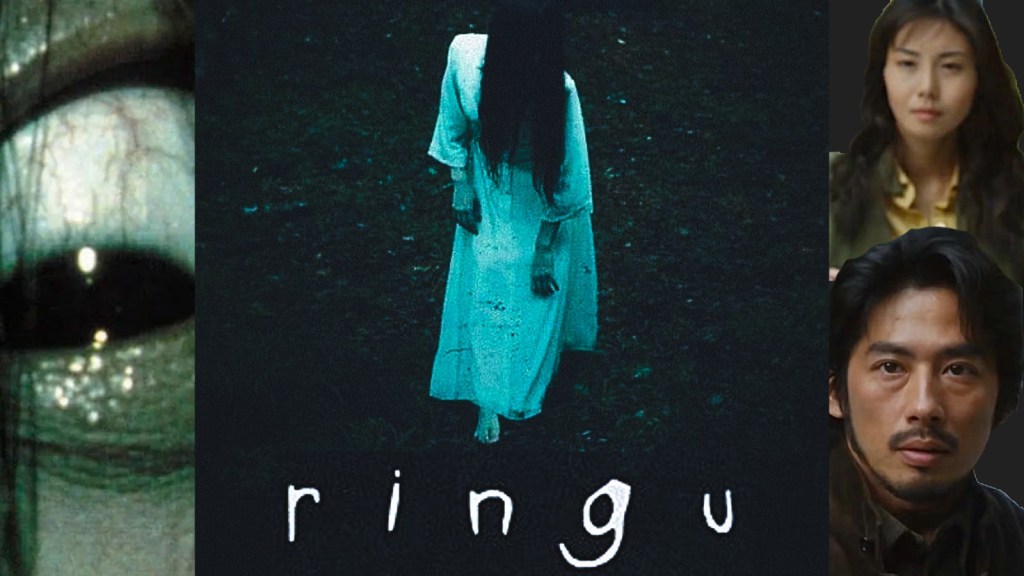
Ringu, the movie that started it all; the urtext, if you will, of J-Horror. Based on the Koji Suzuki novel of the same name, Hideo Nakata’s 1998 masterpiece didn’t just redefine horror for a generation: it created a new cinematic language of dread. Eschewing gore and cheap jump scares, Ringu roots its terror in the everyday: a cursed videotape, a ticking clock, the suffocating anxiety of urban isolation. The film’s central figure, Sadako, is more than a ghost; she’s a vessel for generational trauma, rage, and the fear of technology’s uncontrollable spread.
Nakata’s direction is icy and restrained, letting the horror creep in at the edges, growing with every haunted image and uneasy silence. There’s a melancholy beauty to the film’s muted palette and slow pace, inviting viewers to experience fear as something intimate, almost mournful. At its heart, Ringu is about stories: how we tell them, how we inherit them, and how they haunt us. It’s not just a film about a deadly curse; it’s about the way trauma is passed down, mutated, and inevitably returned. Ringu is essential J-horror; not only because it launched a thousand imitators, but because its haunting resonance has yet to be matched.
Ringu released in Japan on January 31, 1998, and was based off the 1991 Koji Suzuki novel of the same name.
(Warning: Contains Spoilers)
Sunday, September 5th, 1997
Ringu opens with a scene that is both intimately familiar and deeply unsettling: two high school girls, Tomoko (Yuko Takeuchi) and her friend Masami (Hitomi Sato), alone in Tomoko’s house, passing time by swapping ghost stories. The air in the quiet suburban home is thick with an unspoken dread, a tension heightened by the girls’ nervous laughter and the way darkness seems to press in from the edges of the screen. The urban legend they share is now infamous: a mysterious videotape, whispered about in school hallways, that brings death to any who watch it… exactly one week later.
Masami tells a variation of the tale, about a schoolboy who, while visiting family in Izu, tried to record a TV program. Because rural channels didn’t match Tokyo’s, the tape should have been blank. Instead, when he played it back, he saw a strange woman on the screen, pointing directly at him and intoning: “You saw it.” The phone immediately rang and, as the story goes, the boy was dead a week later.
Masami laughs off the story, but Tomoko’s reaction is grave. She recalls with mounting fear that she herself watched a strange tape during a trip to a cabin in Izu exactly one week ago. She presses Masami about where she heard the rumor, running through names of friends, only to be told that everyone is talking about it. When Tomoko confides that she and some friends watched the tape (Sunday, August 30th) and received a mysterious phone call immediately after, the tension ratchets up. She tries to play it off as a joke, but the unease lingers between them, right up until Tomoko laughs and admits she’s joking. They banter lightheartedly for a moment, until the phone actually rings.
For a moment, panic takes over. The girls rush to answer the phone, only to find it’s Tomoko’s mother. Their laughter is forced, the earlier comfort momentarily eroded by fear. Their relief is welcome. Masami leaves the room, and Tomoko is left alone in the kitchen. The TV clicks on by itself, static filling the screen. Tomoko, unsettled, shuts it off and returns to pouring drinks, but the sense of intrusion grows. When she finally turns around, she lets out a scream; her face twisted in terror. The image freezes, rendered in stark monochrome, and the film’s spell is cast. The curse, it seems, is already at work.
Sunday, September 12th, 1997
Days later, journalist Reiko Asakawa (Nanako Matsushima) begins her investigation into the cursed videotape rumor, accompanied by her TV crew. She interviews a trio of middle-to-high school girls, probing them for details about the infamous urban legend. The girls recount the basics (the mysterious tape, the phone call, the one-week deadline) and mention first hearing about it on a late-night TV show, possibly aired on a local Izu station. When Reiko presses for specifics, she’s met with a blur of half-remembered gossip and secondhand fear: yes, a girl supposedly died, but it was always “a friend of a friend” who knew the victim. One girl claims a couple was found dead in a parked car; news that had made the papers just days before.
Back at the newspaper office, Reiko sifts through the evidence with her colleague Takashi Yamamura (Yoichi Numata), who brings her clippings about a recent traffic accident they’d been covering. They puzzle over how such urban legends ignite after a particularly horrific or unexplained death. Reiko notes that every account she’s gathered points back to the Izu peninsula; something in that place, or those stories, seems to be at the core.
Her curiosity sharpening to concern, Reiko combs the local papers until she finds the story: a 19-year-old boy from Tokyo and a 17-year-old girl from Yokohama discovered dead in a parked car on the morning of September 6th. As she pores over the article, a male colleague (AD Okazaki, played by Yurei Yanagi) notices her distraction and offers to help, agreeing to track down which high school the deceased couple attended. The sense of dread builds, not with sudden scares but through the slow accretion of facts, rumors, and the subtle suggestion that something truly uncanny is at work. A brief time later, Reiko returns to her Tokyo apartment, the weight of the mystery, and her growing fear for her own family, beginning to settle in.
At home, Reiko is greeted by her young son, Yoichi (Rikiya Otaka), already neatly dressed in a small suit. He shyly tells her that he’s set out her own clothes as well; both of them are preparing for a wake or funeral. The air is heavy, their morning routine subdued by the presence of grief. Yoichi, innocent but perceptive, looks up at his mother and asks, “Why did (his cousin, Reiko’s niece) Tomo-chan die?”
Reiko hesitates, caught between a journalist’s instinct for facts and a mother’s desire to shield her child. She struggles for words, knowing there are no easy answers. The question lingers, echoing not just the sorrow of personal loss, but the growing sense of dread that something far stranger and more malignant may be at work. The tragedy that once seemed distant, just another story to report, has now intruded into her own life, and the curse’s shadow falls a little closer to home. “Some strange disease,” she tells Yoichi quietly, her voice trembling as she tries to shield him. “But don’t talk about it at Aunt Yoshiki’s, okay?” It’s clear from his silence and wide eyes that Yoichi and Tomoko were close; the loss hangs over him, confusing and unresolved.
They arrive at the Yokohama home of Reiko’s older sister, Yoshiki (Kiriko Shimizu), where relatives and friends have gathered in an atmosphere thick with mourning and unease. Yoichi sits among older male family members, small and lost in the crowd, while Reiko is told her sister is lying down, shattered by grief. In the kitchen, Reiko joins the women of the family. One, lowering her voice, asks if Reiko’s work as a journalist has helped her find answers about Tomoko’s sudden death. Reiko can only repeat the official line: the autopsy was inconclusive, no evidence of wrongdoing. But the women are unsatisfied. “People don’t just die like that,” one whispers, her unease mirrored in the other’s eyes. “They won’t let us see Tomoko; it’s a closed-casket funeral.” The sense of something unnatural, something withheld, pulses beneath the surface of their grief.
Meanwhile, Yoichi slips quietly upstairs, drawn to Tomoko’s darkened room. He lingers momentarily in the doorway, unwilling to turn on the light, as if sensing the space is not quite empty. His mother finds him moments later and gently reminds him not to wander in alone; Tomoko’s room, like her death, is now forbidden territory.
As Reiko shepherds Yoichi back downstairs, her phone rings; Okazaki calling with news: he’s tracked down the high school from the earlier article. “Seikei Academy, in Yokohama.” The connection is confirmed by the memorial sign at the house’s entrance: “In loving memory, Seikei Academy.” What began as urban legend is now inextricably tied to her own family, and the curse inches closer with every clue.
Outside, standing before the simple white memorial, Reiko scans the small crowd of mourners and spots a group of Tomoko’s high school friends, their faces drawn and solemn. She approaches quietly and asks if they were close to Tomoko. The girls, barely looking up, nod and exchange nervous glances. One murmurs, almost under her breath, “They all died on the same day.”
Reiko, suddenly alert, presses for clarity. “Who died?”
“Yoko and Tomoko. And Iwata, too… he crashed his motorbike,” the first girl whispers. “They all saw the video.”
A chill runs through Reiko as she tries to keep her voice steady. “What video?”
The girl hesitates, then says, “Yoko told us: they watched this weird videotape together. When it ended, the phone rang, just like in the stories.”
“Tomoko saw it too? Where?” Reiko asks, her unease deepening.
“They all went and stayed somewhere.” the girl says. Another adds, “The girl who was with Tomoko when she died… she lost it. She’s in the hospital now.”
“She won’t even go near a TV anymore,” a third girl adds, her voice shaking.
Reiko is left standing in the moonlight, unsettled, the pieces of the legend and her own loss starting to fit together with terrifying precision. The curse isn’t just a story; it’s a pattern, repeating itself, drawing closer to everyone it touches.
Monday, September 13th, 1997
Back at the newspaper office days later, Reiko pores over police footage with her colleague Yoshino (Yutaka Matsushige). On the grainy screen, investigators discover the bodies of the couple found dead in their car. Yoshino quietly supplies the details: the girl was Yoko Tsuji (Maki Ikeda), just seventeen, in her final year at Seikei Academy; the boy, Tadahiko Nomi (Takashi Takayama), nineteen, was preparing for college entrance exams. The car doors were locked from the inside.
As the camera lingers on the scene, a chilling image appears: Tadahiko’s face, contorted and frozen in abject terror, eyes wide as if he died mid-scream. Yoshino then mentions that their hearts simply stopped: “They had just started snogging and then… died.” But the forced levity only highlights the unnaturalness of the deaths. Reiko studies the footage in silence, the gravity of the curse settling heavier than ever. The legend, once dismissed as gossip, now has a body count… and a face.
Reiko then visits her grieving sister Yoshimi, this time alone. The house is subdued, full of daylight but strangely dim: the heaviness of Tomoko’s absence is everywhere. Yoshimi is withdrawn, traumatized by her daughter’s sudden, inexplicable death. A somber silence hangs between the sisters until Yoshimi quietly remarks, “Yo-chan was at the funeral. He used to go upstairs and play in Tomoko’s room.” “Yes, he did,” Reiko replies, a bittersweet smile flickering across her face.
After a moment, Reiko slips upstairs to Tomoko’s room. The space is bathed in soft, natural light, dust motes drifting through the air. As Reiko quietly explores, her eyes fall on Tomoko’s desk, where a slip of paper stirs in the breeze from an open window. It’s a receipt for a photo shop; one small clue among many. Reiko turns to find Yoshimi standing in the doorway, her gaze fixed on the closed closet. “I found Tomoko dead here,” she says, voice trembling. The film flashes back: Yoshimi opening the closet door to discover Tomoko’s corpse, her face frozen mid-scream in a rictus of terror, as if she’d died trying to hide from something unspeakable. Back in the present, Yoshimi collapses to her knees in grief, her sobs filling the silence. Reiko stands with her, bearing witness to her sister’s pain.
Later, Reiko is seen walking out of the photo shop, a packet of developed photos in hand. She flips through the images: Tomoko and her friends on their trip to “Izu Pacific Island,” laughing, smiling, full of life. But as she nears the end of the roll, her breath catches: in several group photos, the teenagers’ faces are eerily blurred, warped as if smudged by some invisible force. Disturbed but grateful for the clue, Reiko notes the “Izu Pacific Island” sign in the background, pinpointing her next lead.
Back home, Yoichi, already dressed for school, quietly watches his mother cook. Reiko tells him she may be late coming home and that he should microwave his dinner. Before he leaves, Yoichi blurts out: “Tomoko watched the cursed tape.” Shocked, Reiko kneels beside him and warns him not to mention such things at school. Yoichi nods solemnly and heads out, leaving Reiko unsettled and determined.
Soon, she is driving through the countryside, bound for Izu Pacific Island (a campground). She methodically explores the site, using Tomoko’s photos to identify the specific cabin, B4, where the group had stayed. Inside, the cabin is warm and inviting, a far cry from the horror that might’ve unfolded there. She notices a TV and VCR in the den but thinks nothing of it at first. Taking a moment to rest, she flips through Tomoko’s notebook, smiling at her niece’s whimsical doodles and jokes, until the encroaching darkness reminds her of her true purpose.
As night begins to fall, Reiko eats alone outside at the camp restaurant, the sounds of people playing tennis in the background a jarring contrast to her unease. She then heads to the main office, photo in hand, and asks the clerk about the teenagers who stayed on August 29th. He studies the image and checks his records. Reiko’s attention is caught by a shelf of VHS tapes, one unlabeled and in a plain sleeve, slouching on the bottom row. “Someone must’ve left it,” the man shrugs.
Back in the cabin, Reiko’s curiosity gets the better of her. She slides the mysterious tape into the VCR and sits back to watch. What she sees is a collage of bizarre, unsettling images: a swirling ring of clouds, a woman brushing her hair in a mirror, cryptic kanji for “eruption,” a man pointing to the sea. The video is brief but deeply disturbing, a fever dream of disconnected terror.
As soon as the tape ends, the phone rings… just as in the urban legend. Reiko, now deeply unnerved, answers, only to hear silence on the other end. She hangs up, glancing at the clock: 7:08 pm. “One week…” she whispers, dread mounting. Hastily, she gathers her things and the tape, leaving the cabin as quickly as she can, the curse now tangibly close.
Tuesday, September 14th, 1997
A steady rain falls as Yoichi makes his way to school, small and solitary beneath his umbrella. Ahead of him, a man—his estranged father, Ryuji (Hiroyuki Sanada)—stands under his own umbrella. There’s a silent, awkward moment as the two pass each other without acknowledgment, Yoichi’s eyes averted. Ryuji watches him go, then continues on, arriving at Reiko’s apartment. Before he can ring the doorbell, Reiko opens the door, as if expecting him.
Ryuji steps inside and shrugs off his jacket. “So, Yoichi’s in school,” he remarks, trying for casualness. “Year one,” Reiko answers. The conversation is stilted, edged with the discomfort of former lovers. He mentions he’s still teaching at the university; she offers tea and they settle in; the gulf between them as palpable as the silence in the rain-drenched city outside.
Ryuji cuts to the chase: “So, you got a phone call?” Reiko nods gravely. “I’ll get a phone call after I watch it, then?” he quips, a scientist’s skepticism lacing his tone. Reiko, deadly serious, tells him four people have died and all on the same day. Ryuji scoffs, suggesting she should try a shrine or get an exorcism, but there’s an undercurrent of unease.
Reiko hands him a Polaroid camera and asks him to take her picture. When the photo develops, her face appears grotesquely distorted, just like the teens’ photos. The sight shakes her. Without further prompting, Ryuji turns on the television and cues up the cursed tape. Reiko, unable to bear witnessing it again, steps out onto the veranda, the sound of rain masking her rising panic.
Inside, Ryuji watches the tape, curiosity and disbelief coloring his face. When it’s over, he calls Reiko back inside. Together, they wait for the telltale phone call. But the apartment remains eerily silent. Ryuji smirks, half-relieved, half-disbelieving: “No phone call.”
He tells Reiko to make him a copy of the tape for him to analyze, reasoning, “It’s not certain death yet. It’s a tape. Somebody must’ve made it.” Determined, Reiko vows to dig deeper: she’ll check the campground’s guest logs for who stayed in Cabin B4 before Tomoko’s group and investigate any pirate TV broadcasts that might have bled onto the tape. The investigation has become personal, and the sense of danger more immediate than ever.
Wednesday, September 15th, 1997
The following day, Reiko returns to the newsroom, pushing herself to the limits of exhaustion and fear. Okazaki is standing at a desk, sorting through faxes, when he finds what she’s been waiting for: papers from the Izu bureau, paperclipped and the top corner. Reiko, hunched over the newsroom’s bulky video analysis machine, has spent hours studying the tape, searching for hidden details. She’s transfixed by the image of the well; grainy, ambiguous, but pulling at her intuition. Okazaki enters, hands her the documents. She thanks him, her mind already racing ahead to the next lead she must chase herself.
Outside, in a quiet park washed clean by last night’s rain, Ryuji sits on a bench, notebook in his lap, the world shrunk to the scribble of pen on paper. From his perspective, a pair of legs approaches: white skirt, stockings, shoes with dirt staining the tips. He doesn’t look up. A woman’s voice, echoing as if from a dream or memory, asks, “Was it you? Did you do this?” Ryuji remains silent, gaze averted, and the woman’s legs walk away. He finally looks up, unsettled by the uncanny encounter.
Later, Reiko waits for Ryuji on the steps of his apartment building, sheltering under the eaves. He arrives by bike, looking surprised and a little weary. She asks if he’s alright, sensing a disturbance he won’t explain. “Nothing,” he says abruptly, ushering her inside with his bicycle. Once upstairs, they settle in and compare notes. Reiko reports that none of the previous guests at Cabin B4 seem capable of making the cursed tape; all ordinary people, nothing unusual and none brought a tape with them to the cabin. She also checked for pirate TV broadcasts in Izu, but nothing on record.
She hands him both her research and the tape’s copy. Ryuji loads the tape into his player, and together they scrutinize it in slow motion. The screen flickers with the familiar image of a woman brushing her hair in a mirror. “Asakawa, have you ever seen this woman before?” he asks. Reiko shakes her head. The image blurs, distorts, the woman disappears; the camera’s angle flips, and for a split second a long-haired girl in white, face shrouded, appears in the mirror. Then the vision snaps back to the original shot, as if nothing had happened. Both are unnerved. The woman can be seen looking to her right, to where the girl in the flipped mirror had been standing.
Reiko rewinds to examine the shot. “It’s strange,” she points out, “from this angle, the cameraman (or the camera) should be reflected in the mirror. Unless it’s a trick, maybe some special effect, but…” The tape then cuts to the antique paper, kanji crawling across it. “What ‘eruption’ does it mean?” she wonders aloud. Ryuji squints, unable to read it clearly on a regular TV.
Just then, a knock at the door. Ryuji’s university student, Mai Takano (Miki Nakatani), enters, balancing groceries and wearing a familiar air. She greets Reiko, whom Ryuji introduces as his ex-wife, then reminds Ryuji about an overdue essay. He asks her to request a week’s extension from the publisher, but she insists he handle it himself. Their casual back-and-forth reveals a certain intimacy: Mai is no stranger to Ryuji’s apartment. After they leave, Mai playfully alters a character on Ryuji’s chalkboard, a touch of lightness in the gloom.
Reiko and Ryuji head to the newsroom, where she demonstrates the tape’s monochrome images on a specialized machine, hoping for clarity. Together, they analyze the kanji and find an image of people crawling in agony along a beach, followed by a figure pointing toward the sea, his head obscured with a cloth or towel. Another shot reveals a close-up of an eye, the kanji for “Sada” (“pure, chaste”) etched inside. Ryuji notes the late hour, checks his watch, and asks if Yoichi is safe alone. Reiko assures him their son is used to it.
Trying to ease the tension, Ryuji muses, “Whoever made this tape, they left a mark; almost like they want someone to stop them.” Weariness pulls at both of them, but as Ryuji freezes a frame on the screen, he recites a strange phrase heard on the audio: “Frolic in brine, goblins be thine.” Reiko asks its meaning, but Ryuji promises to investigate tomorrow. The riddle of the tape, its cryptic horror, and their dwindling days hang in the air as the screen fades to black.
Thursday, September 16th, 1997
The morning sun shines as Yoichi heads off to school, his small figure dwarfed by the city around him. Life seems, at a glance, almost normal: routine and orderly. But inside Reiko’s apartment, the tension remains. She sits in her living room, eyes fixed on the TV screen as a newscast airs the interview she conducted days earlier with the group of middle-to-high-school girls about the cursed tape legend. Their anxious faces and whispered rumors now play back for the whole city to see, transforming private dread into public folklore.
Later, Reiko is on the phone with Ryuji, sharing the results of their ongoing investigation. Ryuji’s voice, precise and clinical, comes through the line: “That saying is from Oshima Island. There’s a volcano there, Mt. Mihara.” The call cuts to the next phase of their research, where Reiko and Ryuji sit side-by-side at a library table, surrounded by a fortress of books and yellowed newspapers. They comb through records, seeking anything that might link the cryptic phrases from the tape to real-world tragedies.
Reiko, her brow furrowed with exhaustion, steps away to call Yoichi on her flip phone. Her voice is soft, apologetic; she asks if he’s alright being alone, reassures him she’ll be late again tonight, and apologizes for not being around. The distance between mother and son seems to grow wider with each day consumed by the curse.
Returning to their shared desk, Reiko glances down and spots an old newspaper article headlined “Mt. Mihara Erupts.” Ryuji leans over her shoulder, remarking, “It was a long time ago,” but the detail lingers in their minds. Frustrated and increasingly agitated, Ryuji gathers his books and stands. He asks if she has a bureau or correspondent in Oshima. “Yes,” she answers, “a correspondent.”
“Get me the number. Tonight.”
“What for?”
Ryuji’s reply is gentle, but heavy with finality: “You only have four days left. I’ll deal with your correspondent. You should be with Yoichi.” The gravity of his words lands hard. Reiko is left alone in the library, haunted by the ever-ticking clock and the impossible responsibility of saving herself… and her son.
Friday, September 17th, 1997
The morning sun shines on the peaceful countryside as Reiko and Yoichi arrive at her father’s house. Her father, Koichi Asakawa (Katsumi Muramatsu), is clearly delighted to see his grandson, and the mood, at least for now, feels like a reprieve from the mounting dread. Yoichi, animated with anticipation, is thrilled to go fishing with his grandpa. The three of them head down to a shallow stream, donning wading boots. Yoichi chases after the small fish with a net, while his grandfather good-naturedly attempts to catch them with his bare hands. Laughter echoes across the water when Yoichi declares that his grandpa is “not very good at this,” and the elder man only laughs in return. For a moment, the film lingers on this snapshot of familial joy: simple, wholesome, precious.
That night, Yoichi, now in his pajamas, falls asleep in front of the television. Reiko gently picks him up, carrying him to bed and tucking him in on a futon mat. It’s a rare moment of maternal tenderness; one the curse threatens to steal from her. Later, she steps aside to make a phone call to Ryuji, who updates her on his investigation. He’s spoken with her correspondent on Oshima and believes he’s identified the woman in the mirror: Shizuko Yamamura, who predicted the eruption of Mt. Mihara forty years ago, then threw herself into the volcano. “What do we do now?” Reiko asks, voice taut with urgency. “Go down there (Oshima),” Ryuji instructs. “I’ll go tomorrow.” The reality of the ticking clock slams into her. “But I only have three days left!” she protests. “I know… and I have four. I’ll call you again.” The phone call ends, leaving Reiko isolated, the threat closing in.
Her father approaches, sensing her distress. “Is something wrong?” he asks, gently. “No… just some work,” she replies, masking the terror beneath a calm exterior. Later, in the darkness, Reiko lies asleep on her futon. A child’s voice calls out: “Auntie…” She stirs, groggy, and peers across the room to see a shadowy form lying on the adjacent mat, its arm extended, pointing toward the wall. Assuming it’s Yoichi muttering in his sleep, she reaches over to wake him, only to realize the mat is empty.
A bolt of dread hits her. She throws open the sliding door and sees Yoichi, awake in the next room, watching the cursed videotape on the VCR. “No!” she screams, rushing over to cover his eyes and snatch the tape from the machine. Shaking him, desperate, she demands to know why. “Why did you watch that? You brought it, didn’t you? Why did you bring it?” Yoichi answers in a flat, haunted tone: “Tomo-chan… Tomo-chan told me to.”
Reiko’s horror and heartbreak are complete: the curse has taken root in her son. The line between victim and bystander has been erased.
Saturday, September 18th, 1997
Dawn breaks cold and gray as Reiko and Ryuji stand together on the deck of a ferry, its Norwegian flag fluttering in the wind, en route to Oshima. The waves below are restless, slate-colored, mirroring the tension between the pair. They speak quietly, voices nearly drowned by the sea breeze. Ryuji confides that he sensed something uncanny in Reiko’s apartment days ago. He thought it was just the tape’s influence. However, Reiko asks him if it was Tomo-chan. “She’s not Tomoko anymore,” Ryuji reflects sadly. Reiko wonders aloud if Yoichi has inherited his father’s second sight. Ryuji’s silence, punctuated by a small nod, confirms her fear.
The weight of guilt settles on Reiko. “It’s all my fault, then, isn’t it? It should’ve ended with Tomoko and the others.” Ryuji doesn’t offer comfort. “I wonder… Who did the story start with?” she thinks aloud. Ryuji says that stories like this don’t start with a single person. They begin as ripples of anxiety and rumor, sometimes even willed into being by those who fear or desire the supernatural. He moves away, leaving Reiko alone with her worries and the vast, indifferent sea.
Upon landing, the couple is met by Mr. Hayatsu (Hiroyuki Tanabe), Reiko’s reserved, polite, local correspondent who guides them to his van. As they drive through Oshima’s rugged rural landscape, Hayatsu shares fragments of local history: the Yamamura family once controlled prosperous fishing fleets, but their fortunes faded. Shizuko’s cousin still lives on the island, running an inn with his children: the very place where Reiko and Ryuji will spend the night.
Reiko’s questions about Shizuko’s suicide hang in the air. Ryuji provides context: after Shizuko predicted the eruption, she became a sensation, hailed as a seer. But her fame attracted Professor Heihachiro Ikuma (portrayed by Miwako Kaji in flashbacks/photos), a parapsychologist with his own agenda. Ikuma took Shizuko to Tokyo for ESP experiments, which quickly became a media circus. When one of the experiments led to a death, Ikuma was disgraced, fired from his university and vanished. Ryuji doubts he’s still alive, but the past feels suddenly close. Reiko wonders about the rumored daughter; Ryuji notes the old rumors, but nothing confirmed.
At the inn, the mood grows more oppressive. The mirror in their room matches the one from the cursed video; an uncanny reminder that the boundary between their investigation and the supernatural has dissolved. Wandering the hall, Reiko chases after an elderly Yamamura man (Yoichi Numata), the inn owner’s father, desperate for answers. Almost-tearfully, he insists he has nothing to say about Shizuko, and grows angry when pressed about her daughter, refusing to acknowledge her existence.
Back in their room, the emotional toll is heavy. Reiko hugs her knees, sobbing softly, overwhelmed by fear, guilt and hopelessness. Ryuji, exhausted and hungry, tries to distract himself with the meal laid out before them. Their conversation turns dark: Reiko pleads with Ryuji to be with her when she dies, to save Yoichi with whatever knowledge he gains. Ryuji’s frustration explodes: he lashes out about their broken family and the madness that seems to haunt all touched by his psychic power. The argument ends with Reiko in tears, the weight of their doomed fate almost unbearable.
There’s a knock at the door. An older woman (Kazue Yamamura, portrayed by Miwako Kaji), the inn’s housekeeper, steps in; her arrival a reminder that the secrets of Oshima are held tightly by its oldest residents. The sense of folklore, isolation, and encroaching supernatural danger is palpable. Two days remain.
She enters the room holding a black-and-white photograph. “You were asking before about Shizuko,” she says softly, offering the image to Ryuji. He rises from the table; curiosity mixed with gentle respect in his demeanor. The photo shows a young Shizuko Yamamura alongside her husband: a frozen memory from a lifetime ago, before scandal and tragedy unraveled their world. Reiko joins him, gazing at the faded image. “Is that Dr. Ikuma?” Ryuji asks quietly, recognizing the man standing beside Shizuko. Kazue nods, confirming it was taken before she (Kazue) ever came to the inn; before everything went wrong.
She excuses herself, leaving the pair alone with the evidence of a lost era. For a long moment, Reiko and Ryuji study the photograph, its ghosts as palpable as the island’s autumn mist. As he looks into Shizuko’s distant eyes, Ryuji feels a chill; almost as if the old saying, “Frolic in brine, goblins be thine,” is whispering through the paper, carried on the weight of family secrets and unhealed wounds.
The boundaries between past and present blur for both of them. Whatever they’re seeking, whatever curse they hope to break, its roots are deeper and more entangled than either could have imagined.
Sunday, September 19th, 1997
The dawn breaks gray and uneasy over Oshima. Reiko and Ryuji wander down to the beach, the sea churning restlessly beneath a bruised sky. The old man from the inn, silent and brooding, sits gazing out into the ocean, lost in thoughts that belong to another time. Ryuji approaches, gently prying for details about Shizuko. This time, something in the old man’s defenses cracks. He mutters that Shizuko was always a strange woman, one who spent her days staring into the endless sea; a sea, he notes with dark fatalism, “that takes a few of us every year.” Ryuji tests the waters further, reciting the old Oshima saying: “Frolic in brine, goblins be thine.” The old man stiffens, as if the words themselves have power.
Ryuji leans in, suggesting that Shizuko could read minds. The old man’s discomfort grows, but Ryuji presses: “life is hard for those who know what others wish hidden.” Flustered, the old man scrambles to his feet, insisting they leave. But when Ryuji grasps his arm, intending to gently stop him, both are seized by a powerful psychic vision, time and memory blending into a single monochrome nightmare.
Reiko, observing the two frozen men, is suddenly swept up in the vision as well. The world dissolves and she finds herself in an auditorium full of onlookers, reliving the infamous ESP demonstration in monochrome: journalists murmuring, skeptics smirking, Shizuko nervously enduring the test. When she correctly guesses the hidden cards, the room erupts, accusations flying: Dr. Ikuma is a fraud, it’s all a sham. In the chaos, a journalist collapses and dies on the spot, his face twisted in terror; the exact same expression worn by Tomoko and the other victims of the curse. The crowd turns on Shizuko, branding her a monster.
As the doctor and Shizuko leave the stage in disgrace, a girl (Sadako, her daughter) waits behind the curtain. It’s implied, chillingly, that it was Sadako, not her mother, who willed the man to die. “Sadako,” Ryuji mutters, “could she really kill someone with her mind?” The old man spits, “She was a monster.”
The vision continues: Dr. Ikuma and Shizuko, frantic, call for Sadako as she flees. In the dream-space, Reiko finds herself face to face with Sadako; her hand grasping around Reiko’s wrist, nails missing, her presence cold and uncanny. Suddenly, the trance breaks. Ryuji and the old man return to themselves, breathless and shaken. Reiko is still in the grip of the vision, swaying on her feet until she collapses, Ryuji just managing to catch her. On her wrist, the ghostly marks from Sadako’s grip linger; a sign that the curse, or Sadako herself, has chosen her.
Later, inside, Reiko is on the phone, piecing together the Yamamura family’s fate. Shizuko threw herself into the volcano after the scandal; Dr. Ikuma vanished, taking Sadako with him. Now, neither are accounted for; lost to time and rumor, but perhaps not gone.
Ryuji doubts either Ikuma or Sadako are still alive but suggests Sadako’s psychic power was even greater than her mother’s: she could kill with a thought. “That tape isn’t of this world,” he says. “It’s Sadako’s rage.”
A knock at the door brings Hayatsu, warning that the ferries have all been canceled due to an incoming typhoon. Ryuji, desperate, asks after a fishing vessel. Hayatsu tries to talk sense into him, but Ryuji, now at the edge of panic, storms out to find passage off the island himself. The storm whips into fury, the world closing in with howling wind and rain.
Reiko, left alone in her room, receives another call: neither Dr. Ikuma nor Sadako can be found. Despairing, she sobs Yoichi’s name; her sense of helplessness becoming overwhelming. Outside, searching for Ryuji, she finds him at the docks with Hayatsu, wrestling with their predicament. Reiko has a flash of insight: the phone only rang at the cabin, not at her house. Is there a clue there? What does it mean for Ryuji and Yoichi?
Ryuji is still intent on leaving, but Hayatsu insists it’s suicide in this weather. Then, a quiet voice from behind: “I’ll take you. Sadako’s calling you, isn’t she? Maybe Sadako wants me to drown.” It’s the old man, offering his battered tugboat for their journey.
And so, in the dead of night, as the typhoon rages, Ryuji and Reiko board the boat. The storm outside is mirrored by the storm within, and for a moment, as they huddle together against the cold and uncertainty, there’s a fragile, human closeness; one last gesture of tenderness before the final confrontation with Sadako’s wrath.
Monday, September 20th, 1997
The typhoon has passed. Morning light glances cold and pale across the surface of the water as the battered tugboat nears shore. On deck, Ryuji quietly approaches the old man, who, it is now revealed, is none other than Dr. Ikuma himself, Sadako’s father, once disgraced and now living in obscurity on Oshima under an assumed name: Yamamura. The weight of secrets hangs heavy between them. Ryuji comments, almost bitterly, “I guess Sadako doesn’t hate you.” Ikuma, lost in his own haunted recollections, recalls how Shizuko, Sadako’s mother, would wander the beach, murmuring softly to invisible companions in a language that “wasn’t human language.” The boundaries between the human and the inhuman have always been thin in this story, the supernatural pressed up against the everyday.
Once on land, the tension sharpens. Ryuji stocks up on equipment at a local hardware store (ropes, shovels, buckets) while Reiko makes a strained call to Yoichi, reassuring her son that she’ll return as soon as she can. There’s guilt in her voice, the fear of what she’s drawn him into. Then, with grim resolve, Ryuji and Reiko drive back to the Izu Pacific Island campground, the place where this entire nightmare began for Tomoko and her friends.
Arriving at Cabin B4, the couple move with purpose, but anxiety shows on their faces. “Here it is,” Ryuji says, as if naming the source of the curse might rob it of some of its power. They carry their equipment to the side of the cabin, then crawl beneath its raised floor to the shadows below. There, hidden in the gloom and long forgotten, they find a sealed stone lid. Together, with mounting dread, they heave it aside.
As the lid scrapes away, a psychic vision slams into them: a monochrome memory of Sadako, serene at the edge of the well. Dr. Ikuma rushes over, cold and desperate, striking her down with a rock and shoving her broken body into the blackness. As Sadako tumbles into the darkness, the horror becomes physical: both Reiko and Ryuji recoil at the memory, shocked that a father could commit such an act. “He put the lid on,” Ryuji says. “She’s still down there.” The boundary between past and present, crime and curse, is thinner than ever.
Shaken but determined, Ryuji fashions a harness and lowers himself into the well. The air is damp, the darkness absolute. As he descends, his flashlight beam flickers over the stone walls, revealing claw marks (long, desperate gouges) etching a record of Sadako’s final, hopeless struggle for escape. “She was still alive,” he murmurs, grief and horror blending in his voice.
At the bottom, waist-deep in stagnant water, Ryuji starts the tedious task of emptying the well, filling buckets for Reiko to haul up. The hours grind by. Light fades, sweat and exhaustion mounting. When Reiko’s strength wanes, they switch places, Ryuji lowering her into the black, claustrophobic depths. There, groping through muck and darkness, her hand closes on a clump of hair, then the remnants of a skull. Sadako’s skeleton, twisted and incomplete, rises from the water into Reiko’s arms: childlike, almost pitiful. For a moment, it’s as though Reiko is cradling her own child, sharing in the lost girl’s final misery and loneliness.
Above, Ryuji calls to her, urgency in his voice. Reiko, trembling, is pulled up. By the time police arrive and extract the body, the pair are spent, wrapped in towels, the ordeal etched into their faces. There’s a sense that the curse has finally been acknowledged, the wound uncovered at last.
Outside the well, beneath a dark sky, Ryuji turns to Reiko. “It’s over. I’ll take you home.” At her apartment, the two share a rare, quiet moment of warmth and human connection; the ordeal has, for a time, brought them back together. Ryuji encourages Reiko to rest, then gently reminds her of his deadline, as if mundane responsibilities might finally reassert themselves in a world made sane once more.
But for both of them, and for Yoichi, there is still a shadow. As night falls, we sense the curse’s true endgame is yet to play out.
Tuesday, September 21st, 1997
Night ends and dawn breaks quietly; for a fleeting moment, the curse seems broken. Ryuji is either up early or has been up all night, a rare calm about him as he writes his essay for publication; something normal at last. As he sips his tea, he notices a small act of mischief: the chalkboard in his apartment still bears the character Mai Takano altered days earlier. He laughs softly to himself, a flash of warmth and tenderness, calling Mai an “idiot” with affection before restoring his mathematical world to order. It’s the last moment of peace he will ever know.
Elsewhere, Reiko opens her curtains, taking in the pale daylight as if daring the world to confirm she’s survived. She’s apprehensive, changed, her mind churning over the nightmare that claimed so many lives except, it seems, her own.
Back in Ryuji’s apartment, the ordinary morning is shattered as the TV flickers on by itself. Bewildered, Ryuji watches as the cursed tape unspools the familiar nightmare: the well, now with a crawling Sadako, the boundary between screen and reality dissolving. Fear claws at him as Sadako claws her way up from the darkness, out of the well and toward the glass. “Why?” he breathes, realization dawning too late: he’s missed something, failed some crucial step. As the phone rings, he grabs the receiver, knowing instinctively it’s Reiko, but words fail him. Sadako’s ghostly form clambers from the television and into the world, her movements alien, her nails torn away from her fingers. Ryuji collapses, the phone still in his hand, as Sadako’s single monstrous eye gazes into his soul. In an instant, terror claims him; Ryuji dies as the others did, his face contorted in a rictus of horror.
Reiko races to his apartment, frantic, but the police are already there. An officer blocks her way with bureaucratic calm: “The body’s already been removed, ma’am.” “I’m Ryuji Takayama’s wife!” she protests, desperate, but there’s nothing left to do but mourn. Upstairs, Mai Takano is a broken figure, shellshocked and silent, slumped against the wall. When Reiko shakes her, Mai can only stammer that she found him this way, already gone, his face twisted in fear.
Reiko moves numbly through the apartment, consumed by grief and guilt. “What did I do that you didn’t?” she asks the emptiness, searching for an answer. Sitting alone, she stares at the reflection in the black TV screen; except there are two reflections: her own, and Ryuji’s, standing behind her, his head covered with a towel, pointing mutely toward his red bag. “Ryuji?” she gasps, hope and terror mixing in her voice. She spins around but finds only emptiness. Driven by a new understanding, she rummages through the bag and discovers two VHS tapes: one marked “copy.” The realization strikes her like a blow. She had survived not because she broke the curse by rescuing Sadako’s body, but because she made a copy and showed it to someone else: passing the curse on.
Wednesday, September 22nd, 1997
Desperation hardens into resolve. Yoichi doesn’t have many days left. There’s only one way to save him: she must find someone to watch the tape, to bear the curse in his place. We see her driving through the countryside, the tape and VCR beside her, a voiceover conversation with her father hinting at her plan; Yoichi sits in the back seat. Reiko’s face is grim, changed; she knows what she must do, and it’s as monstrous as the curse itself.
The final image is a distant, lonely car winding through forested roads, a dark cloud curling overhead. There’s no victory, only the perpetuation of a horror that cannot be stopped; only spread. The screen fades to monochrome, the nightmare unresolved.
Symbolism, Analogues & Themes
A cornerstone of modern J-horror and a cultural phenomenon that reached far beyond Japan’s borders, Ringu redefined what horror could be in the digital age: intimate, melancholic, and quietly relentless.
More than two decades later, Ringu still feels eerily current. Its silence speaks louder than screams. Its ghost doesn’t chase; it waits. Its fear is not in blood, but in inevitability. This analysis will explore Ringu in four parts: its Symbolism, its Analogues and cultural roots, its deeper themes, and finally, my verdict on why it remains essential not just as horror, but as cinema with soul.
Symbolism:
The Ring Itself: sound, shape, cycle
The title’s master image works on multiple registers at once. First, the ring as sound (the phone that tolls after viewing) functions like a death knell, a mechanical memento mori. It’s not a voice; it’s an indifferent signal. Second, the ring as shape: the circular lid of the well, the circle of light seen from its floor compresses womb, tomb, and lens into one chilling aperture. Third, the ring as cycle: the curse’s demand that you copy and pass it on; imposes a perfect loop of survival-through-contagion. Circles in Ringu are never “wholes”; they are traps: you don’t escape the curse, you complete it. The act of copying (reproduction) is not a cure but a continuation. In that sense the “ring” is also the reel: VHS spools, magnetic loops, the endless winding of narrative and rumor. Form becomes fate.
Water & the Well: womb/tomb, memory/silence
Water carries contradictory meanings in Japanese ghost tradition: purity and pollution. Ringu concentrates that paradox in the well: a vertical, saturated grave that is simultaneously a womb (enclosure, gestation, amniotic quiet) and a tomb (containment, forgetting). Sadako’s confinement in water suspends time; it preserves grievance like a specimen. When Reiko descends, she’s not just “investigating;” she’s plunging into a repressed memory-system where truth has been drowned beneath social shame. The circular mouth of the well, viewed from below, becomes a false hope of salvation: a light that is distance, not grace. Water in Ringu is heavy, cold, slow; never cleansing. It is memory that refuses to evaporate.
Screens, Frames, and Thresholds
Where Western horror often stages a door or mirror as the passage between worlds, Ringu elevates the television screen; a modern shōji. The tape is a ritual object masquerading as mass media, and the screen becomes a membrane between the living and the dead. Sadako’s most infamous gesture, crawling out of the frame, turns the frame itself into a lie. Frames (of TV, of photographs, of the well’s mouth) claim to separate, document, or contain; the film’s terror is that nothing is contained. The boundary can be crossed at will, and the technology that should mediate reality becomes a conduit for the beyond. A screen isn’t a window; it’s a door without a lock.
Eyes, Gaze, and the Ethics of Looking
The human face registers as corrupted (the photographs with warped faces), suggesting that to be seen by the curse is to have one’s identity degraded at the level of representation. The crown jewel is Sadako’s single exposed eye; the moment when the hidden subject returns the gaze. In a film where institutions (press, academia, television) exploit vision, that eye is punitive but also testimonial: I was seen wrongly; now I see you truly. The gaze is not eroticized; it is a judgment. And it’s delivered through mediation (camera, screen, memory) so that seeing becomes complicity. You watched. You are watched. The chain is closed.
Hair as Veil, Silence, Erasure
Sadako’s long, wet hair functions as both concealment and indictment. In iconography, hair is identity, sensuality, and shame; here it’s a portable curtain, a personal blackout that refuses our voyeurism. It literalizes erasure: society’s willingness to smother certain bodies and histories under a shapeless dark. When she parts her hair just enough to reveal the eye, the gesture weaponizes unveiling. The film asks: who controls visibility? Ringu aligns feminine-coded invisibility (silencing a psychic girl, discrediting her mother) with institutional violence; the hair is the flag of the wronged.
Phones, Timers, and the Tyranny of Seven
The post-viewing phone call is the curse’s metronome. Seven days isn’t arbitrary; it’s liturgical time (echoes of purification cycles, creation myths, mourning intervals) boiled down to a bureaucratic countdown. The number turns dread into appointment: horror as calendar entry. The call’s meaninglessness (no message, just duration) is the point; the modern world is full of signals that mean nothing yet govern us. Ringu leverages that emptiness to elevate anxiety into a sacrament: every day a station on a private via dolorosa.
Media as Relic, Relic as Media
The cursed tape reads like a sutra gone feral; a sequence of glyphs and gestures that encode witness and command. The tape doesn’t want to be “understood”; it wants to be propagated. That’s a crucial symbolic shift: truth is less important than transmission. In the absence of ritual authority, media becomes the new priesthood… and it is blasphemous, performative, hungry. The worn texture of the VHS image (static, scratches, dropouts) is not just aesthetic; it signifies age and touch, the residue of countless hands: the way rumors and curses acquire patina.
Motherhood, Scandal, and the Volcano/Well Dyad
The backstory’s opposing elements, fire (Mt. Mihara) and water (the well), stage the social combustion that preceded Sadako’s drowning: public spectacle, media frenzy, male authority challenging female credibility. Fire is public annihilation (Shizuko’s disgrace, the suicide); water is private burial (Sadako’s silencing). Read together, they form a moral seismograph of patriarchal panic: burn the mother’s name, drown the daughter’s body. The dyad maps how shame circulates in communities: first as gossip’s blaze, then as a long, cool forgetting.
Domestic Spaces as Vectors
Apartments, hallways, classrooms, offices (settings of the unremarkable) are framed as sites of leakage where the numinous seeps into habit. Ringu rejects special haunted houses; the ordinary is compromised. That choice is symbolic as much as logistical: in a society organized around work, school, and media, horror has no foreign address. It resides in the places we’re told are safe, reminding us that safety is the most dangerous myth.
Copying as Sin, Care, and Survival
Reiko’s final, devastating insight (that what saves you is copying) recasts replication as moral crisis. To duplicate is to choose someone else’s risk. The symbolic charge here is brutal: parenting, journalism, even love are forms of transmission; what are we passing on? The tape makes that subtext explicit. Salvation is indistinguishable from contagion, and the only ethics available are compromised ones. In a story obsessed with images, copying is both craftsmanship and crime.
Analogues:
The Onryō: Sadako in the Lineage of the Vengeful Spirit
At the spiritual heart of Ringu is the archetype of the onryō (怨霊), a vengeful spirit, almost always a woman, who dies under intense emotional distress, often related to betrayal, shame, or violence. In Noh and Kabuki theater, figures like Oiwa from Yotsuya Kaidan or Okiku from Banchō Sarayashiki are cast as ghostly avengers whose presence lingers precisely because justice was denied them in life.
Sadako is not merely inspired by these figures; she inherits them. She is Okiku in the well and Oiwa in the mirror but modernized: not drowned by a samurai but silenced by a researcher, disbelieved, and buried in bureaucracy and concrete. Her rage is not simply personal; it is generational, institutional, and transmitted by media. Ringu updates the folkloric ghost for a world where the new priesthood is science, television, and reporting, and where women are still denied power in each.
Japanese Folklore Meets Modern Anxiety
Japan’s folk horror is deeply entwined with the concept of tsukimono (spirit possession) or kegare, spiritual impurity that can cling to places and people. Sadako’s curse doesn’t operate by moral logic, but by contamination. There is no divine justice, no lesson to learn; only the fact that proximity to trauma infects.
The well becomes a modern yūrei-zuka: a grave marker, a containment site. But unlike the stone-capped burial mounds meant to appease angry ghosts, Sadako’s grave is forgotten. There was no ritual. Ringu suggests that spiritual responsibility didn’t disappear in modernity; it was merely outsourced to machines and forgotten until the machinery broke down.
Western Literary Echoes: The Gothic and the Viral
Ringu also shares DNA with Western Gothic fiction, particularly works where knowledge leads to destruction. Reiko’s investigation follows a path much like that of Jonathan Harker, uncovering a malignant force that cannot be destroyed, only propagated. But while Western Gothic often climaxes with heroic confrontation (Van Helsing vs. Dracula), Ringu turns away from confrontation and toward moral compromise. You don’t defeat Sadako. You copy her.
There’s also a strong echo of cosmic horror here; Lovecraftian not in aesthetics, but in the philosophical sense: the idea that human comprehension is limited, and that forces exist which will consume us not through malice, but through indifference and pattern. The tape, like the Necronomicon, doesn’t care who reads it. It only wants to be known. It is viral knowledge.
Media Echoes: The Real Horror of Japan’s 1990s
Post-bubble Japan in the 1990s was haunted by more than ghosts: economic stagnation, rising social alienation, and cultural anxiety around youth, gender roles, and technology. Sadako emerges in this context as both a metaphor and a product of these pressures.
There’s a real-world analogue in the media hysteria of the time. Consider the 1980s–90s TV psychics boom, when figures like Chizuko Mifune (whom Sadako’s mother is clearly modeled after) were alternately revered and ridiculed. These women were often dismissed as frauds, despite their popularity, and many met tragic ends: suicide, scandal, public breakdown. Sadako is their fictional heir: a gifted woman whose powers are exploited, feared, then erased.
And then there’s the Aum Shinrikyo cult and the 1995 Tokyo subway sarin gas attack; a national trauma involving secrecy, faith gone awry, and invisible dangers creeping into everyday life. The atmosphere of distrust, the fear of unseen threats, and the tension between modernity and superstition all swirl in the background of Ringu. The curse could almost be read as a memetic terror, passed from person to person like a rumor, like a belief, like a lie too late to disprove.
Intertextual Layering: From Koji Suzuki to Japanese Theatre
Koji Suzuki’s novel was already deeply intertextual; it riffs not only on Japanese folklore but also on urban legend, Shinto cosmology, and quantum theory (more in Rasen). The film retains the bones of the novel but reshapes them with cinematic references: long, slow shots reminiscent of Kwaidan; the meticulous investigative structure of 1970s police dramas; and even the television aesthetic of Japanese horror variety shows (kaidan specials) that were a staple of summer programming.
In this way, Ringu isn’t just a horror film. It’s a meta-haunted object: a curse that remixes Japan’s cultural memory, its fears of forgetting, its dread of what festers beneath the clean surface of everyday life.
Gendered Ghosts and the Specter of Silence
Sadako also belongs to a larger transnational family of horror figures: the silenced woman who returns. She shares traits with Carrie White, Medusa, and even Hester Prynne; women whose violation or rejection makes them monstrous, not because they were evil, but because they were not believed.
In Japanese cinema, however, the consequences are more ambient than explosive. Sadako doesn’t kill in a blaze of glory. She seeps. She persists. She is both emotion and information, trauma converted into image and then dispersed. In that sense, she is not just a ghost: she is a symbol of female rage turned viral, stripped of its context and weaponized through repetition.
Technological Ghosts: From Spirit Photography to Digital Folklore
Ringu’s curse lives in a tape, but its ancestry lies in spirit photography; the Meiji-era belief that cameras could capture ghosts, usually as translucent blurs near the deceased. The film updates this concept: the warped faces in photographs are no longer proof of presence, but symptoms of erasure. The curse doesn’t show up visibly: it distorts the record. What was once seen is now corrupted, incomplete. It’s a spiritual version of digital decay.
This connects to the rising folklore of media; creepypasta before the internet truly gave rise to it. The cursed tape is a proto–“dead media” myth, like haunted ROMs or websites that vanish at midnight. It’s physical, but it behaves like a ghost on a server: glitchy, elusive, hungry to be replicated.
Sadako and the Otherness of Queerness
This isn’t stated directly in Ringu (and was mostly stripped from the film adaptation), but in the novel Sadako is intersex; a detail that complicates her identity as both ‘monstrous’ (to a conservative society) and liminal. Even absent this in the movie, Sadako reads as queer-coded in her refusal to conform to gendered expectations of appearance, voice, or presence.
She is neither child nor woman, victim nor villain, dead nor alive. Her power is in her in-betweenness, and her punishment is her difference. In that sense, she becomes analogous to marginalized identities everywhere: she was not destroyed for what she did, but for what she was and now she demands to be seen on her own terms.
Themes:
Memory and the Persistence of Trauma
At its core, Ringu is a story about what cannot be buried. Sadako’s death is not just a murder; it’s an erasure. The world forgets her, or chooses to, and the curse becomes the revenant form of memory. Her vengeance is not personal so much as historical: she demands not only to be seen but to be remembered. And memory, here, is not benign. It’s sharp, heavy, and dangerous. The past isn’t a place to revisit; it’s something that invades, seeps into tapes, televisions, family photos. In Ringu, memory is the true horror, and the only way to survive is not to escape it, but to reproduce it.
The horror isn’t just that Sadako exists. It’s that her suffering echoes, and every person who sees her image becomes a carrier for what society refused to grieve properly.
The Failure of Institutions and the Limits of Reason
Throughout Ringu, every institution that is supposed to protect or explain (journalism, science, law, even motherhood) fails. Asakawa (in the novel) and Reiko (in the film) are journalists, trained to investigate and rationalize. Ryuji is a professor. Yet none of their tools (interviews, logic, psychology) solve the curse. In fact, their search for truth just hastens the collapse. The answers don’t save them. They only deepen the tragedy.
There’s a lingering distrust in the film: institutions are useless in the face of spiritual trauma. They cover up, dismiss, explain away. Ringu is a world where the adults are educated, professional, and still completely unprepared for the weight of old ghosts. There is no authority left; only the haunted individual, alone with her fear.
The Curse of Parenthood
Reiko is not just a journalist, she’s a mother. This makes the curse’s implications more intimate and painful. The moment she realizes her son has watched the tape, the story shifts from investigation to desperation. It’s no longer about solving a mystery. It’s about protecting someone she loves, even if that means making another person watch the tape.
This introduces one of the film’s most devastating questions: what will you do to protect your child? And if the answer is “sacrifice someone else,” are you saving them… or damning yourself further? Ringu paints motherhood not as salvation, but as moral ambiguity. Love is powerful, yes, but in this world, it isn’t pure. It’s a force that binds, corrupts, and replicates. It’s a curse all its own.
Technology as a Vessel for Spiritual Contagion
Ringu was revolutionary in how it approached modern media. The cursed videotape is not just a plot device; it’s a statement about how technology has replaced ritual, and how media has become a new form of spirituality. You don’t need a shrine to summon a ghost. You just need a VCR.
Technology in Ringu is not neutral: it transmits. It carries emotion, pain, violence. The curse isn’t just in the tape; it is the tape. This transforms technology into something sacred and profane: a haunted mirror of our collective failures. The more we rely on machines to mediate experience, the more vulnerable we become to the spiritual rot that hides in their grooves.
The Ambiguity of Justice
One of the most haunting things about Sadako is that her rage is justified, but her methods are monstrous. She was wronged. She was silenced. She was buried alive. Her suffering is real. But her curse is indiscriminate. It kills children, parents, strangers. It spreads like a virus with no moral filter.
This forces the viewer into an uncomfortable place: do we sympathize with Sadako? Do we fear her? Both? Ringu complicates the idea of a “villain.” It gives us a ghost who is both victim and monster, and asks us what we would do if we inherited her pain.
There’s no justice in this world, only replication. And replication doesn’t ask questions. It just continues.
Silence, Secrecy, and the Social Cost of Shame
Sadako’s story is one of erasure: a child hidden away, a mother publicly humiliated, a family name wiped from history. The curse is born not just from murder, but from shame. And shame, in Japanese society especially, is not just personal: it’s communal. One person’s disgrace can stain a whole family, a whole institution.
That’s why the curse must be passed on quietly. You can’t scream. You can’t go public. The victims die with twisted faces, not words. Ringu presents a culture where speaking out carries risk, and so trauma mutates in silence until it demands to be heard. The tape is a scream on mute.
Contagion as Love, as Survival, as Damnation
To survive, you must copy the curse. You must give it to someone else. It’s a brutally literal metaphor for how we pass on trauma: to lovers, to children, to strangers. But Ringu pushes further: what if passing on your pain is also an act of care? Reiko makes someone else watch the tape to save her son. She hates herself for it. But she does it.
So the curse becomes a metaphor for intergenerational pain and the terrible choices people make to survive. The curse lives because we refuse to die alone. That’s horror. That’s parenthood. That’s life.
The Horror of Ambiguity
Ringu never explains everything. Sadako’s full nature is unclear. Her powers don’t follow a tidy rulebook. The curse is transmitted in part by a sense of dread, not just by the tape itself. The final moments offer no closure, no exorcism, no triumph; just a quiet, unresolved horror.
You don’t walk out of Ringu feeling safe. You walk out feeling watched.
This is one of J-horror’s greatest gifts: it refuses the Western need for resolution. Instead, it gives us ambiguity. The horror isn’t just what happens, but what we don’t understand about what happened. What remains unknown becomes part of us.
My Verdict:
To call Ringu a horror film feels insufficient. It’s a haunting, yes, but also a grief, a ritual, a mirror. This is a film that doesn’t just scare its audience; it reminds them. Of what was forgotten. Of what still festers. Of what must be passed on.
What makes Ringu so enduring is its restraint. It trusts silence. It trusts stillness. In an era of horror built on spectacle, it had the audacity to do almost nothing; no chase scenes, no jump scares, no shrieking soundtracks. Just a cursed tape, a cold well, and a phone that rings when it’s already too late (but only at cabin B4). It weaponized inevitability.
But beneath that surface terror lies something even more devastating: Ringu is a story about people who fail each other. A mother who cannot protect her child. A psychic whose gifts become her undoing. A girl who is silenced so completely that her voice must return as static. The curse isn’t evil for the sake of it; it’s a record of suffering, encoded in analog, passed down by negligence, shame, and willful forgetting.
In that way, Ringu feels spiritual. It mourns as much as it condemns. It offers no clean resolution, no triumphant heroism. Even survival feels ethically compromised. Reiko doesn’t win; she continues. She copies. She chooses someone else to suffer so her child won’t. And isn’t that what trauma does? It moves. It haunts. It begs to be seen by someone else. Anyone else.
For those of us drawn to ghost stories (not for their violence, but for their longing) Ringu is more than a classic. It’s a touchstone. A reminder that horror is most powerful when it’s quiet, wounded, and full of memory.
So yes, Ringu is scary. But more than that, it’s sorrowful. And that’s why it lasts.
 J-Horror Blog
Leave a comment