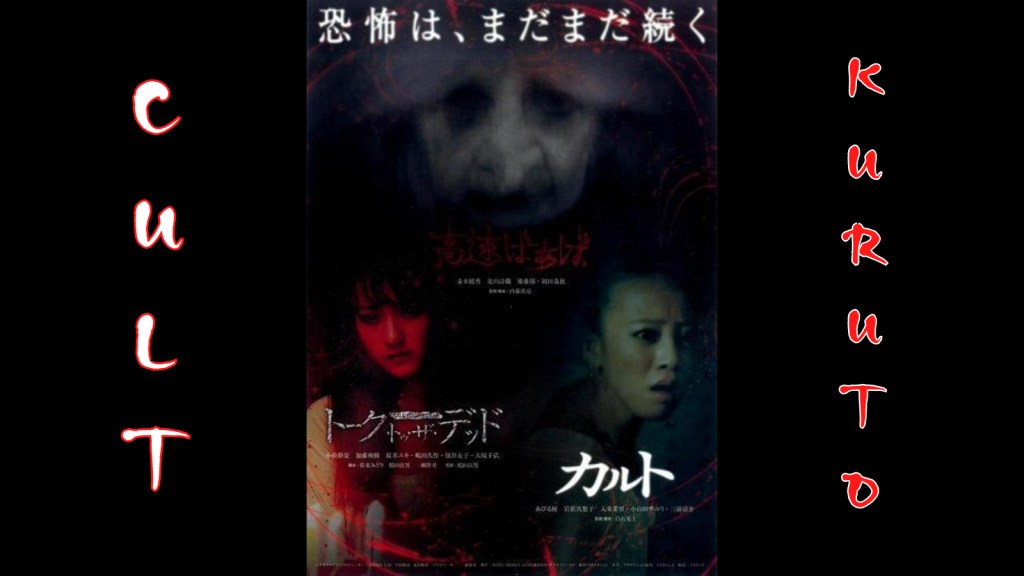
Koji Shiraishi’s Cult is a meta-found-footage fever dream that gleefully deconstructs both the conventions of Japanese horror and the spectacle-hungry media culture that surrounds it. Framed as a reality-TV ghost investigation, the film lures the viewer in with familiar tropes (cursed families, psychic exorcists, vengeful spirits) only to turn them inside out with bursts of surreal, escalating terror. Shiraishi keeps things playful (sometimes outright goofy), yet never loses his grip on genuine, skin-crawling dread. The introduction of the flamboyant “Neo” character halfway through, with his anime-style bravado and smirking disregard for tradition, is jarring and divisive; either breaking your immersion or, for some, pushing the movie into dark comedy.
At its best, Cult is both a loving send-up and a sharp critique of the horror machine itself, exposing how easily trauma and the supernatural are commodified for entertainment. The film’s blend of reality TV absurdity, cultic dread, and supernatural body horror may not be as emotionally resonant as Shiraishi’s Noroi, but it’s a wild, entertaining ride that’s as willing to poke fun at its own genre as it is to terrify you. For fans of experimental found footage and horror with a self-aware bite, Cult is essential; just brace yourself for Neo, whose presence you’ll either delight in or wish you could exorcise yourself!
(Warning: Contains Spoilers)
Found footage film CULT (“Kuruto”) opens in familiar territory for director Koji Shiraishi: the world of Japanese reality TV, specifically a show that documents supernatural investigations. Three young actresses, Yu Abiru, Mayuko Iwasa, and Mari Iriki (all playing themselves) are recruited by their agency to participate in the exorcism of a haunted house. From the very start, the film is self-aware, with the actresses expressing anxiety about the job and joking about horror clichés. But the playful atmosphere quickly curdles, as they’re briefed on the background of the case by their director Yoko Taniguchi (Mari Hayashida): a family (the Kanedas) has been plagued by a string of increasingly violent paranormal incidents in their suburban home. Yu Abiru states that she enjoys spiritual and scary material. Muyuko Iwasa states that she is very frightened of the supernatural and passed out once at a spiritual spot. Mari Iriki states that she was able to psychically bend a spoon in elementary school. All three actresses resolve to do their best, then watch video footage of the Kanedas experiencing spooky phenomena and review some agency-related paperwork.
The mother, Tomoe Kaneda (Sayuri Oyamada), and her teenage daughter, Miho (Natsumi Okamoto), have suffered terrifying poltergeist activity: objects flying, furniture thrown, and mysterious injuries. Their situation has deteriorated to the point that the father has already been driven away, leaving the two women desperate for help. A camera crew had already set up a camera outside the house by the time the actresses arrive, ready to document (with handheld camcorders) what they expect to be a standard Buddhist exorcism ceremony.
Before entering the Kaneda home, the actresses meet Mr. Unsui, a young Buddhist monk, outside the house. Unsui immediately notices a “dark spirit” clinging to Mayuko Iwasa. Without hesitation, he performs a quick, impromptu ritual, expelling the malevolent presence from her. Mayuko is shaken by the experience, and Unsui, calm but serious, tells her she is particularly susceptible to spiritual attachment; something that sets a tone of unease for the rest of the group. This small exorcism highlights that the boundary between “performance” and “reality” is already blurred; what was meant to be a media event has, for at least one participant, become frighteningly personal.
After this encounter, Unsui and the actresses discuss the video footage from the Kaneda home and the unsettling paranormal incidents. Unsui admits that, even as clergy, he cannot determine the true nature of the haunting. This ambiguity further heightens the sense of danger: the evil present is not easily categorized or banished.
As they finally approach the front door to meet the Kaneda family, Unsui steps into the doorway first, respectfully introducing himself and carefully observing the family’s teenage daughter, Miho. He notes that she, much like Mayuko, seems to have an innate vulnerability that makes her a potential target for spirit attachment. However, he reassures the family that, at this moment, he does not sense any entities latched onto her.
With these warnings in mind, Unsui moves through the home, performing blessings and purification rituals in each room. The atmosphere remains tense; while Unsui’s presence and rituals bring momentary relief, his uncertainty and the actresses’ unease suggest that whatever haunts the Kaneda family is both powerful and, for now, lurking just out of sight.
Inside Miho’s bedroom, Unsui continues his purification ritual. He carefully places a small porcelain dish marked with a six-pointed (Davidic) star and fills it with salt, a classic ward against malign spirits. The ritual is quiet, deliberate, and imbued with centuries of tradition, but the tension in the room is palpable. After Unsui finishes, Yu Abiru remarks that they’ve now been at the Kaneda house all day and asks Unsui if he senses anything supernatural. Unsui, to everyone’s surprise, confesses that he feels nothing unusual; an anomaly, he admits, since he rarely encounters such a complete absence of spiritual activity during a case.
As the group talks, a sudden noise interrupts the calm, coming from the spot where the porcelain dish was set down. Turning, Unsui sees that the dish has vanished. The salt that had been inside it is now scattered across the floor, forming an intricate, almost otherworldly geometric pattern: far too precise to be accidental. In Miho’s hand, without her knowledge of how it got there, is one half of the broken dish; the other half is missing. The air in the room feels charged, as if the spirit’s presence is now asserting itself through subtle, manipulative acts.
Unnerved, Unsui and the others move outside to regroup. There, Unsui moves quietly, “sensing” the flow of spiritual energy in the space. He theorizes that the Kaneda house sits atop an energy vein; a leyline-like channel that spirits can travel along and which can act as a beacon, drawing supernatural activity to the location. To demonstrate his suspicions, Unsui retrieves a small tennis ball from a flowerbed, asking Mrs. Kaneda if it’s a dog toy; she confirms it is. Placing the ball carefully on level ground, they watch as it inexplicably rolls on its own. For Unsui, this confirms the presence of unseen, unnatural forces at work. Mayuko asks if she can try; the ball does not roll for her. Mari then tries; the ball does roll for her. Unsui mentions that, with training, she could become a powerful psychic, which unsettles her further.
Deepening the sense of the spiritual pervading the ordinary, Unsui recommends that everyone present abstain from eating meat or fish, warning that these foods can make a person more susceptible to spirit possession. The advice lingers, adding a layer of traditional superstition and bodily vulnerability to the group’s growing unease, and marking the boundary between the everyday and the supernatural as increasingly fragile.
As evening falls, the atmosphere in the Kaneda house becomes heavy with anticipation and dread. The three actresses/tv hosts (Yu Abiru, Mayuko Iwasa, and Mari Iriki) move through the rooms, setting up cameras to document whatever may unfold during the night. They return to the living room, waiting quietly while Unsui, the young monk, prepares to conduct the exorcism ceremony at an altar he’s assembled with ritual objects and sacred implements. Tension mixes with nervous banter: Yu Abiru notices a bit of ketchup at the corner of Mayuko’s mouth, and Mayuko wipes it away sheepishly, while Mari mentions that her body feels hot: an ominous sign, but easily dismissed in the anxious haze.
Unsui asks everyone to focus. He begins chanting, intoning Buddhist prayers as incense wafts through the room. Upstairs, the ceremony’s energy triggers movement: Miho’s bedroom door slowly creaks open of its own accord, caught on camera. Outside, another camera records the tennis ball that Unsui tested earlier, now rolling, then floating on its own, accelerating toward the living room window. It slams into the glass with a violent bang, startling the group and heightening the sense that something has awakened.
The Kanedas’ small dog, curious or perhaps compelled by a supernatural force, leaves the safety of the living room. The floating ball (now inside) hovers near the stairs, leading the dog upward, out of sight. Suddenly, a noise from upstairs halts Unsui’s chanting. Mayuko doubles over in pain, her distress immediate and intense. Unsui leaps into action, performing ritual gestures to free her from the spirit’s grip, but his efforts seem ineffective. Desperate, he asks Mayuko what she ate, who confesses she had a hamburger, breaking the vegetarian rule Unsui had recommended earlier. Her friends chastise her, and she apologizes, explaining she was simply hungry. The situation grows more dire as Miho, too, begins to exhibit the same symptoms of possession.
Now Unsui must exorcise both Mayuko and Miho at once, increasing the intensity of his chanting and ritual movements. Meanwhile, the Kaneda family dog is still upstairs, drawn by the floating ball into Miho’s room. The cameras catch glimpses of the mounting chaos: Unsui’s struggle, the creeping escalation of the supernatural, and the dog’s fate.
Suddenly, Unsui manages to free Mayuko; a moment of visceral horror as a black, shadowy “spiritual tapeworm” wriggles out of her body and phases upward, vanishing through the ceiling. He turns his attention to Miho, but is gradually repelled by an invisible force, straining and backing away as the possession intensifies. Miho springs up, her movements unnaturally jerky and inhuman, and darts out of the room, scrambling up the stairs reverse. The others give chase, panic overtaking curiosity.
At the threshold to Miho’s bedroom, Unsui urges the others to keep back, but in their alarm, they crowd him. Peering inside, they catch a nightmarish sight: Miho crouched over the Kaneda now-deceased dog, devouring its carcass with animalistic savagery, her face slick with blood. The line between human and beast has blurred. Unsui tries desperately to maintain control, but Miho, possessed and predatory, stands and approaches with a chilling, blank stare.
Unsui confronts her, chanting, then bum-rushes and tackles her back into the room. He restrains her in a chokehold, one arm pinning her down as he fumbles with his cell phone. With the other hand, Unsui calls his superior, Ryugen, begging for help as he fights to subdue Miho. Ryugen, a seasoned exorcist, begins to chant over the phone, his voice amplified by Unsui’s speaker. Together, their prayers grow louder, a desperate battle of wills against the spirit inside Miho. At last, another black spiritual worm is expelled from Miho’s body, escaping upward through the ceiling.
The tension briefly subsides as Miho momentarily falls limp. But then, in a final grotesque flourish, Miho begins to convulse and heave, eventually vomiting up the missing half of the salt dish Unsui used in his ritual. The group is left unsettled and exhausted, knowing that whatever darkness inhabits the house has only been barely held at bay.
The next day, shaken but determined to find answers, the three actresses regroup with Unsui and his master Ryugen, preparing for the next confrontation in their fight against the supernatural forces plaguing the Kaneda family.
After the traumatic events in the Kaneda house, the group regathers the next evening with Ryugen, Unsui’s imposing and more seasoned mentor. Ryugen is gentle but direct, apologizing to the actresses that Unsui couldn’t handle the intensity of the haunting. He explains that the Kanedas have been temporarily relocated to a building where he regularly performs exorcisms, assuring everyone that, for the moment, the family is safe. During this meeting, Yu Abiru confides to Ryugen that she had a nightmare: Mari Iriki was screaming, her body entirely black. Ryugen reassures her, though unease lingers.
Inside what looks like an apartment or hotel suite, the group gathers with the Kanedas around a table. Ryugen sprinkles a pile of salt at the center and asks each person to touch it. When Miho, the Kaneda daughter, places her hand on the salt, she recoils, saying it feels hot. Mayuko touches the salt and says it feels cool, while Yu feels nothing out of the ordinary. Ryugen explains that, in his experience, if the salt feels hot, it means the person is still connected to a supernatural force. It becomes clear that to sever this connection, they must return and perform another exorcism. Mayuko asks Mari to touch the salt. She does but jerks her hand back as if scalded, then tries to laugh it off, but Yu admonishes her for not taking things seriously. As the group prepares to leave, the camera lingers on Mari, who seems strangely preoccupied with the fingers that touched the salt, nursing them quietly.
Back at the Kaneda home, the tension spikes. Outside, Mari suddenly doubles over in pain, crying and insisting that she can’t go in, that she’s too frightened and wants to quit. Ryugen assesses her as unstable and tells her she should return home for now, warning that she could endanger the group if she stays. The cameraperson promises to contact Mari’s manager about her withdrawal, and Mari leaves the site in a taxi, much to the disbelief of the other two actresses. As they reenter the house, the camera picks up two neighbors peering through a window next door, a silent audience to the ordeal; mirroring the voyeuristic gaze of the television audience.
Inside, they find the living room coffee table smashed to pieces, the debris eerily arranged in the same geometric pattern that appeared in the salt earlier. Unsui explains that the space itself has been “twisted,” a phenomenon his grandfather once described: powerful spirits can literally warp reality. Night falls as preparations are made. Unsui and Ryugen kneel at the altar, beginning the new exorcism ritual, while Yu and Mayuko kneel behind them. Miho and her mother sit to the side, Miho restrained in her chair as a precaution; she appears unfazed by her bonds. There are seven people in the house, including an unnamed camerawoman.
Outside, a static camera records a passerby nonchalantly tossing a small object into the flowerbed by the front door, a detail reminiscent of the tennis ball incident. Upstairs, the cameras pick up floating, black wormlike spirits. Downstairs, the group hears a rumble, heightening the tension. The priests intensify their chanting as Miho begins to make strange, distressed noises and stares blankly at the floor. Suddenly, the lights go out. Switching to night vision, the cameraperson captures a horrifying sight: a long, humanoid shadow, solid and impossibly tall, emerges from the ceiling, its feet already touching the floor, its shape distorted and menacing.
Unsui and Ryugen rise to confront the apparition. A tendril-like arm extends from the shadow and, without physical contact, sends Unsui crashing to the ground, unconscious. Ryugen’s chanting grows frantic as the entity reveals a skull-like head, its bugged-out eyes dangling grotesquely. Ryugen manages to pull Unsui to his knees and continues to pray, but the shadow creature lurches, bends impossibly, and then darts into Unsui’s body. Unsui collapses, silent and unmoving. The lights flicker back on, and Miho falls quiet. Ryugen kneels beside Unsui, shaking him in vain. The actresses are shaken, but Ryugen assures them Unsui will recover.
What follows is one of the film’s most disturbing sequences: security footage from the TV agency manager’s office. Mari Iriki stands silently before her manager, who scolds her for quitting, warning it will reflect poorly on the agency and the other staff involved. Mari begins to smirk, an unnatural, sinister smile, and tells her manager, “A god is asking me to help him with my power.” Confused, the manager presses her, and Mari calmly repeats, “I’ll help him.” Suddenly, the table violently slams forward, pinning the manager against the wall. Mari reaches out her hand and the manager collapses, apparently dead, as Mari walks out of frame: her demeanor eerily blank.
The narrative then returns to the Kanedas, who appear on a camcorder, thanking Unsui and Ryugen for “getting rid of the demon.” Everyone seems in good spirits. But when the video is shown to the actresses at the agency, they notice a chilling detail: in the reflection on the table, Miho’s face is that of a demon. Yu voices her surprise, having believed the exorcism was successful. The director grimly informs her that Unsui was hospitalized that night; his condition quickly worsened, and he died the following day. The girls are stunned and deeply unsettled.
They next visit Ryugen, who is bedridden in the hospital, his neck in a brace. A young monk explains that Ryugen, after running errands, suddenly darted into traffic; an inexplicable compulsion, possibly the result of spiritual attack. Ryugen, pale and weak, tells the actresses that Miho is still possessed, apologizing for failing to protect her. He warns that “the thing” shouldn’t be touched by a human and, realizing his own end is near, entrusts his task to a powerful psychic friend. He asks the girls to set up a camera in his hospital room, feeling certain something bad is about to happen.
That night, the camera records Ryugen sleeping as the young monk prays at his bedside. Suddenly, the young monk begins to choke and collapses to the floor, dead. Ryugen is jolted awake just as the tall shadow creature materializes at the end of his bed. Paralyzed by his injuries, he begins to pray desperately as the shadow man bends over him and, in a final, horrifying act, enters Ryugen’s body as inky, black smoke. Ryugen convulses and then falls still.
The next scene unfolds in the TV agency’s meeting room, where the remaining actresses and the Kaneda family are joined by a new, conspicuous presence: the psychic Ryugen had mentioned as his “powerful friend.” This new exorcist is immediately striking; dressed in a tailored black suit, with dyed blond hair, and crisp white gloves. He sits cross-legged atop a table, oozing a performative, sexually ambiguous cool, and an air of self-amused superiority. It’s a look and attitude that could have been ripped straight from an intentionally-cringe anime, right down to his dramatic nonchalance and tsundere self-regard (an “antihero wannabe who huffs his own farts,” in laymans’ terms). The room, already charged with unease, is made more surreal by his presence.
The psychic glances over the group and offhandedly declares that Ryugen simply “wasn’t strong enough to resist the creature.” When the others ask his name, he shrugs, saying, “Call me anything. Pick a surname, a given name.” After some coaxing, he finally says, with a smirk, “Call me Neo;” a winking reference to The Matrix, and a clear sign of his self-styled mystique (they mention the film).
Despite the absurdity of his persona, Neo’s powers are genuine and disturbing. He focuses on Mayuko, telling her she still “has some in her,” and that Ryugen, for all his experience, failed to detect it. With a flourish, Neo slips off one of his white gloves and instructs Mayuko to turn around. He then quickly, almost surgically, plunges his fingers into her back. Mayuko gasps but is unharmed as Neo extracts a writhing, black spiritual worm from her body, flicking the slimy, bloody thing onto a cloth with a magician’s indifference. The rest of the group watches, equal parts amazed and horrified. Yu rushes to examine Mayuko’s back, finding no mark, no scar, no blood… nothing but the memory of the intrusion.
Mrs. Kaneda, astonished, asks Neo what religion he follows to possess such abilities. Neo, ever the self-styled iconoclast, coolly responds that he can’t trust gods and believes only in himself. The answer is both glib and, in its own way, chilling: a rejection of every tradition that’s failed so far and a reminder that, in this film, even the supernatural is subject to the whims and egos of those who claim to control it. (He can make or break it for some people; he feels out of place in an otherwise serious film.)
After deciding that the Kaneda mother and daughter would be in danger if they stayed, Neo and the two remaining actresses (Yu and Mayuko) return alone to the Kaneda home for the final confrontation. True to form, Neo performs a cringe-inducing “jacket flip” in front of the static camera in the living room; so sure of his own style, so convinced of his own legend that he seems like a parody of an anime psychic. The three settle in, almost bored by the routine, and Yu asks what their next move will be. Neo, in his usual dramatic fashion, simply says, “We wait.”
As they idle, Neo suddenly leans in and asks if Mari Iriki was ever inside the house. Yu confirms, explaining Mari quit earlier in the investigation. Neo sighs heavily, almost pouting, and laments that he fancied Mari: “I wish it were just me and her.” The girls ignore the comment, but the moment is uncomfortable, Neo’s persona pushing the group’s nerves.
Footage from the house’s cameras shows a period of silence and uneasy normalcy, until Neo sits forward, eyes sharpening. “They’re here,” he announces, almost gleefully, just as a loud bang comes from upstairs. The camera in Miho’s bedroom captures the source: black, wormlike spirits phasing through the bedroom wall and slamming into the opposite side, a flurry of supernatural violence unseen by those below.
The sudden disturbance is too much for Mayuko. Overcome by terror, she panics and flees the living room, despite Neo’s urgent command not to leave. In the hallway, she is confronted by the floating worm-things, which herd her up the staircase. At the top, she finds herself trapped: a writhing mass of spirit worms blocks her escape, crowned grotesquely by the severed head of the Kaneda family dog, making it appear as if the worms are its tendrils. Screaming, she is paralyzed by fear as the supernatural closes in.
Meanwhile, Neo rushes to act. He pulls out a candle from his briefcase, lights it, and begins a bizarre, wordless chant, his voice rising and falling in an uncanny, otherworldly pattern: “Oooohhhaaaahhhhoooohhhh.” At the chant’s climax, a flame shoots from the candle straight through the ceiling: phasing upward, igniting nothing, but its energy catastrophic for the spirits. The worms shrivel and crumble to inky, scorched dust. Yu and Neo hurry to Mayuko, who is left sobbing on the floor. Yu comforts her, while Neo, half-annoyed and half-aroused by the chaos, calls her a fool for messing things up. With a distant stare, he admits, “This excites me.” Pressed, he explains, “They’re setting things up. First, outside!”
The group heads outside, and Neo searches the garden, quickly discovering a small vial hidden in the flowerbed by the front door. “Just as I suspected,” he announces, unscrewing it to reveal a strange powder and a severed cat’s paw inside. Neo explains: “This is the trigger for a demon bomb. Someone threw it here.” The camera flashes back to earlier footage of the mysterious passerby tossing something into the flowerbed. Yu, disturbed, asks if the cat’s paw is the trigger, then where is the bomb itself? Neo, ever the showman, tells her to find it, insisting she has psychic potential. He covers her eyes and encourages her to point in the direction she “doesn’t like.” They approach a flower pot along the property, and Neo, pleased, empties it to reveal a smooth, dark metal cube: the bomb.
He then points dramatically to the neighbors’ window, where two older women are watching. “They’re responsible,” he declares, and, with little fanfare, tosses the cube onto their property. He and the girls follow to the neighbor’s house, Neo retrieving the bomb and ringing the bell incessantly until a middle-aged woman answers. Another woman, dazed and half-tranced, shuffles into view. Neo grabs her shirt, exposing a branded geometric pattern on her chest: the same symbol seen in earlier supernatural events. The actresses gasp in horror. Neo brandishes the cube and warns the women that unless they move out by morning and never return, he will unleash the ‘reverse curse’ on them. Tendrils of spiritual energy writhe from the cube, and the women scream, one panicking, the other quickly agreeing to leave. Neo withdraws the curse and leaves with the crew.
Back on the Kaneda property, Yu asks what happened, and Neo flatly explains that the two women orchestrated the demon curse. He then says he’s exhausted and orders to be awakened in the morning, retiring inside. In the rain-soaked dawn, the group watches as moving trucks take the women away. Yu notices one woman’s face is blackened; Neo says the curse reversed onto them.
The Kanedas finally return home. Mayuko goes to find Neo, who is dozing on the sofa. The family asks if all is finally resolved now that the neighbors are gone. Neo assures them, almost dismissively, that everything is handled, that he has checked the entire house, and all evil is gone. Yu, uneasy, confesses she has a bad feeling, suggesting her supposed psychic sensitivity is warning her something is wrong. Neo, irritated, scolds her for sowing fear: “When I say safe and done, it is so. See, you scared them!” He maintains his cool, but the audience (and Yu) remain unconvinced.
The camerawoman asks Mrs. Kaneda if she can leave the surveillance cameras overnight and retrieve them in the morning. Mrs. Kaneda hesitates, asking if they’re turned off; the camerawoman lies, assuring her they are. Outside, Neo tells the actresses to go on ahead but asks the camerawoman to stay. She lingers as the others leave, and Neo quietly instructs her to keep the cameras rolling, “There will be interesting stuff captured,” and requests that she research something for him (the details of which are omitted).
That night, the house sits in darkness, the surveillance footage rolling. Mrs. Kaneda asks Miho if she wants the lights on, and Miho nods. The house grows silent. Outside, the familiar “casual passerby” returns, standing at the window, his face now disturbingly warped and demonic. He gestures with his arm in an unnatural, almost puppet-like arm salute. Mrs. Kaneda, pretending to sleep, spies on him from her window, noticing a growing crowd outside: cultists gathering in the rain, chanting and performing (what look like) limp-wristed Roman salutes, their bodies undulating like the very worm-creatures that have haunted the home.
Inside, Mrs. Kaneda slips into a trance, stands rigidly on her bed, then steps backward out of her room, drifting through the hall to stand over Miho as she sleeps. Outside, the cultists intensify their ritual, their arms contorted, their voices rising. As the mother bends over Miho, a long, intestine-like spiritual tendril emerges from her mouth and slithers down into Miho’s. Miho convulses, her body wracked by pain, as the entity passes between mother and daughter.
Mrs. Kaneda, still entranced, descends the stairs and steps out to join the cultists, collapsing in front of Neo as he confronts them with the cube. “Here is the reverse curse, as I promised,” he announces, unleashing spiritual tendrils from the cube that lash out at the cultists, sending them reeling, groaning, and stumbling away in defeat… now cursed themselves. The mother collapses at Neo’s feet.
Suddenly, a projection-ghost of Mari Iriki (her body black and face twisted) appears and attacks Neo. The psychic resists, chanting and focusing his power until the apparition dissolves into an inky puddle, evaporating as quickly as it appeared.
After the cultist confrontation outside, it’s still late at night when Yu and Mayuko, visibly rattled, race to the Kaneda home. They’re on the phone with Neo, who briefs them with chilling efficiency: the cultists had returned, Mari Iriki’s “demon ghost” had attacked, and, most ominously, Mari herself was now fully possessed and at large, “out of control.” Neo warns that Mari must be found and contained, and tells the girls to hurry to the Kaneda house. Still reeling, they leap out of their taxi and bombard Neo with questions: “Why so sudden? What’s happening?” as they rush inside.
The living room is a tableau of unease. Neo has bound both Kaneda “mother” and daughter, Miho, to chairs. Both are unconscious, and Yu and Mayuko are startled and confused. Neo, tired but resolute, simply says he’s “doing what must be done.” Turning to the camerawoman, he asks if she’s found what he requested. She hands him a family photograph: Miho with her family, taken before moving to the current home. Neo immediately recognizes the real mother isn’t the woman tied up in the living room.
He wakes Miho and asks her to identify the people in the photo, pointing first to a girl next to Miho. Struggling, panting, Miho finally manages, “Kaori.” Next he points to herself: “Me.” But when asked about the woman beside her, Miho falters, unable to remember. Neo diagnoses the issue: “Something in her is blocking her memories.” He stands, moves behind Miho, and inspects the top of her head, ultimately extracting a slender spirit-worm (perhaps six to eight inches long), which he then seems to absorb into his glove. He crouches back down and asks again: Who is the woman in the picture? This time, Miho answers, “My mom.” The girls are floored, because the woman tied up before them is not Miho’s real mother.
Neo wakes the impostor, now revealed as a cultist. She tries to maintain the ruse, calling herself “mom,” but Miho recoils, no longer deceived. Neo points out the first clue: at their very first meeting, this woman’s oddly probing questions about his powers and religion made him suspicious. He searched the house and found no family photographs—another red flag. The woman, now exposed, drops all pretense. “The ruse is over,” Neo says. She offers no name but launches instead into cult-speak: “This is a big event. You should capture it on camera. That’s why I brought you here, but I wasn’t expecting him.” She reveals the cult’s plan: using Miho’s psychic abilities and body as a “gateway,” they intend to bring their god into the world. Neo scoffs, “A god? It’s just a demon.” The girls, confused, ask if she’s in a cult (“What is a cult?” Mayuko asks… an almost comical naivete). The camerawoman explains: “A religious group against our society… they believe in a malevolent leader and want to destroy our way of life.” Pressed, the cultist refuses to say where Miho’s real mother is. Neo pulls her shirt a bit to see her back and spies the geometric symbol embossed in her flesh.
A rumbling from upstairs interrupts the standoff; “It begins,” the cultist announces. The lights flicker, then plunge the house into darkness. The girls scream; the camerawoman flips on night vision. Miho’s head tilts back, her mouth opening wide as the long, wormlike creature planted earlier rises from her throat, its tip pressing against the ceiling. The worm’s end morphs into a grotesque human face, and a horde of worm-tendrils erupt, attacking Neo. Neo fights back, summoning a cluster of glowing white spiritual worms with a rising chant. His spectral worms absorb the demon tendrils and the face, then disappear. The worm-thing slithers back into Miho’s mouth. (It’s possible that Neo can send and take things from a sort-of pocket dimension. At least, that’s my theory.)
Neo, realizing the danger isn’t over, tells the others, “Miho’s in trouble,” and asks for Mayuko’s help; he’s too drained to do it alone. He asks to use her body as a conduit for Miho, instructing her to trust him and keep looking down. He levitates the spirit worm out of Miho and transfers it into Mayuko. The lights snap back on. Miho, dazed, seems freed of her possession; Neo collapses with exhaustion. Yu quickly unties Miho and reassures her she’s safe. Mayuko, terrified, asks when Neo can remove the parasite from her. He assures her he’ll do it tomorrow, that he needs to recover, but she’ll be safe until then. Yu, still unsettled, grabs Miho and moves her from her seat; just in time, as a bookcase falls over, which would have crushed them both.
Floating above the toppled bookcase is the demon-ghost of Mari Iriki, her eyes black, her voice echoing with supernatural malice: “You can’t stop us now. Our god is coming… coming… coming. Humanity will be destroyed.” Neo, rallying what little energy he has left, rises to confront her. He strips off a glove, points his palm, and launches into another theatrical chant. Mari’s ghost writhes, crumbles into inky black smoke, and vanishes. Neo, out of breath and still striving for cool, intones, “A real battle has begun,” locking eyes above the camera with a moment that’s pure anime cringe; self-aware, absurd, and almost campy in its melodrama.
And with that, the movie ends abruptly: leaving the fate of Mayuko, Miho, and even our tsundere Neo, himself unresolved, the threat of the cult and their “god” still looming. The camera cuts to black, the ending blurring the line between spectacle and apocalypse, parody and horror. There are no extra scenes during or after the credits.
Symbolism, Analogues & Themes
Symbolism: At first glance, Cult is overflowing with the surface trappings of J-horror—ghosts, exorcisms, spirit worms, and bizarre cultic rites—but beneath the schlocky theatrics, Shiraishi’s film is suffused with a thick web of symbolic imagery that reflects both Japan’s historical anxieties and the postmodern moment in which the movie was made. The most striking symbol throughout is the ever-present spirit worm: a shape-shifting, black, almost intestinal entity that slides between mouths, bodies, and even generations. These worm-creatures are much more than spectral parasites. They represent the transmission of trauma and contamination, the way spiritual corruption seeps through families, communities, and even media itself. The act of the worm passing from mother to daughter, or being transplanted from Miho to Mayuko by Neo, becomes a grotesque metaphor for the inheritance of psychic wounds, secrets, and unresolved guilt that haunt not only the Kaneda family, but the wider social fabric.
The cultists’ geometric brand, the strange sigil burned or scarred into their skin, is a recurring motif, echoing both the ancient idea of spiritual “marking” and the modern concept of identity being forcibly imposed from outside. The geometric pattern appears in salt, in shattered furniture, and on flesh, creating a kind of viral visual language throughout the film. It’s as if the evil at the film’s heart is not simply a supernatural entity but a contagious code, capable of infecting bodies, spaces, and objects. This sigil, often associated with forbidden knowledge or the legacy of secret societies, marks its bearers as both chosen and doomed; a double-edged fate that reflects the film’s bleak outlook on belonging and otherness.
Another major symbol is the use of animals and animal parts: the cat’s paw “demon bomb,” the severed dog’s head atop a pile of spirit worms, and the manipulation of living and dead pets. Animals in Cult are both victims and tools; their bodies become vessels or triggers for supernatural violence. In Japanese folklore, animals often bridge the gap between the human and spirit worlds, and here, their mutilation is a visual shorthand for the blurring and violation of boundaries. The dog’s head, crowned on a pile of writhing worms, is an especially vivid symbol of innocence corrupted, and a reminder that in this world, nothing is sacred.
The house itself is a loaded symbol, ostensibly a place of safety and family, it is revealed to be a stage set for horror, a spiritual crossroads, and ultimately a trap. The persistent rearrangement of objects, the destruction of furniture, and the repeated setting up of cameras all underscore the instability and permeability of the home. The Kaneda residence, once an ordinary suburban space, is gradually stripped of all comfort and order, mirroring the way the family’s identity had been steadily eroded and rewritten by the cult’s influence. The house, like the bodies in the film, is a vessel waiting to be filled with something: trauma, possession, violence.
Shiraishi’s persistent use of mirrors, reflections, and camera feeds also plays a crucial symbolic role. Surveillance is omnipresent: the reality TV crew’s cameras, the ever-watchful neighbors, and the motif of reflections revealing the true, demonic face beneath the human surface. The camera does not merely record events, it participates in them, becoming a conduit for the supernatural. This is made chillingly clear when Miho’s reflection in the aftermath of the exorcism shows her as a demon; a subtle nod that the horror is never truly exorcised, only displaced, or perhaps that the act of observation itself invites the monstrous. The boundary between observer and participant dissolves, turning every viewer (within the film and in the audience) into a potential carrier of the curse.
Neo himself, as a character, is a walking, talking symbol of postmodern spiritual crisis. His anime-inspired affectations, ambiguous gender, flashy style, and narcissistic bravado lampoon both real-world exorcists and the culture of self-mythologizing influencers. His refusal to adhere to any religion (“I only believe in myself”) is symbolic of a society adrift from tradition, desperate for new authorities but suspicious of all old certainties. Even his powers, seemingly unlimited but emotionally hollow, stand in for the way modernity both magnifies and trivializes spiritual anxiety.
Finally, the titular cult is itself a symbol: of fear, of social breakdown, of the seductive power of belonging in a world where institutions (family, religion, media) no longer provide comfort or coherence. The limp-wristed Roman salute, the synchronized chanting, and the collective possession are images ripped from nightmares about conformity and mass psychosis. In Cult, evil is never just a single ghost; it is an epidemic of belief, ritual, and collective complicity, always one viral video (or one broken boundary) away from infecting everyone.
Analogues: At its heart, Cult is a knowing, self-aware riff on the entire tradition of the exorcism and possession subgenre; not just in Japan but globally. The most obvious analogue is The Exorcist, with its climactic rituals, projectile spiritual entities, and the fundamental battle for a young girl’s soul. Yet Shiraishi’s film diverges from Catholic trappings and takes the exorcism narrative into the uniquely syncretic territory of Japanese spirituality, where Buddhist monks, New Age psychics, folk superstitions, and homegrown cults all jostle for authority. Unlike The Exorcist, Cult offers no single dominant religious order; instead, it presents a free-for-all of spiritual actors (Unsui, Ryugen, Neo and the cult) each with their own methods and failures, echoing Japan’s uneasy coexistence of old and new beliefs.
Cult also stands shoulder-to-shoulder with the found footage/mockumentary tradition pioneered by films like Noroi: The Curse (also by Shiraishi), Blair Witch Project, and Paranormal Activity. The constant presence of cameras, both diegetic (the reality TV crew) and extra-diegetic (surveillance footage, static cams), allows the film to toy with the conventions of media reality; suggesting, as Noroi did, that the act of recording is itself an invitation for the supernatural to manifest. Where Noroi took a slow-burn documentary approach, Cult foregrounds the “show” aspect, openly mocking the sensationalism of Japanese TV and the way media turns genuine suffering into consumable spectacle.
The titular cult and their apocalyptic rituals evoke memories of infamous Japanese new religious movements; most notably Aum Shinrikyo, whose 1995 subway sarin attack cast a long shadow over Japanese consciousness (and why there are limited trash receptacles in Tokyo). Cult does not reference this history directly, but the film’s imagery of mass chanting, branded members, and the sense of ordinary neighbors hiding extraordinary secrets unmistakably echoes the collective anxieties about “new religions,” brainwashing, and the fragility of social trust in post-bubble Japan. The blend of folk horror and urban paranoia brings to mind classics like Onibaba and Kuroneko, but filtered through a late-capitalist, reality-TV lens.
In the global horror landscape, Cult draws clear analogies with Western films about “contagious” evil: from Ringu (with its cursed videotape and viral spread of supernatural trauma) to Hereditary, where family secrets and inherited trauma become literalized as supernatural possession. The recurring motif of the “spirit worm” (moving from person to person, crossing generations, hiding inside the mundane) mirrors the anxieties found in films like It Follows, where the threat is less a singular monster than a transferable, insidious curse.
On a meta level, Neo’s character is an analogue for the entire generation of pop culture spiritualists, reality TV “personalities,” and anime anti-heroes; equal parts parody and homage. He channels everything from flamboyant onmyoji in old Japanese dramas to the psychic showmen of contemporary variety shows, while also serving as a pastiche of “chosen one” protagonists in anime, right down to the exaggerated poses and performative seriousness. His Matrix-inspired moniker (“Neo”) and faux-Western affectations speak to the ways Japanese pop culture has always absorbed, twisted, and exported global trends.
The presence of the fake mother as a plant within the Kaneda family is another echo of a familiar folk horror motif: the changeling or usurper who infiltrates a community, using love or authority as a mask for something predatory. This dynamic (where the maternal is warped, memory is suppressed, and the family is rendered porous) is a direct analogue to everything from Rosemary’s Baby to Japanese kaidan about fox-wives and inugami, as well as real-world anxieties about the breakdown of kinship and identity.
Finally, the film’s ending (where the ghostly Mari returns, the “god” is still at the threshold, and Neo strikes a pose in the face of apocalypse) echoes the unsatisfying, open-ended dread of so much 21st-century horror, where nothing is ever fully solved and the audience is left with the queasy feeling that the story is not contained by the screen. In this way, Cult is deeply in dialogue with its predecessors and contemporaries, remaking their tropes as both homage and parody, while refusing any neat closure.
Themes: One of the most persistent and unsettling themes in Cult is the fragility of identity (personal, familial, and communal) in the face of infiltration and deception. The Kaneda household, ostensibly an ordinary family, is gradually revealed to be a façade constructed by supernatural manipulation and cultic interference. The true mother is missing, replaced by a “plant” who passes as her, while Miho’s very memories are blocked by spirit worms. This motif of identity theft and memory tampering reflects not only the horror of possession but the existential anxiety of not knowing who you (or your loved ones) really are. It’s a powerful metaphor for how trauma, cult indoctrination, or abuse can warp and erase the truth of self and kinship, leaving only confusion and the hollow mimicry of normalcy.
A closely linked theme is the transmission of evil and trauma as a kind of spiritual contagion. The spirit worms, which slither between mother and daughter, between Miho and Mayuko, are not just visual grotesqueries: they’re the film’s emblem of how curses, pain, and spiritual pollution are never truly isolated to one victim. Instead, they move from body to body, generation to generation, and even through media and ritual. Shiraishi suggests that horror isn’t just about the sudden intrusion of the supernatural, but about the insidious persistence of corruption: what is not acknowledged, exorcised, or healed will inevitably seek new hosts. The curse, like a virus or a buried secret, refuses to remain silent.
This ties directly into the film’s critique of spectacle and the ethics of media. The reality TV format is not just a frame but a subject of mockery and unease. The actresses, the producers, and even the exorcists themselves are complicit in transforming genuine suffering and spiritual crisis into entertainment. Cameras are everywhere, yet they do not provide protection or truth; instead, they become vehicles for further contamination. The presence of the camera may in fact enable the supernatural, as if the act of observation itself invites haunting. By extension, Cult raises uncomfortable questions about the voyeuristic impulses of the audience: are we, too, responsible for perpetuating the curse by watching?
A major thematic concern is the breakdown of traditional authority and the crisis of belief. The succession of spiritual “experts” (Buddhist monks, psychic mediums, flamboyant Neo) highlights a landscape where no single tradition is adequate to deal with the supernatural threat. Each authority figure fails in some way, and Neo’s postmodern bravado (“I believe only in myself”) is more performance than genuine salvation. The film is skeptical of institutions, be they religious, familial, or media-related, and suggests that, in an age of fractured meaning and spiritual confusion, anyone can pose as an authority, but no one can offer real security. The result is a sense of existential drift, where the borders between true and false, sacred and profane, are dangerously blurred.
The motif of ritual and repetition permeates the film, underscoring both the desperate human need for structure and the futility of trying to control chaos. The repeated exorcisms, the obsessive use of salt, the invocation of geometric patterns, and the cultists’ synchronized chanting all point to a longing for order in the face of incomprehensible forces. Yet, every ritual ultimately fails or is hijacked, and even the “reverse curse” that Neo wields is only a temporary fix, not a true solution. This speaks to a deeper theme of entropy: the gradual unraveling of meaning, safety, and community as horror escalates. In Cult, ritual does not save but merely forestalls disaster.
Underlying all of these is the chilling theme of contagion and complicity. The film’s ending refuses closure: evil is never truly vanquished, and the survivors are left haunted, infected, changed. The cultists are not distant, abstract villains but next-door neighbors, normal citizens, even “family.” This everyday banality of evil suggests that anyone (by action or bystander apathy) can become part of the chain. In the end, Cult implies that horror is not an external invader, but a networked, social disease: it grows in the cracks of neglected pain, spreads through ritual and repetition, and survives by using our own systems (family, faith, media, even community) against us.
In sum, Cult is about the impossibility of purity and the inevitability of contamination in a world where boundaries are always porous, authorities are always suspect, and the past is never truly dead. It’s a story of masks, mimicry, and the everyday machinery of possession (spiritual, psychological, and cultural) that keeps horror alive and endlessly multiplying.
Verdict
Cult is, without a doubt, one of the most fun and inventive entries in the Japanese found footage horror subgenre, and I absolutely recommend it to fans of J-horror, folk horror, or anyone looking for something offbeat and self-aware. It’s a film that manages to juggle ritualistic dread, cult paranoia, possession horror, and an open satire of reality TV culture, all while maintaining a propulsive pace and sense of escalating weirdness.
That said, I have to give a very specific caveat: Neo, the psychic exorcist who appears in the latter half of the film, can either make or break the experience, depending on your taste. For me, Neo’s performance is so self-consciously anime, so stylized and exaggerated, that he feels dropped in from another universe entirely. If Cult were an episode of a supernatural anime, he’d fit right in, but here, his presence is so jarring that it honestly breaks my suspension of disbelief. Every time he’s onscreen, you can almost hear the fourth wall creaking. He’s an intentionally-cringe, over-the-top character that some viewers will find hilarious or iconic, while others (like myself) may find him more of a distraction than a boon.
If Neo were dialed back, just a bit less cosplay and a bit more genuine tension, I think Cult would stand as a genuine masterpiece of found footage horror. As it is, the film is still a wild ride, genuinely creepy in places, and absolutely worth a watch for anyone curious about the intersection of cult horror, media satire, and the always-messy business of exorcism. It may not crack my personal top tier of J-horror favorites, but it’s a great late-night watch; especially with friends who can appreciate its camp, its cleverness, and yes, even its cringe.
 J-Horror Blog
Leave a comment