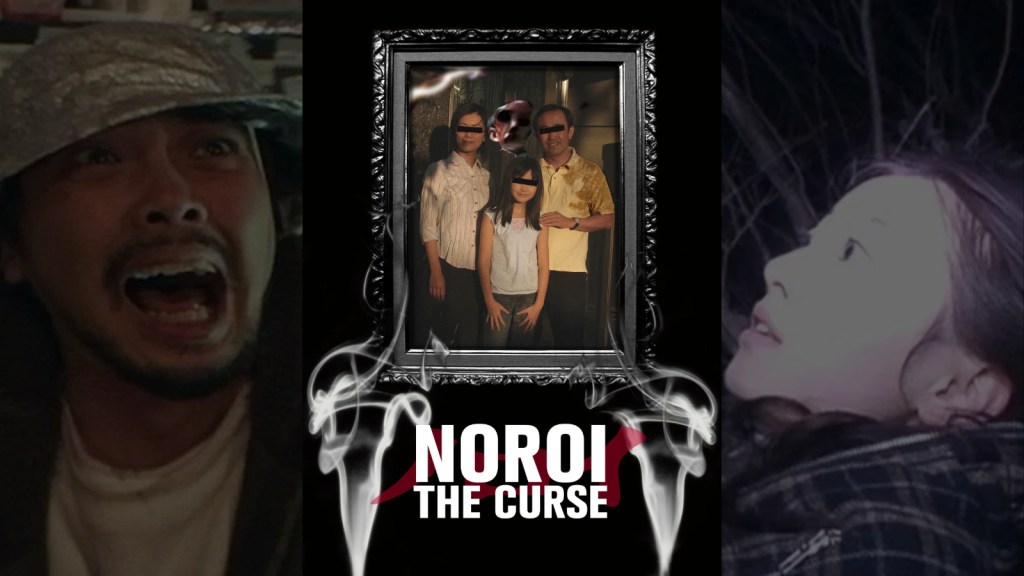
Noroi: The Curse is a 2005 Japanese found-footage, folk-horror film that quietly became one of the most influential (and unnerving) entries in J-horror. While it shares the urban legends, spirits, and media technology tropes of Ringu or Ju-On, Noroi leans even harder into documentary realism and rural folklore. The result is a slow-burn, mosaic nightmare; a film that’s less about “jump scares” and more about a feeling of deep, gnawing wrongness creeping in from the edges of society.
Where many horror films are content to show you the monster, Noroi builds a mythos: a tapestry of cursed places, forgotten rituals, and intergenerational trauma that makes you feel as if the horror predates not just the film, but the modern world itself.
The film presents itself as a metadocumentary, allegedly pieced together from the last work of one Masafumi Kobayashi, a well-known journalist and paranormal investigator who vanished mysteriously. It’s a “film within a film”: interviews, TV clips, news reports, home videos, and handheld investigations are all stitched together. This approach lends it a chilling verisimilitude: everything feels just a little too real, too messy, too incomplete.
As the film unfolds, we watch the “documentary” begin to collapse under the weight of the curse it’s trying to investigate. The tension is cumulative: it’s less about one climactic scare than about the slow realization that something truly ancient and malevolent is lurking just beneath the mundane world.
(Warning: Contains Spoilers)
Part One: Opening Investigation
Kōji Shiraishi’s Noroi: The Curse begins not with bombast or spectacle, but with the quiet, procedural rhythms of a seasoned paranormal investigator. Masafumi Kobayashi (Jin Muraki), whose low-key charisma anchors the film, introduces himself as the creator of a series of documentaries on supernatural phenomena. He’s well-known in the Japanese media landscape as a rational, diligent chronicler of the weird; a believer, but not a sensationalist. The film opens by framing everything we’re about to see as “his final work,” instantly infusing the narrative with a sense of fatalism and inevitability. We’re shown footage of his house ablaze, mention of his dead wife found inside and Kobayashi still on the lam.
This “metadocumentary” approach is one of Noroi’s greatest strengths. Rather than demanding our suspension of disbelief with slick visuals or manufactured scares, it invites us to accept the reality of what we’re seeing through form and style. The presentation is rough, unpolished; Hisashi Miyajima’s camerawork is jittery, the lighting is frequently poor, and audio often drops out or distorts. All of these choices reinforce the “realness” of the footage and make the viewer complicit, as if we’re watching something pieced together from lost archives, warnings sent back from the brink.
Kobayashi’s first case takes him to a quiet Tokyo suburb, where a series of increasingly strange and disturbing events have upended the peace of a small neighborhood. The case seems almost mundane at first: a woman named Junko Ishii (Tomono Kuga) has recently moved in, and her neighbors complain of odd noises (crying, banging) coming from her house late at night. Pigeons are found dead on the property. Kobayashi and his crew speak with a neighbor, Ms. Mikako Okui (herself), and her young daughter (Ryoko Okui), both clearly unsettled. The girl, in particular, insists she can hear babies crying from inside Ishii’s house, a detail that lingers in the air, half-believed but impossible to shake.
The investigation quickly reveals that Junko Ishii is a deeply disturbed figure. She is elusive and hostile when approached, her windows covered, her life opaque to the outside world. There’s something “off” in her affect; her paranoia seems less like a symptom of persecution and more like the mark of someone hiding a secret. When Kobayashi and his camera operator, Miyajima (himself), attempt to approach her, they are rebuffed. The scene lingers on the exterior of the house, its silence and stillness suggesting not safety, but a kind of latent menace.
But by the time Kobayashi returns for a second visit, the tone has darkened: he learns that Ms. Okui and her daughter have died in a sudden, unexplained car accident. The abruptness of their deaths, especially following the child’s eerie claims, deepens the aura of unease and suspicion enveloping Ishii’s house, transforming a simple haunting into something more dangerous and tragic. Junko Ishii has also moved out of her home, which unsettles the crew. The sense of absence becomes a kind of presence; the horror is not just in what happens, but in what can’t be easily explained away.
What’s striking in these early scenes is the matter-of-fact tone. There’s no dramatic musical cue or heavy-handed suggestion that something supernatural is afoot. Instead, the horror emerges through the banality of neighborhood gossip, children’s drawings, and awkward interviews. Kobayashi’s methods are empathetic and careful: he listens, takes notes, and doesn’t leap to conclusions, which makes the accumulating evidence all the more chilling. Noroi trusts the viewer to find dread in the everyday.
Kobayashi’s investigation begins to connect other disappearances and deaths in the vicinity, including that of pets and birds. There’s a motif of animal death, a classic omen in folk horror, signaling that whatever force is at work here, it warps the boundaries between the human and nonhuman. The imagery of dead pigeons and crows, and the repeated complaints of strange animal sounds, suggest a world out of balance, as if the curse is already leaking into the landscape.
Rather than unleashing ghosts or monsters from the start, Noroi operates through suggestion and accumulation. The “haunting” in these first chapters is social, psychological, and environmental as much as it is supernatural. The fear comes from the sense that something unseen is always watching, something woven into the fabric of ordinary life. The neighbors’ discomfort, the inexplicable sounds, the shadowy glimpses through windows: all of these are threads in a web that only gradually reveals itself as a curse.
Part Two: The Net Widens
As Noroi transitions from its haunting, intimate opening investigation, it pulls the viewer into a wider, more chaotic network of misfortune and mystery. What started as a localized, almost mundane haunting now begins to branch out, weaving together disparate stories that at first seem unrelated but are bound by the same invisible malignancy. In this act, the film’s genius is revealed: it captures how evil (and trauma) spreads not in a straight line, but as a creeping infection, leaping between people, media, and memory.
A turning point arrives when Kobayashi begins investigating the story of Kana Yano (Rio Kanno), a child psychic featured on a television variety program. The film-within-the-film structure expands, incorporating clips from this show (ostensibly light entertainment) where Kana’s “gifts” are displayed for an audience that treats the supernatural as harmless spectacle.
During a test of her abilities and after psychically drawing hidden images, where she’s tasked with materializing water in an empty, closed flask, she materializes not just liquid, but also a single hair. The program’s hosts are impressed and the show moves on, but Kobayashi, watching the taped episode, recognizes that Kanna is legitimate.
Kobayashi’s approach to Kana and her family is careful, even tender. He interviews her mother, learning that Kana has always been “sensitive,” but recently her gifts have become a burden. Kana’s nightmares worsen, and she begins drawing the same pattern of squirming, worm-like shapes; imagery that will recur throughout the film. When Kana suddenly vanishes without a trace, the sense of mounting dread is unmistakable. The film emphasizes the callousness of the media, the impotence of the police, and the isolation of those marked by the supernatural. Here, the curse is revealed as something that preys on the vulnerable, especially children; its transmission is both viral and predatory.
While searching for answers, Kobayashi is drawn into the orbit of Marika Matsumoto (herself), a popular young actress with psychic abilities, who has begun experiencing a series of inexplicable and terrifying events while on an investigation of her own. Her ordeal, like Kana’s, is mediated through television: Marika is the subject of a “paranormal variety show” in which she’s sent to investigate haunted places as a kind of comic relief. As Marika Matsumoto’s strange experiences continue, the film intertwines taped footage from a live, in-person public-speaking event concerning the recent episode.
During one of the taping of a Q&A with a live audience, while discussing the bizarre events that have recently taken place, Marika is suddenly attacked by Mitsuo Hori, a disturbed, eccentric, tin-foil-wearing psychic who had been invited to speak as a guest. This shocking incident happens in real time on stage, with the audience looking on in confusion and unease. Hori’s violent outburst heightens the sense of the curse’s pervasive influence, and Marika’s breakdown is framed not as a mere spectacle, but as a sign of her deteriorating mental state.
Following this public event, Marika becomes more isolated, and her fear deepens. In an effort to provide support and a sense of safety, Kobayashi eventually invites Marika to stay at his home, where his wife can keep her company. Kobayashi himself continues his investigation with Marika’s assistance.
Marika introduces Kobayashi to her upstairs neighbor, a young woman around Marika’s age, who she thought may have heard or seen something strange lately. Kobayashi interviews her but she doesn’t have any experiences to tell.
Kobayashi, his cameraman Miyajima, and Marika decide they must seek out and interview this Mitsuo Hori. It becomes clear that Hori is far more than frantic and eccentric; he may also have severe developmental issues and/or complex trauma. He is, in a way, the film’s Cassandra: acutely attuned to the curse, yet doomed never to be believed.
Hori’s obsession with “ectoplasmic worms” and “miasma” at first sound like the ramblings of a madman, but his drawings (identical to Kana’s) and his knowledge of the curse’s signatures point to a deeper, hidden truth. He warns of a coming disaster, fixates on a pattern of missing children, and repeatedly mentions a parking lot where “the worms are everywhere.” Hori’s madness is not comic, but tragic: he is both a casualty of the curse and its unwilling prophet. Hori asks who or what “Kagutaba” is, to which the crew responds they have no idea.
He then draws Kobayashi a crude map and mentions a blue building nearby a parking lot. The crew eventually find the location and observe a young, stoic man on his apartment’s balcony grab a pigeon with his bare hands and take it inside. Kobayashi and the crew ask about the man, Osawa (Takashi Kakizawa), with neighboring tenants. They find he is something of a recluse with quiet, antisocial tendencies.
The scenes with Hori are some of the film’s most uncanny. His “tinfoil room,” the squirming drawings, and his panic attacks whenever certain names or places are mentioned create a suffocating atmosphere. The film refuses to laugh at Hori, even as others might. Instead, it invites the viewer to listen; suggesting that, in a world where evil is insidious and misunderstood, only the marginalized or “mad” can perceive the truth.
By now, Noroi has begun to operate like a true tapestry: Kobayashi’s investigation is no longer a straight line, but a web of overlapping tragedies, recurring symbols, and echoes between characters. The film returns again and again to certain motifs: dead birds, strange noises, hand-drawn sigils, children’s disappearances, the inability of adults to protect the young.
Kobayashi’s footage, spliced with TV shows, police reports, and home videos, creates an overwhelming sense of information overload. At times, it’s difficult to see how everything connects, mirroring Kobayashi’s own struggle to make sense of what he’s found. But behind it all, a pattern is emerging. The curse is not random; it moves along lines of trauma, media, and bloodline.
The boundaries between the cases blur. Marika’s sleepwalking & knot-tying, Kana’s drawings, Hori’s warnings, Ishii’s obscurity; each story reflects and amplifies the others, as if the curse is testing for cracks in the world, waiting for the right moment to erupt.
Part Three: Unearthing the Past
As Kobayashi’s investigation continues, the shape of the curse becomes clearer… but also far more frightening. No longer is this merely a string of misfortunes or isolated tragedies. Instead, the “curse” takes on the dimensions of a myth: something born of blood, ritual, and ancestral failure, returning to claim a modern world that has forgotten its debts.
Kobayashi contacts an ethnologist to inquire about the word Kagutaba. The aging ethnologist tells him the meaning is something like “a tool for destroying” and it’s related to a ‘demon ritual’ practiced by a local village.
Driven by the accumulating clues (recurring patterns, strange symbols, and the mounting list of the dead and missing) Kobayashi and his team dig deeper into Japan’s rural past. The trail leads to a remote, now-drowned mountain village called Shimokage. The village, erased from maps and collective memory, was flooded to make way for a dam, decades prior. In this classic J-horror move, the horror isn’t just in the supernatural, but in the violence of modernity itself: the destruction of old places, the forced displacement of communities, and the rituals lost or botched in the rush to “progress.”
Shimokage, they discover from a local historian, was the site of a local cult that worshipped an obscure, animal-masked demon-god called Kagutaba. Kagutaba was once venerated with regular rituals meant to appease and bind its anger, but these practices were suppressed (and finally, disastrously interrupted) when the village was ordered to evacuate. The final ritual, which should have sealed Kagutaba for good, was a disaster. Through interviews and rare archival footage, we see the villagers struggling through a hasty, desperate rite, led by the village priest.
This is where the film’s folk horror DNA crystallizes. Kagutaba is not a new monster, but an ancient one, and its curse is not vengeance but consequence. The rupture caused by the incomplete ritual has been festering for decades, leaking into the world through bloodlines, psychic wounds, and forgotten history. The curse is not just supernatural but social; a legacy of the violence done to the land and its people.
As Kobayashi’s investigation progresses and more details about the failed ritual are uncovered, the camera returns repeatedly to Junko Ishii. Initially portrayed as a hostile, unstable figure in the neighborhood, she is gradually revealed as the bearer of an inherited, unfinished spiritual responsibility. Her father, the village priest during the botched ritual meant to appease the demon Kagutaba, was directly involved in the ritual, and Junko herself played a pivotal, albeit painful, role.
Junko is shown to have been the one to wear the Kagutaba mask during the ceremony, a critical and physically agonizing part of the ritual. During the ceremony, Junko, in immense pain, collapsed and the ritual was interrupted. This failed rite, performed in the late-1970s or early-1980s, left the curse incomplete and left Junko spiritually tainted, which eventually led her into a life marked by violence and tragedy.
After this failed ritual, Junko left the rural village and moved to Tokyo, where she attended nursing school and later worked at a clinic in the 1980s that illegally performed late-term abortions. In this grim, morally complex role, Junko was responsible for disposing of the fetuses. However, as the film progresses, it’s revealed that she kept the fetuses. Junko’s secretive act of keeping them is linked to a ritual sacrifice she plans to carry out later, involving the new ‘priestess’, presumed to be Kana Yano, whom Junko kidnapped.
In a key revelation, the local historian shows Kobayashi an old woodcut scroll, known as the Shimokage Way, which depicts a previous priestess of Kagutaba being fed monkey sacrifices in a similar ritual. The parallels between the woodcut and Junko’s own behavior become clear: she is attempting to repeat these ancient rituals, this time with human fetuses, to feed the demon Kagutaba and its future priestess.
Kobayashi and his crew, including Marika and Miyajima, discuss their findings and begin to theorize that Junko, in an effort to revive the ancient ritual, could have smuggled the aborted fetuses from Tokyo back to the village where the cursed residents had relocated. The villagers, mostly unscattered, still hold onto deeply ingrained practices, and it seems Junko is attempting to finish what her father had started.
Upon learning of the new village where the displaced community now resides, Kobayashi decides to investigate. He uncovers that Junko and her young son have recently moved back to the area, but her behavior is deeply unsettling. She is not the same woman who left for Tokyo. She’s now acting strangely, her presence marked by an even more palpable aura of danger and spiritual corruption.
As the investigation progresses, the stories of Kana Yano, Marika Matsumoto, and Mitsuo Hori all return to the legend of Kagutaba and Shimokage village. The worm-like drawings, the psychic breakdowns, the animal deaths, and the missing children all align with the specifics of the Kagutaba mythos; its demand for sacrifice, its link to psychic sensitivity, and its hatred of being forgotten.
Marika informs Kobayashi that her upstairs neighbor, along with Osawa and others, have committed group suicide, by hanging in a nearby playground, from a swing set. Back at the Kobayashi residence, Marika seemingly suffers a type of trance where she appears to be hanging by the neck via an invisible rope. Marika, unaware of what just transpired, is alarmed and convinces Kobayashi to take her to the Shimokage dam in order to perform a severing ritual similar to the one in the historian’s footage.
Kobayashi protests but eventually agrees. However, he believes they need to enlist the help of Mitsuo Hori and pick him up enroute to the dam. Their crew now numbered four: Kobayashi as investigator, Miyajima as camera man and driver, Marika as a psychic affected by Kagutaba and Hori as the ‘lead’ psychic.
Once there, the group makes a plan to take a row boat to the center of the lake, directly above where the now-submerged shrine is located. Kobayashi took a video camera and manned the oars while Marika brought a sickle and a length of cloth rope. Aboard the boat, Marika sets up the rope in front of her and severs it with the hand sickle, thereby completing the ritual. She says she feels better but she doesn’t look it.
Just then, Hori begins acting frantic and pleads with them to return to shore with haste. He feels something is wrong and mentions Kana’s name. Marika and Miyajima get in the van, while Kobayashi tries to calm Hori down. With a sudden vision, Hori starts raving and takes off running into the woods. Kobayashi gives chase. Dusk will soon arrive.
As Kobayashi chases Hori deeper into the forest, Marika begins to show signs of possession and abruptly leaves the van screaming. Miyajima runs after her. He finds her laying on the ground, screaming intermittently. Marika eventually breaks free of the episode and Miyajima calms her down. Both are understandably frightened but begin trekking back to the van.
Kobayashi finds Hori near an abandoned shrine, deep in the forests around where Shimokage once stood; piles of sacrificed dogs scattered throughout. Here, the boundaries between past and present, dream and waking, human and spirit, begin to collapse. The location itself is haunted: a nexus where Kagutaba’s presence feels thick, almost suffocating, in the air.
Hori exclaims Kana’s name as he points to an old torii gate. Kobayashi, switching to a night-vision filter on his video recorder, catches sight of Kana amid a mass or writhing spirit-fetuses. After a few moments, the ghastly scene is over; vanished, as if it had never occurred.
Part Four: Climax and Ending
After Kobayashi and Hori discover the shrine and the horrifying, supernatural sight of Kana Yano and the spirit-fetuses, their initial fear for Kana’s safety drives them further into the rural expanse, where they desperately search for her. Their investigation takes them to Junko’s home in the new village, at the edge of the forest, a place that feels steeped in sorrow and abandonment.
The home is very unsanitary and inside they find a chilling scene: the room is filled with sacrificed pigeons, ritualistic objects, and miscellaneous relics of an ancient cult: symbols, masks, and talismans related to Kagutaba. The grim setting points directly to Junko Ishii’s ongoing attempt to revive the ancient ritual, this time with Kana as the new priestess and a horrific use of the fetuses she had kept.
But the most horrifying discovery comes when they see Junko Ishii’s fresh corpse, hanging from the rafters. It is clear that she has taken her own life, perhaps in a final act of despair after carrying out the ritual or in an attempt to escape the curse’s control. Kana, the girl who had been the intended vessel for Kagutaba, lies dead on the floor not far from Junko’s body, her life snuffed out in the wake of the failed ritual.
In the corner of the room, Junko’s son sits next to Kana’s lifeless body. The scene is unsettling and tragic; this child, caught in the middle of a cursed bloodline, is the last living witness to a horrific chain of events. Kobayashi, desperate to save the boy, and fearing for everyone’s safety, takes immediate action. They call the police to report the bodies and seek help in the aftermath of the horror that has unfolded. Kobayashi’s priority is to further rescue the boy, whose fate is still hanging by a thread.
Once the police arrive to collect the bodies, the situation seems to have reached its final chapter. Kobayashi and Hori reunited with Miyajima and Marika, having survived the shocking discovery, now face the painful reality that the curse is not yet finished, and that Junko’s son may not have been freed from the evil that has marked his family. The officers take the bodies, and the investigation appears to have concluded. But the story isn’t over yet.
Back at his home, Kobayashi has adopted Junko’s son, perhaps in an attempt to protect him from the curse, but the boy’s fate remains uncertain. As time passes, Kobayashi seems to settle into an uneasy calm. His obsession with the curse may have led him to a place of temporary peace, but the horror isn’t over.
One evening, in the late hours, there’s a knock at the door. Kobayashi answers, and it’s Mitsuo Hori, who has escaped from the mental institution he was placed in after the events at the Ishii home. Hori is visibly upset: his demeanor violent, his eyes wide with mania. He’s holding a large rock in one hand and appears unstable, consumed by emotion and fear.
Hori’s reappearance is directly related of the curse, in that he has come to the conclusion the child is evil. In a sudden, frenzied outburst, he rushes past Kobayashi and beats the Ishii boy with the rock. It’s a brutal, unprovoked attack that leaves the child lying motionless on the floor. But then the true horror is revealed: the child rises, but he is no longer just a boy. His face momentarily transforms into that of Kagutaba, the demon, as if the curse has fully overtaken him.
At this pivotal moment, Kobayashi’s wife, in a state of possession, suddenly douses herself in gasoline and sets herself on fire. The fire quickly spreads throughout the house, consuming everything in its wake. Kobayashi is paralyzed by grief and helplessness, unable to save his wife.
Hori, now possessed, reaches out to the child, who has become an agent of the curse. They walk out together, leaving Kobayashi powerless to stop them. In that moment, the true depth of the curse is revealed: it doesn’t just destroy; it transforms, passing from one vessel to the next, ensuring that the evil can never be eradicated. The house burns to the ground. Kobayashi is not seen again. His body is never found.
Days later, the body of Mitsuo Hori is discovered, lifeless and mutilated. His corpse is found stuffed into a garbage can, a cruel and fitting end for a man whose life had been consumed by the curse. But Junko’s son, the boy who became the new vessel for Kagutaba, is never found. The film ends with the chilling knowledge that the curse has survived, shifting to a new host.
Marika Matsumoto and Hisashi Miyajima are presumed to have survived the horrors, but the film leaves their ultimate fate unresolved. In a final, eerie scene, the film cuts to the Sugishoubu studio where the variety show was filmed. The crew receives a package containing Kobayashi’s video camera, tapes, and other notes, a disturbing token from the past. The box, containing the very materials that Kobayashi used in his investigation, is a reminder that the curse has traveled through media, and may now belong to those who dare to watch…
Symbolism, Analogues, and Themes
At its foundation, Noroi is a folk-horror film. The curse at the center of the story, Kagutaba, originates from the forgotten and forcibly erased village of Shimokage. The entire film is haunted by this act of cultural violence: the flooding of the village to build a dam, which not only destroys homes but interrupts ancient rituals meant to contain or appease a supernatural force.
While Noroi is deeply supernatural, its horror is grounded in real-life patterns of neglect, isolation, and the failure of institutions. Ritual is central to the film: the failed ceremony to seal Kagutaba, Junko Ishii’s attempts to replicate sacrificial rites, and the modern rituals of media and investigation. These rituals are meant to contain chaos, but when they are broken or performed incompletely, horror slips through.
Perhaps the most terrifying aspect of the film is what it refuses to resolve. The curse is never explained away by science or rationality. The rituals, symbols, and supernatural events don’t come with instructions, and the protagonists’ efforts to solve or stop the curse only deepen its power.
Symbolism: In Noroi, Kagutaba is far more than a folkloric “demon.” It operates as a potent symbol for all that is repressed, unspoken, and collectively denied within society. The mask of Kagutaba (grotesque, almost animalistic) stands as a visual representation of the wild, chaotic energies that polite civilization tries to wall off. It’s not just frightening because it’s supernatural, but because it points to a primal reality always lurking beneath the surface, threatening to break through whenever vigilance slips. In this sense, Kagutaba becomes a living metaphor for trauma, history, and violence; those forces that communities try to forget, only for them to resurface in new, mutated forms.
The geography of Noroi itself is thick with symbolism. The abandoned Shimokage village and its drowned ruins (offscreen) evoke the idea of buried histories and intergenerational trauma: wounds deliberately submerged but never healed. Every submerged shrine and ruined foundation stand in for the pasts we try to cover over with modernity. The rituals once performed there, now obsolete and forbidden, are like psychological scars: reminders that society’s stability depends on the continual repression of darker truths.
Masks and sacrificial objects throughout the film (especially the Kagutaba mask and the ritual fetishes) highlight the uneasy boundary between order and chaos, human and inhuman, known and unknown. These ritual artifacts function as both protection and provocation, constantly threatening to blur the line between the natural and supernatural. They serve as reminders that what we seek to contain or hide (whether spiritual, personal, or historical) is never truly gone; it simply shifts form.
Children, especially Kana Yano and Junko’s son, are recurring symbolic victims; innocence caught in the machinery of violence, ritual, and the unresolved past. They’re not just casualties, but living vessels for the curse, highlighting how cycles of harm are perpetuated when society refuses to confront its shadows. Kana’s psychic powers and eventual abduction, as well as the eerie, almost silent presence of Junko’s son, underline how the most vulnerable become conduits for the trauma adults refuse to address.
Junko’s horde of aborted fetuses is one of the film’s most grotesque and powerful symbols: a perversion of ancient animal sacrifices once performed to appease Kagutaba, as shown in the old Shimokage scroll. The shift from animal to human, from communal rite to solitary madness, exposes what happens when ritual is severed from meaning or social cohesion. The village’s former protections (dogs at every threshold, sickle-knives by every front door) become almost fetishistic relics, desperate attempts to maintain boundaries in a world that no longer truly believes. They are symbols of a culture haunted by the collapse of its own protective structures.
The media (cameras, videotapes, TV specials) are more than mere investigative tools; they are the new vessels through which the curse travels. In Noroi, to film or record is to unwittingly become a carrier, a transmitter of spiritual contagion. The story’s found footage structure implicates not only the characters but also the audience, suggesting that participation, even as a passive observer, risks entanglement with the curse. Every attempt to explain, document, or rationalize the supernatural only ensures its continued spread, turning media itself into an infection vector.
Mental illness and marginalization (most notably embodied by Hori, Kana, and Marika) are treated with sympathy but also as tragic vulnerabilities. These are the characters, most attuned to the supernatural threat, able to “see” the curse with painful clarity. Yet society ignores or pathologizes their warnings: Kana’s suffering is disregarded by adults and sensationalized by media; Marika’s breakdown is treated as mere spectacle; Hori’s apocalyptic visions are dismissed as insanity. Junko’s own trauma is seen only as aberrant, never as a symptom of communal rot. In this way, the film’s symbolic logic indicts a culture that is willfully blind to its most sensitive members… and pays the price for it.
Visual motifs like the worm-like drawings, recurring static, and broken mirrors run through Noroi, serving as ominous markers of infestation, contamination, and the continual disruption of reality. The ‘ectoplasmic’ worm (the film’s most persistent symbol after the Kagutaba mask) hints at something beneath the surface, feeding, multiplying, always on the verge of breaking through. Doubled images, mirrors, and interference signals repeatedly warn that what we see is never the whole truth; the supernatural is always lurking at the edges of perception, warping reality just out of sight.
In Noroi, every symbol is loaded: a mask is never just a mask, a ritual is never just a performance, and a camera is never just a camera. They’re all fragile bulwarks against the relentless, cyclical return of what society refuses to face.
Analogues: Noroi resonates on multiple levels with both real-world anxieties and a broad spectrum of folk horror traditions. Its narrative of a displaced village (Shimokage, flooded and abandoned in the name of modernization) directly mirrors countless stories from around the world where traditional communities are uprooted, their rituals and landscapes erased by the march of progress. This loss isn’t merely material; it becomes a spiritual wound, a kind of cultural haunting that persists in the land and psyche. The horror in Noroi is thus not just supernatural, but also historical: the trauma of forced forgetting, the violence of modernity imposed on older ways of being.
These anxieties place Noroi in conversation with folk horror classics like The Wicker Man, Children of the Corn, and even Don’t Look Now. In these films, ancient traditions survive in the margins, threatening to erupt when outsiders (or the forces of progress) violate them. Yet Noroi transposes these concerns to a uniquely Japanese register: the specter of rural depopulation, the uneasy coexistence of ancient superstition and contemporary skepticism, and the lingering fear that what’s repressed or forgotten will inevitably return to claim the living. Where The Wicker Man features the confrontation between modernity and old religion, Noroi is more melancholic: suggesting that in Japan, modernity hasn’t replaced the old so much as buried it alive.
On another axis, Noroi is a direct descendant of Ringu’s cursed videotape: a story that literally “goes viral,” propagating horror via the very technology meant to connect and enlighten. Like Ringu, Noroi positions media (cameras, tapes, TV specials) as both the carrier and catalyst for supernatural evil, an analogue for how stories, rumors, and even curses can take on a life of their own in a wired society. The “viral horror” here isn’t just about contagion, but about the loss of control over narrative, meaning, and the boundaries between the real and the unreal. In Noroi, to document is to risk infection; to share is to endanger yourself and others.
There are echoes, too, of Japan’s own urban legends: the “creepypasta” of the internet era. Noroi’s format mimics the pieced-together, found-footage aesthetic of web horror, but also channels older ghost stories passed along in hushed whispers. The movie taps into the unique Japanese anxiety that old curses and new technology are not opposites but deeply intertwined: a haunted world where the past seeps into the present through every available medium.
Finally, Noroi shares DNA with other Shiraishi films, like Occult and Cult, where the boundary between investigative documentary and supernatural horror is deliberately blurred. The very act of investigation, so central to Japanese true crime and paranormal TV, becomes a source of danger, not illumination. This reflexive, self-aware structure is a hallmark of 21st-century J-horror, turning the audience into participants in the curse’s spread, complicit in the ritual of haunting.
Themes: At its core, Noroi is a meditation on the persistence and inheritance of trauma, using the supernatural as both metaphor and mechanism. The failed rituals, those meant to contain or appease Kagutaba, become emblematic of generational wounds left unhealed. Rather than severing the cycle of violence, these rituals collapse, spilling their unfinished business into the present. Every botched ceremony, forgotten offering, or broken taboo is a wound that refuses to close, ensuring that the curse remains active, seeking new hosts across time. In this light, Kagutaba is not just a vengeful spirit, but a personification of history itself: trauma, injustice, and pain echoing endlessly, often resurfacing when communities, or individuals, least expect it.
This cyclical nature of the curse speaks to a deeply pessimistic worldview. Evil, in Noroi, isn’t a thing to be overcome and banished, but a pattern to be survived; sometimes barely. The film is relentless in showing how suffering and corruption slip through cracks in society, moving from one generation, household, or medium to another. Whether it’s the psychic children, the traumatized outcasts, or the audience itself, no one is entirely safe; everyone is potentially a vessel for what came before. There is no clean break, no final resolution; just the relentless return of what was repressed.
Another major theme is the complicity and failure of media. Cameras, TV specials, and documentary evidence are not just neutral observers, but active agents in the propagation of horror. Rather than clarifying, containing, or exorcising the curse, the media in Noroi serves to sensationalize and amplify it, turning genuine suffering into spectacle. The act of filming does not protect; it exposes. The lens is not a shield, but a channel. In this way, the film is a biting critique of voyeurism, true crime, and the endless commodification of real pain for entertainment. The audience, drawn in by the promise of revelation, is implicated: haunted by the very act of watching.
Beneath this critique is an even deeper anxiety about the limits of knowledge. Noroi methodically assembles evidence, interviews, and testimony, but every answer only raises more questions. No amount of documentation or rational inquiry can ever fully grasp the enormity of the evil at the film’s core. Kagutaba (and by extension, trauma itself) is too old, too vast, too deeply embedded to be neutralized by reason, faith, or technology. The film ultimately suggests that some horrors are ineffable, operating at a scale and intensity that resists all attempts at control. To name the curse, to record it, is not to banish it, but to invite it further into our world.
In the end, Noroi is a film about the fragility of the boundaries that keep us safe: between past and present, sanity and madness, knowledge and ignorance. It’s about what leaks through when those boundaries fail, and how the human desire to explain or contain the inexplicable sometimes only makes things worse. The curse, like trauma, is always waiting to be rediscovered, reawakened, and perhaps worst of all… passed on.
Verdict
Noroi: The Curse is a folk-horror epic dressed in the clothes of a modern documentary, using the language of TV and urban life to show how ancient wounds never fully heal. Its greatest horror is not the jump scare, but the sense that we are all participants in rituals we don’t fully understand: rituals of storytelling, memory, and denial. By blurring the lines between the supernatural and the social, the past and the present, Noroi becomes a mirror for our own anxieties: about history, trauma, and the stories that haunt us, even if we refuse to believe. The curse persists because forgetting is a wound, and the past is never truly gone.
I thoroughly enjoyed this film and would recommend that any J-horror fan watch it. Noroi: The Curse is a masterclass in found footage horror; atmospheric, unsettling, and layered with meaning. If you love slow-burn supernatural mysteries that reward patient viewing, this one belongs at the top of your watchlist.
 J-Horror Blog
Leave a comment